
Rye Bread Day 1
January 31, 2011 § 3 Comments
Beatrice doesn’t ask much from me. So, when she asks a favor or makes a request, I’m on it.
“Can you make some rye bread?” she texted to me last Wednesday. I was at the airport, headed out of town until Saturday night. I didn’t have my cookbooks nearby to reference. Rye bread? There’s nothing like a good Jewish rye from New York. Thin toasted slices with butter – nothing beats it. You want rye bread, Beatrice? Rye bread is what you’ll get.
First thing Sunday morning I turn to my go-to bread-baking book, Amy’s Bread (2nd edition) and look up rye. Now, keep in mind that in this cookbook, all but, I don’t know, maybe four or five recipes DO NOT call for some sort of starter. And bread starters take at least 24 hours to develop. At least. So, I’m not surprised when I see this Amy’s Rye with Caraway and Mustard Seeds recipe call for a “firm levain.”
I’m new at this starter thing. I’ve made one once before – the one Joanne Chang has in her cookbook – and kept it going for a couple of months. It was super easy. And reading through Amy’s Bread several months earlier, I knew there were several different types of starters. This levain thing was one of them.
Okay, I’m on my way.
Amy’s Bread – that’s a real bread-baker’s cookbook. I should have known there’d be something more to making this “levain” than … than whatever I had imagined.
So, I turn to the recipe for firm levain. And the recipe for firm levain itself calls for Active White or Rye Sourdough Starter. Hmm…. okay.
So, again, I turn the pages and find Active White Sourdough Starter. I read over the recipe: organic grapes, cool water, organic unbleached all-purpose flour. At least four 24-hour interval steps. And I say to Jennifer, “Text Bea – tell her the bread’ll be done on Saturday. Maybe.”
A levain is a sourdough starter made without yeast. That’s why the recipe calls for grapes. I’m assuming, correct me if I’m wrong, the grapes’ naturally musty-ness – the yeasty beasts that hang out on fruit – will provide the umpf needed to begin the fermentation process. If you add a pinch of yeast to a starter, that will kick your starter off right. And get it going quickly. With grapes, apparently you need to give it more time. Like, three days more.
So, yesterday at 4pm I mixed the grapes, the water and the unbleached flour. “Let it sit at room temperature (75F to 78F) until it starts to bubble. This will take 12 to 24 hours, longer is your room is cool.”
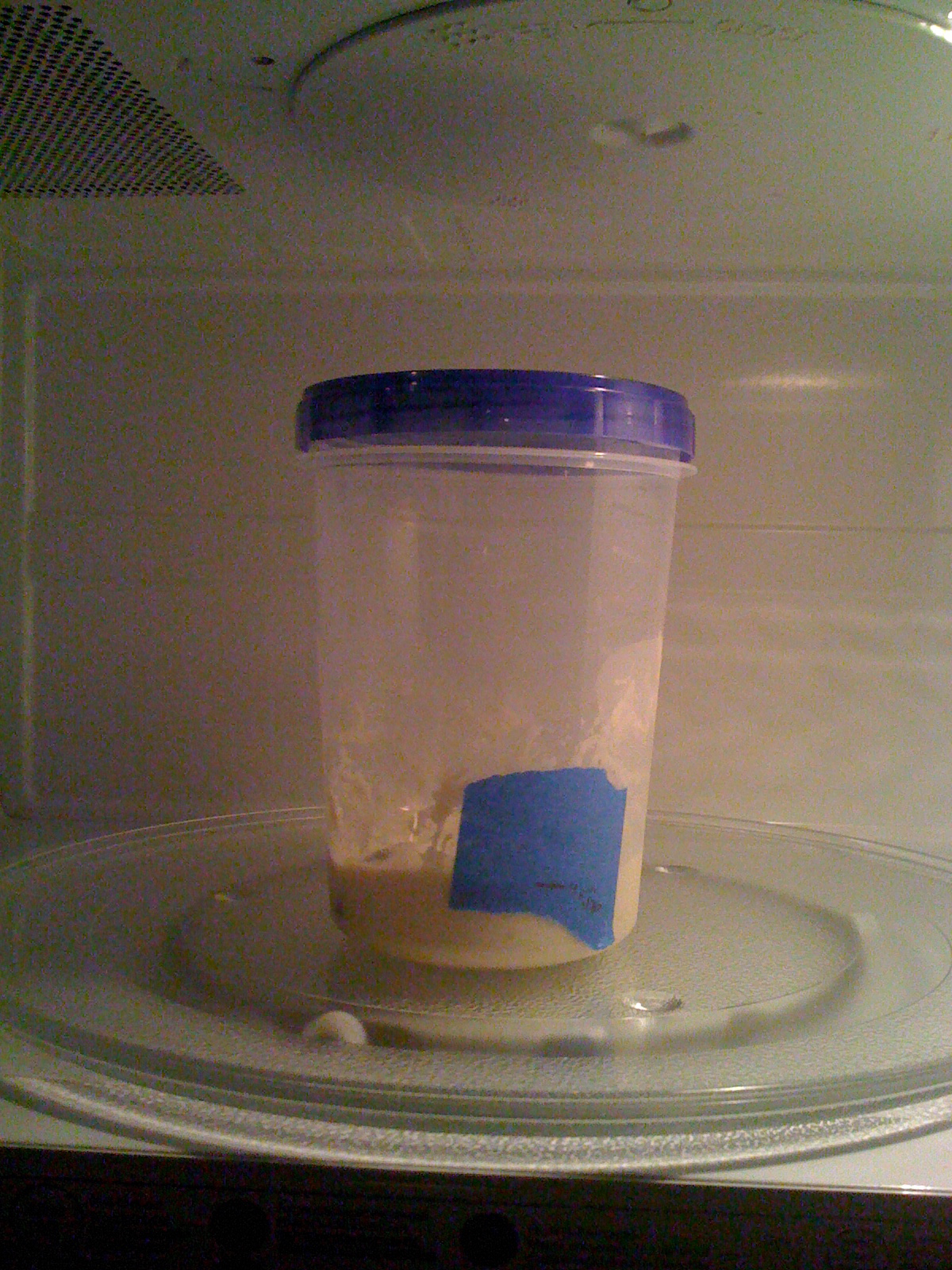
Levain at 4 hours
Okaaay … raise your hand if your room temperature in January is 75-78F?? Anyone? No, didn’t think so. 68F, yes. Not 78F. So, right there I know this levain will take some steady watching; I can’t rely on just watching the clock. This photo shows the levain at 8pm – four hours into the process. The mark on the blue tape records the levain’s original level. You’ll see it’s risen maybe one or two microns …
Oh, you’ll also see that it’s in my microwave. It’s a bit warmer in there. And, as soon as I’m done posting this, I’m going to heat a cup of water to boiling and keep that in there with the levain. The dissipating heat will warm the microwave hopefully 1o degrees or so and keep the levain warmer for a few hours.
If all goes as planned, we’ll have rye bread just in time for the Super Bowl. And a levain to nurture for years to come.
Croutons Are Always an Option
January 12, 2011 § 3 Comments
They are facts of life: milk goes sour, lettuce wilts, and bread gets stale.
There’s only so much you can do with sour milk and wilted lettuce. Actually, the only thing I can think of is to pitch them. Stale bread, on the other hand, has more options. You can take your stale bread to the park and feed the pigeons, I suppose. You can save up a bunch of it and make a stuffing.
Or, my fave—make croutons. In fact, sometimes I make bread just for the crouton possibilities.
That oh-so-yummy loaf of whole wheat bread I baked up yesterday will get a bit dense in a couple of days, I know that. I could exclusively eat sandwiches or snack on toast spread with peanut butter for the next 48 hours to make sure the cursed touch of Stale never approaches. I also don’t want to spend all my time on the treadmill burning off the extra.
Instead, I’m perfectly fine with letting the bread take its natural course to staleness. Croutons are always an option.
Recipe:
Croutons are super simple. Give cubed bread a little oil, add salt and pepper to taste, and toast. All that does is give your salad or soup a bit of crunch – maybe not so much flavor.
Guy Fieri’s recipe for croutons gives the toasted bread a flavorful kick. It calls for (word for word):
* 1/2 teaspoon salt, plus more for sprinkling
* 1 teaspoon freshly cracked black pepper
* 1/4 teaspoon cayenne
* 1/2 teaspoon paprika
* 2 teaspoons dried parsley
* 1 teaspoon dried basil
* 2 teaspoons garlic paste, (2 cloves garlic smashed with the flat side of a knife and a sprinkle of salt, to make paste)
* 1/3 cup extra-virgin olive oil
* 4 cups cubed stale Italian bread, cut into 3/4-inch cubes
Mixed the oil and herbs together. Add bread and toss, put on baking sheet. Toast at 325F for 20-ish minutes. Toss to expose other sides half way through.
Now, that’s all very fine and good. I riff on this recipe quite a bit. We never seem to have dried basil and parsley – only fresh during the gardening season, or only frozen parsley and pesto at other times. I’ll sub in a generous shake of Italian seasoning if I need to.
Plus, I proportion this down to maybe two cups of stale bread—after all, I’m eating as much of that loaf as possible before it gets stale. Watch the oil amounts—you really don’t need that much.
And, when you’re dealing with smaller amounts of croutons, there’s no reason to heat up an entire oven. Toaster ovens are perfect for this. BUT, since the mini oven heats up so much faster, 20 minutes will get you dark brown nuggets instead of flavorful toasties. DO set the toaster oven to 325F, but DON’T step away from it for too long. After 5 minutes, give ’em a look-see and a quick shake. At 10 minutes, consider taking them out to coast in and cool.
Hmm … I should have a photo. Let me get through this loaf of bread first.
Half Whole Wheat Bread
January 11, 2011 § Leave a comment
It’s about time I bake some bread, wouldn’t you say?
It’s a lazy-dozen days into the Year of Ellen Baking and flour hasn’t yet been sprinkled on the kitchen counter. I rolled out of bed this morning and decided to remedy that. Measuring cups and the mixer were in use within 15 minutes of my alarm going off.
It’s not like I have a lot of time to make bread today. The pile of work on my desktop is pretty steep. Making a poolish (a dough starter) and then going through the hours of rising and deflating and proofing and on and on – the protocols for my most flavorful breads – just isn’t in the day’s agenda.
Luckily, I have a quick, one-rise recipe I keep in my back pocket and pull out when time is tight. I found the recipe at Principia Gastronomica last summer. Easy enough to remember. Easy enough to prepare. Easy enough to adjust.
Here’s the ingredient list:
- 3 cups flour
- 1 tsp fast-acting/instant yeast add straight to the flour (I increase by 1/3 tsp – not sure why but it works!)
- 2 tsp salt (I use kosher)
- About a cup of warm water (your finger should feel comfy when inserted into it)
The thing I like about this recipe is that the blogger had suggested to add whatever proportion of flours you wish – all white, half white/half wheat, some spelt – whatever. Just make it 3 cups flour. Baking isn’t known for it’s flexibility; quite the opposite in fact. I like the freedom to try my own thing.
I vacillate between a strict 50/50 white-whole wheat ratio and one where I use 1.75 cups of whole wheat (King Arthur Flour’s whole wheat, which is on the fine side of wheat flours). Today’s bread is the latter.
Don’t have time to make bread in the morning? Dainty Dot does it this way:
- Mix flour(s), yeast, salt in bowl of Kitchen-Aid mixer. Attach a paddle (oiled with Pam or something like that) and secure bowl to mixer.

My must-have tools for bread baking
- While mixer is on low, add about a cup of warm water. When dough becomes shaggy (less than a minute), stop mixer, take off paddle (clean off dough that sticks and put back in bowl) and attach oiled (with Pam etc) dough hook.
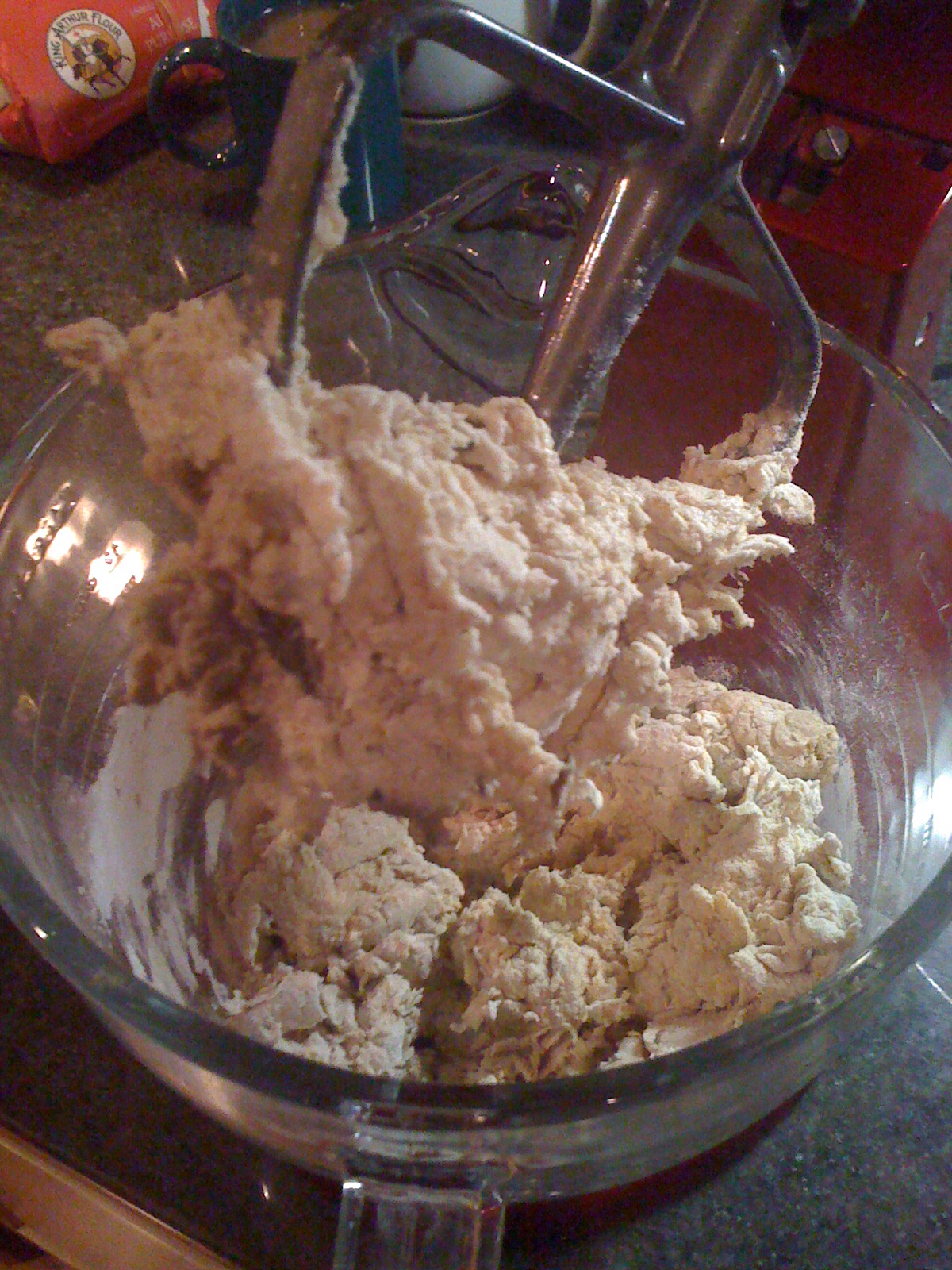
Less than a minute after adding warm water to the dry ingredients, the mixture becomes a shaggy mass.
- Why I oil paddle/hook: Makes it easier to clean dough off paddle, and helps prevent dough from creeping up to top of hook. Alton Brown’s suggestion, not my own genius, unfortunately.
- With hook now on, turn mixer of medium low. Let the hook and dough do their thing. IF the dough is looking a tad dry – if it looks like that dryness would hurt if you were a lump of developing dough – I add squigges of warm water ’til it softens up a bit.
- If dough does creep up the hook, stop the mixer and adjust dough downward.
- After about 5 minutes, the dough should look like it’s swollen just a tad and look a bit like a soft baby’s bum. At this point, take out the dough and put into an oiled (or Pammed) bowl. I like to put my in a large (2 quart-sized) plastic measurer with markings. That way you can tell how much the dough has risen. Next, cover the container with plastic wrap. Put in a warm draft-free space.
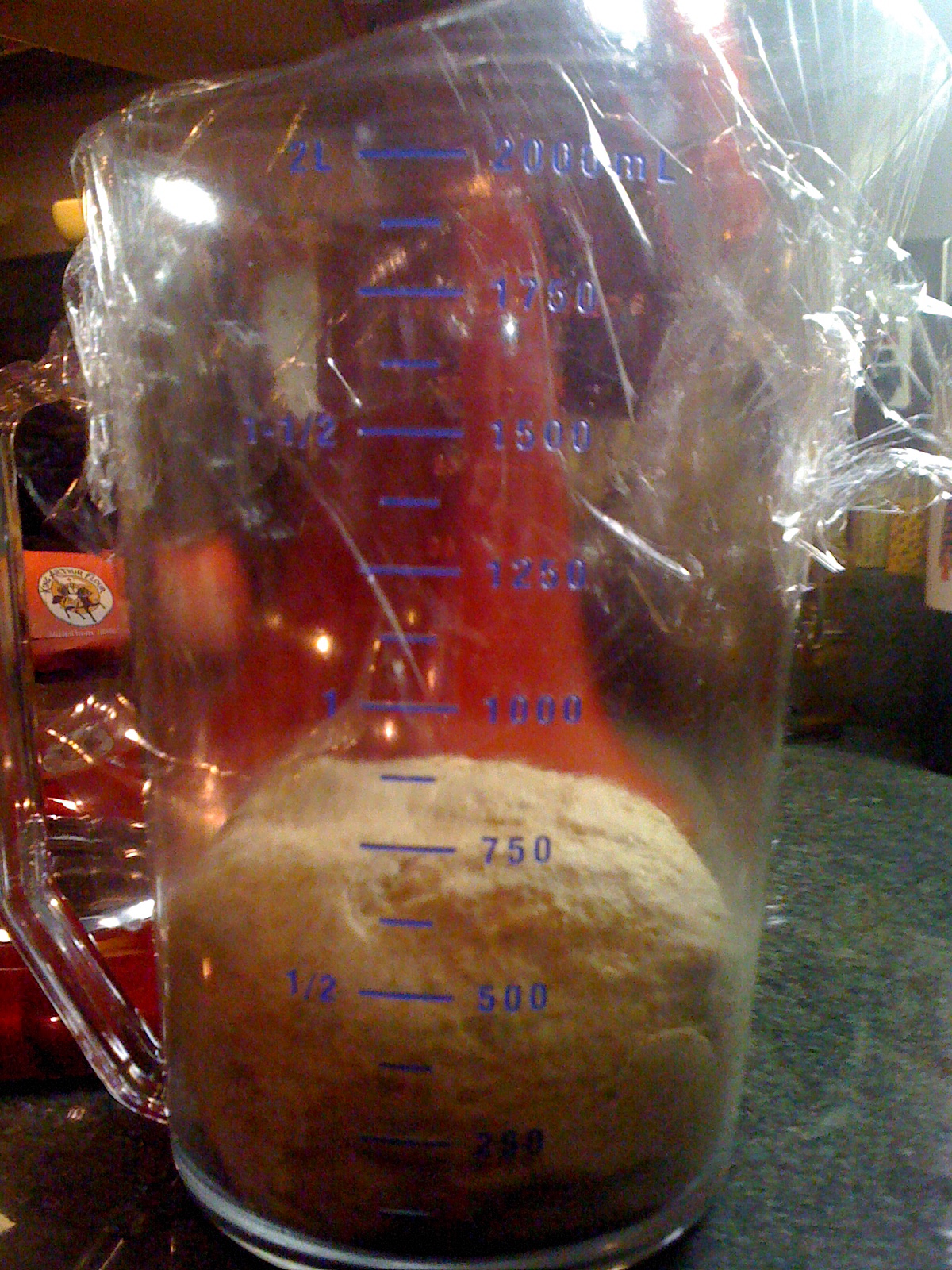
Dough ready to rise.
- Warm? In January? I’m a frugal gal myself. My house is nowhere above 68F at any time between August and June. How the heck do I find a warm space that’ll make my baby snuggly and happy? Here’s the trick: Boil a cup of water in the microwave. Put the dough bowl in the microwave with the just-boiled water. Close door. You’ll have a warmish space for the next hour or so as the water releases heat as it cools down.
- The original recipe says to let the dough rise an hour or so. I take mine a but further – up to two hours. The dough is likely to double in that time.
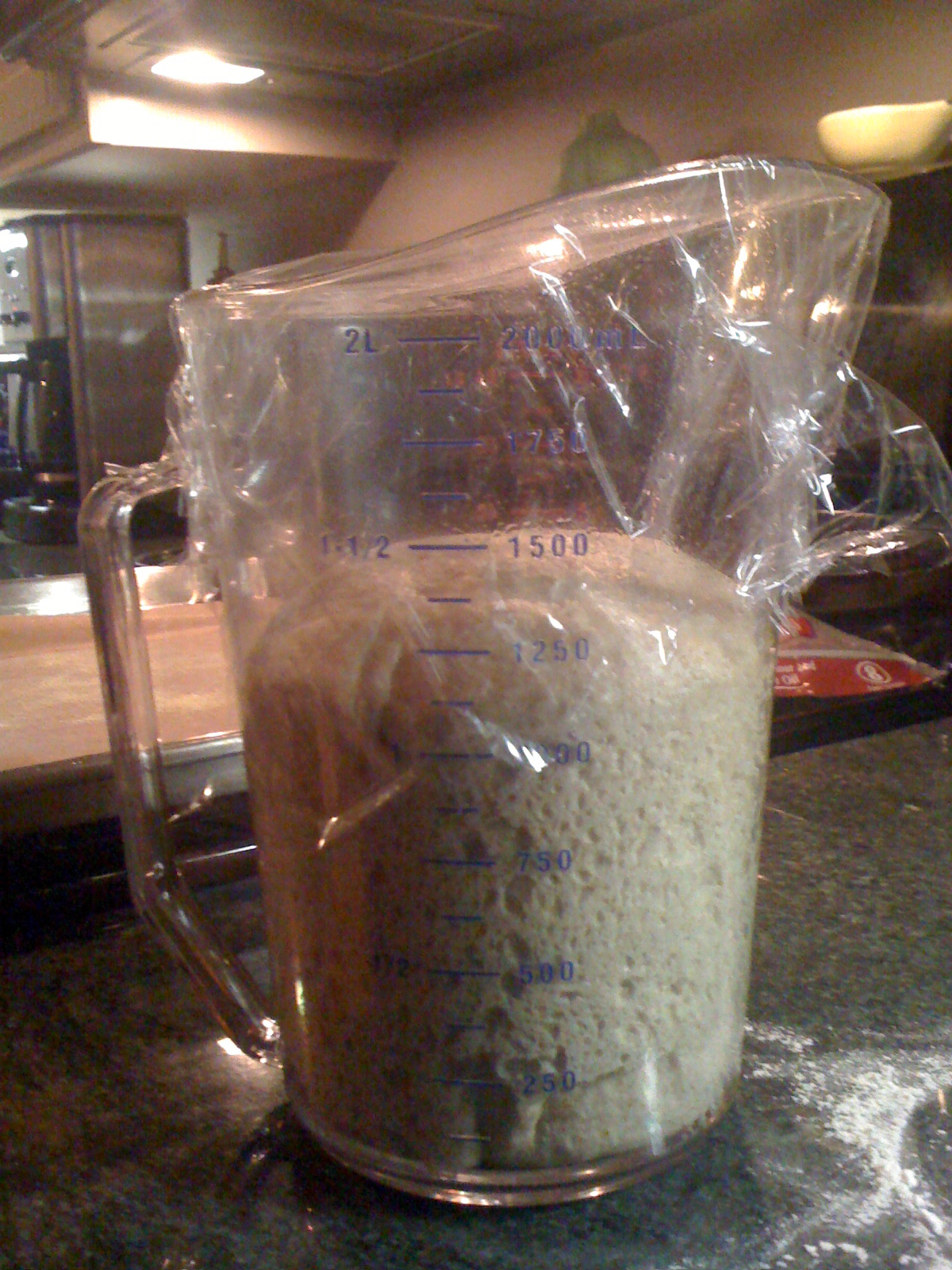
D'oh! It's doubled!
- Spill the somewhat-puffy dough onto a lightly floured surface. The light pull of your hands on the dough coaxing it out of the container is pretty much enough handling to count toward a light “punch down.” You don’t want to let too much of that air out – this is a one-rise dough, after all.
- Actually, you can even skip the “lightly floured surface.” Why? This is a dry dough – a quick dip of your fingertips in some flour is more than enough to prevent the dough from sticking to your fingers. And, in this next step you actually want the tackiness of your surface to work in your favor.
- Pull in all sides of the dough into the middle of a round ball. Try your best to pinch them all into one spot. Top should be a smooth rounded surface, and the bottom should look like puckered lips.

Pull in all the side of the mass of dough into the center and try to pinch together. I admit, I pinched one more time after this photo.
- Next, put the ball bottom side down. Put both hands on either side of the ball, cupping it from the top, and rotate the ball under your hands – kinda pushing up with your left while pulling down with your right. The tackiness of a flourless work surface pulls the dough taut. And, it helps in drawing in those “puckered lips” and sealing it closed as best as possible. Do the push-me, pull-you thing about 10-20 times. When the “skin” of the ball starts to pull very very tight, STOP!

Pushing/pulling the dough in a clockwise direction seals the dough together on its bottom. Pretty cool!
- Put the dough ball on a sheet pan lined with parchment paper that has been lightly sprinkled with corn meal. Cover with that plastic wrap you used previously (waste not, want not, right?). Let it sit while the oven warms up to about 420F (recipe says 425F but my oven runs a bit hot). In fact, I’ll let it sit for up to 1/2 hour.

The dough sits for up to a half hour before heading into the oven.
- Five minutes before you’re ready to put the dough into the oven, throw in some ice cubes. This creates steam, and a humid, steamy oven helps create a nice crunchy crust.
- Right before inserting the dough into the oven do these two things: 1) slash the top of the dough lightly with a quick movement. This slashing will help prevent the crust from breaking haphazardly elsewhere as the dough expands. The dough is gonna split regardless – pre-slashing is like a controlled split. 2) Spritz the loaf 4-5 times with a water spritzer-thingy. Again, this helps create a crunchy crust. But I don’t go crazy trying to control the crust, not like I would if I were making French bread or a sourdough. This is a quick-and-easy bread recipe – the crust is what it is. I’m good with that.
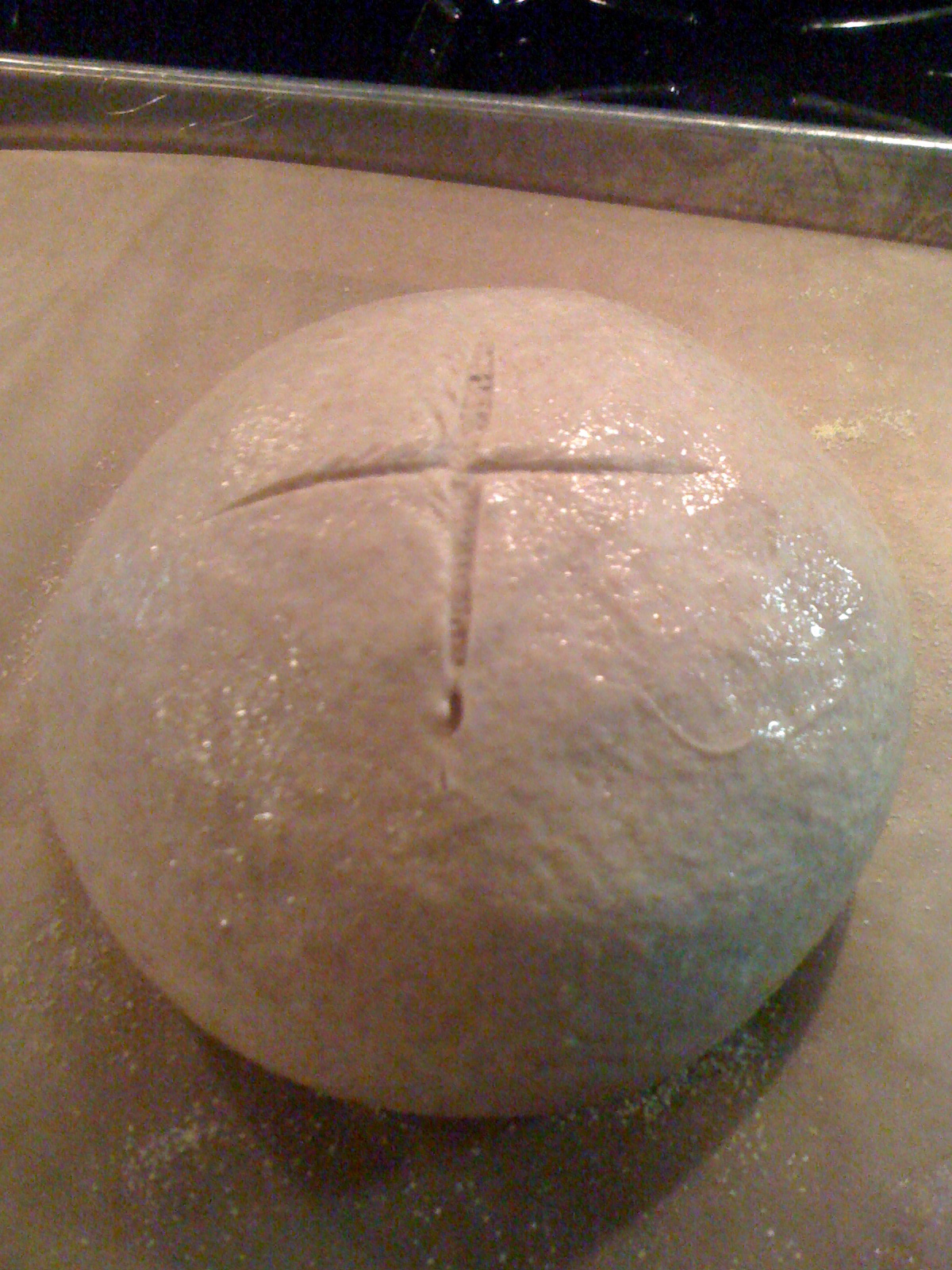
Slash!
- The recipe calls for the bread to bake about 40 minutes. Because my oven runs a bit hot, I take it to 35 minutes and then check its status. Check for doneness by thumping your thumb against the bottom of the loaf. If it sounds hollow, it’s time to set it free from the oven. What’s a hollow loaf of bread sound like? Good question. And I suggest you take a loaf out at 30 minutes, give it a good thump, and remember what that sounds like, and then keep comparing thumps every couple of minutes. Eventually the bread will be done and you’ll note the difference in sound. Well, that’s how I did it, anyway.
- Let it sit on a cooling rack for a while so it can finish cooking completely inside. If you can keep your hands off it, that is.
Using this recipe, I made a loaf of half-whole wheat bread 5.5 inches wide and weighing approximately 1 lb. 6.5 oz. in less than 4 hours. Fresh. Bread. Fast. Yum.
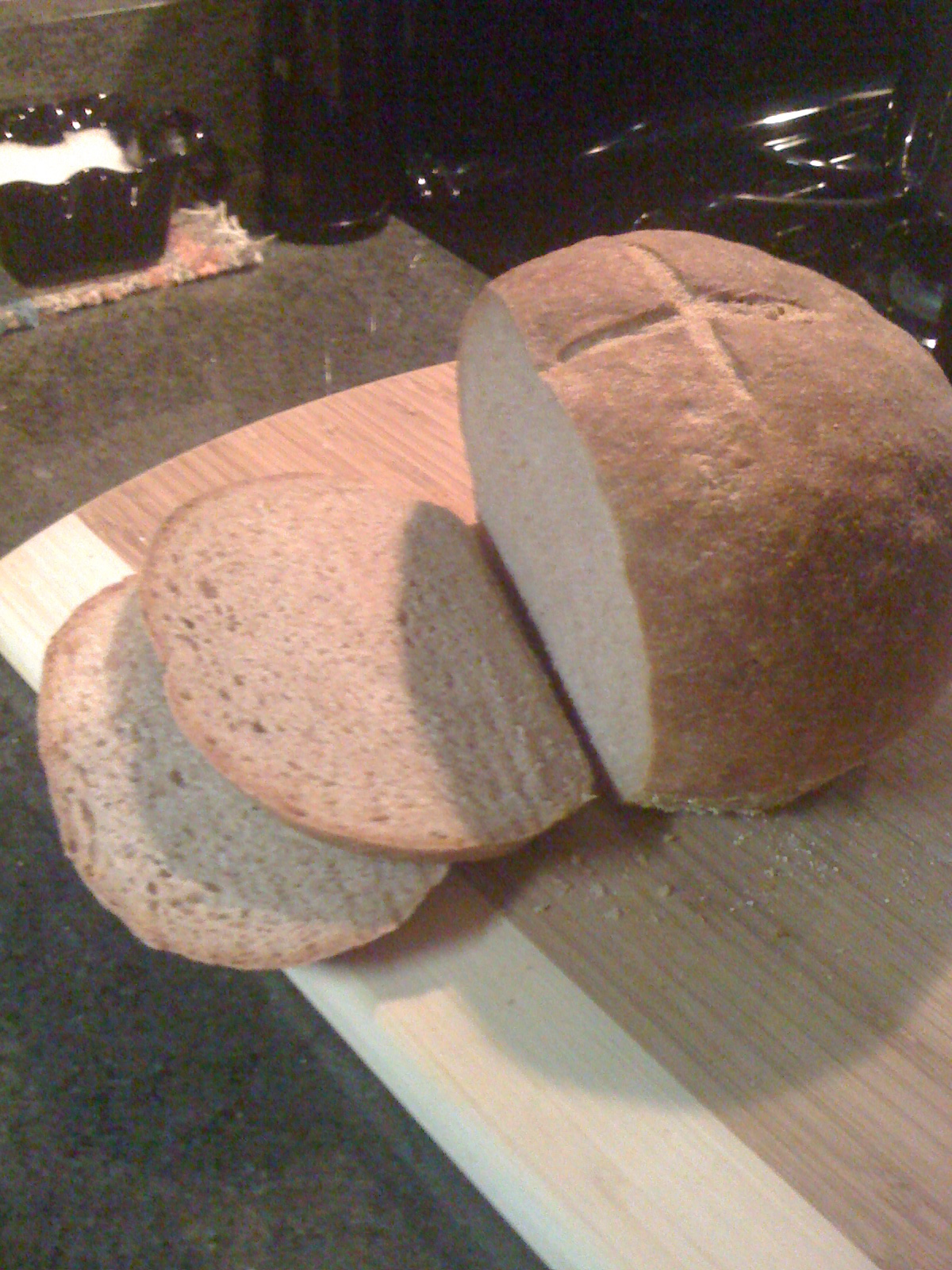
From flour to bread in under four hours - ya! And with minimal hands-on work, too.
Ellen Bakes
January 6, 2011 § Leave a comment
“I really like to bake.”
Those very words can be found in my profile, and I’ve yet to write anything about baking on The Dainty Dot. This is, after all, the Year of Ellen Baking. As a comparison, 2010 was the Year of Ellen Sleeping and 2009 was the Year of Ellen Not Sending Cards. I decided to put a more positive spin on the “Year ofs” during this turn around the sun.
In fact, this blog was originally going to be called “Ellen Bakes.” Imagine when I heard that Martha is premiering a new show later this month called “Martha Bakes.” Coincidence? She must have bugged my house …
Am I baking today? No. This week? Probably not. Blame it on a preparation for a business trip/presentations coming up in a few days. But don’t you fear – I’ll be baking (said with a slight Arnold Schwarzenegger/Terminator affect).
Year of the Pie?
Coincidentally, I heard a buzz that 2011 will be the year of the pie. Sweet pies, savory pies, hand pies, round, square, pan—you put a crust of any sort on it, in it, around it, call it a pie and it’s a rock star this year. And, not to steal Martha’s catch phrase but … that is a good thing. Because Ellen bakes pies. Always have.
Pie crust is an amazing canvas. And really, I’m fixated on perfecting that canvas. I’ve in no way come even half way to making a top-notch crust, but I love the challenge. Fillings? Yeah, ok – it’s the stuff of the pie. But I always remember the crust.
Best pie crust ever is my mom’s crust from my childhood. The flakiest ever, thanks to lard. Rendered from our own pigs. Didn’t mean to skeeve you out but when you grow up on a farm you can expect that sort of thing. Alas, no more lard for mom and dad. Doctors orders.
The loveliest pie combination: Peach-rhubarb, also from fruit grown right on the property. “Peaches? Rhubarb? How are they ever in season at the same time?,” you ask. They aren’t. But as the peaches come on, along with every other fruit and veg roundabout August, and you’re looking for room to store stuff in the chest freezer, you spot the frozen rhubarb. “Hmmmm … let’s make a pie,” is the natural solution.
Flour Bakery + Cafe
Down the block from me is a bakery that is pretty well known – Flour Bakery + Cafe, run by baking’s “It Girl,” Joanne Chang. Awesome place. the line is pretty much always out the door – which is why I don’t really go there too very often. But when I do, it’s oh so good.
Joanne has recently published a cookbook based on recipes she uses at Flour. Bitten with the baking bug, I had to get myself a signed copy, just in time to bake for the holidays. Now, I’m not really a sweets baker – pies are the exception – but the recipes for grown-up oreos and pop-tarts are really spectacular. Every reason to name the book “Flour: Spectacular Recipes from Boston’s Flour Bakery + Cafe.”
Okay, folks – I gotta go get a move-on with that presentation. But, let me leave you with a drool-inducing image of my apple cinnamon pop-tarts baked word for word (almost) from the Flour cookbook. Yum ….

Pop tarts, from Joanne Chang's awesome new cookbook
 The Dainty Dot