
Rye Bread: Day 2
February 1, 2011 § 5 Comments
My friend Amanda’s comment on my Rye Bread: Day 1 post was this: “Amazing how you make this sound time consuming and gross… yet totally tasty and motivating!”
Little does she know what this mass of flour, water and punctured grapes has turned in to …
Here’s a brief journal of my sourdough starter experience. Consider it a journal of Baby’s First Days. And oh boy, if real babies are as slimy as this, I’m so glad I don’t have one.
(I skipped the first few hours. Perhaps I had a bout of postpartum depression.)
**
Monday. 11:21 a.m. Sourdough starter roughly 19.5 hours old. Microwave trick and dissipating boiled water have warmed the starter to 74F. The best I’m gonna get at this point.
Monday, 5:12 p.m. 25-ish hours old. Sourdough starter has turned into bubbly goodness! It smells like … grapes. Really. Yeasty. Grapes. Alas, work prevents me from tackling Step 2 at the moment.
Monday, 6:49 p.m. Still bubbly goodness, with a pleasant grapey-yeasty aroma. Added 113 grams room temperature water and 72 grams unbleached all-purpose flour. Stirred. Put back in microwave. Crossed fingers. Needs to bubbey away for another 12 to 24 hours.

Baby Dough at 26 hours
Tuesday, 6:02 a.m. Baby Dough’s big! Must have almost doubled in size overnight. Lots of big bubbles. Hmm… should I move on to the next step?
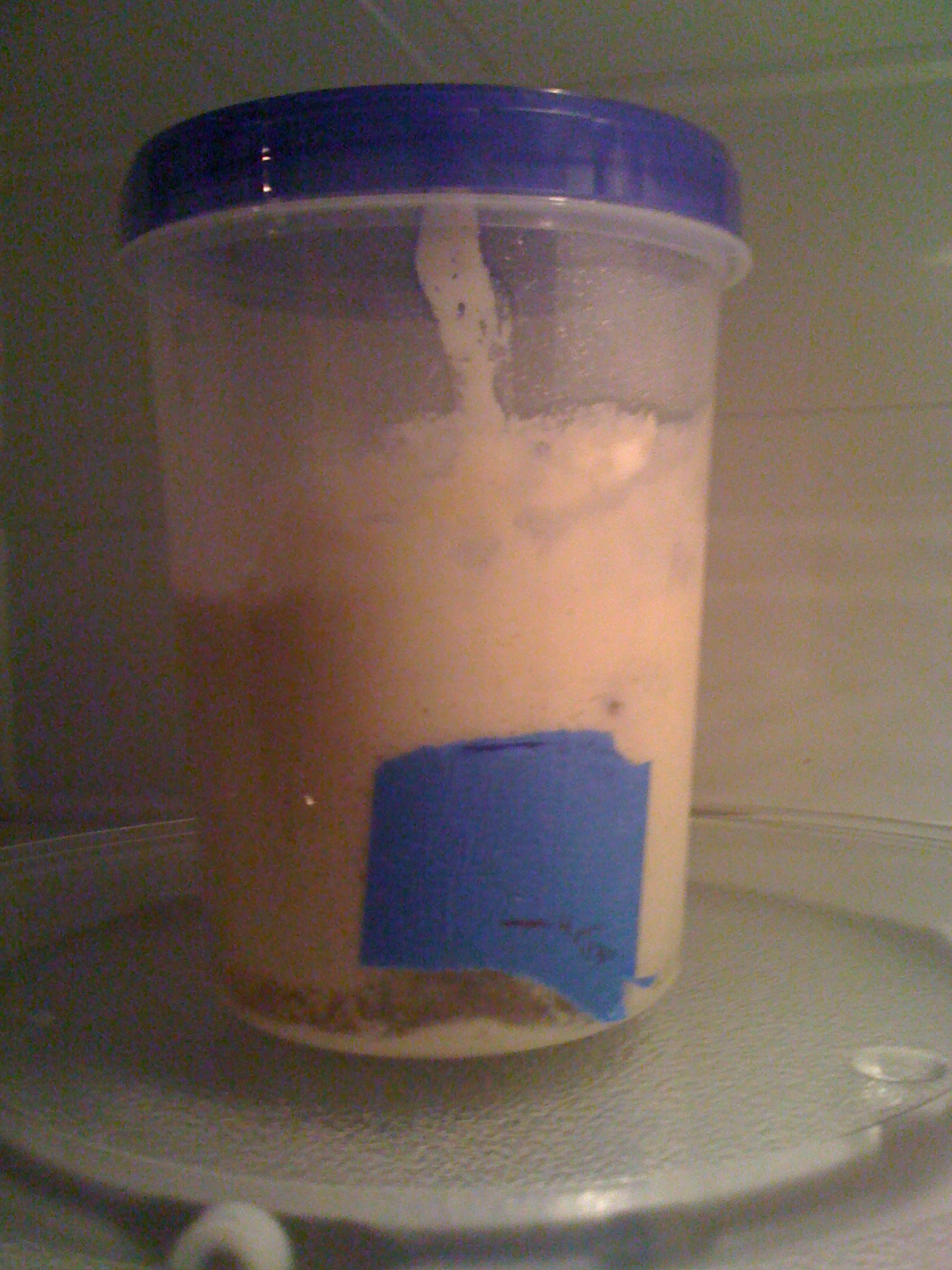
Baby Dough at about 38 hours. Such a big boy!
Tuesday, 8:27 a.m.: I decided to move on to Step 3 after only 14+ hours. It calls for scooping out the grape remnants and a bit of the starter. It’s snot. It looks like snot. It pulls like snot. It’s baby snot. Of course the grapes all settled on the bottom and I had to scrounge around with an iced tea spoon and pull them up through miles of gooey snot. Good thing was there was a layer of liquid on the bottom through which I could see all the grapes. Finding them all wasn’t so hard through the gooey yeasty snot.

Baby Dough at about 40 hours
Answer me this: Why would anyone EVER think this would be something yummy to add pulverized wheat to and then put in a container to cook over hot coals? That leap of faith from snot to baked goods—if you think about it, that crazy idea created civilization. Goo. Flour. Water. Heat. The wheel. The combustible engine. The Internet.
Added 36 grams flour. Mixed thoroughly. Put back in the microwave. Waiting another 12-24 hours.
Tuesday, 4:24. Baby Dough is 48 hours old – yay! Threw a little party, invite other doughs from the neighborhood. They are so adorable at that age …
Baby Dough’s looking a tad under the weather, a little runny. I snuggled him in the microwave with another cup of boiling water and will check back in later. For now, I’ll let him rest. Perhaps the party was too much.
Rye Bread Day 1
January 31, 2011 § 3 Comments
Beatrice doesn’t ask much from me. So, when she asks a favor or makes a request, I’m on it.
“Can you make some rye bread?” she texted to me last Wednesday. I was at the airport, headed out of town until Saturday night. I didn’t have my cookbooks nearby to reference. Rye bread? There’s nothing like a good Jewish rye from New York. Thin toasted slices with butter – nothing beats it. You want rye bread, Beatrice? Rye bread is what you’ll get.
First thing Sunday morning I turn to my go-to bread-baking book, Amy’s Bread (2nd edition) and look up rye. Now, keep in mind that in this cookbook, all but, I don’t know, maybe four or five recipes DO NOT call for some sort of starter. And bread starters take at least 24 hours to develop. At least. So, I’m not surprised when I see this Amy’s Rye with Caraway and Mustard Seeds recipe call for a “firm levain.”
I’m new at this starter thing. I’ve made one once before – the one Joanne Chang has in her cookbook – and kept it going for a couple of months. It was super easy. And reading through Amy’s Bread several months earlier, I knew there were several different types of starters. This levain thing was one of them.
Okay, I’m on my way.
Amy’s Bread – that’s a real bread-baker’s cookbook. I should have known there’d be something more to making this “levain” than … than whatever I had imagined.
So, I turn to the recipe for firm levain. And the recipe for firm levain itself calls for Active White or Rye Sourdough Starter. Hmm…. okay.
So, again, I turn the pages and find Active White Sourdough Starter. I read over the recipe: organic grapes, cool water, organic unbleached all-purpose flour. At least four 24-hour interval steps. And I say to Jennifer, “Text Bea – tell her the bread’ll be done on Saturday. Maybe.”
A levain is a sourdough starter made without yeast. That’s why the recipe calls for grapes. I’m assuming, correct me if I’m wrong, the grapes’ naturally musty-ness – the yeasty beasts that hang out on fruit – will provide the umpf needed to begin the fermentation process. If you add a pinch of yeast to a starter, that will kick your starter off right. And get it going quickly. With grapes, apparently you need to give it more time. Like, three days more.
So, yesterday at 4pm I mixed the grapes, the water and the unbleached flour. “Let it sit at room temperature (75F to 78F) until it starts to bubble. This will take 12 to 24 hours, longer is your room is cool.”
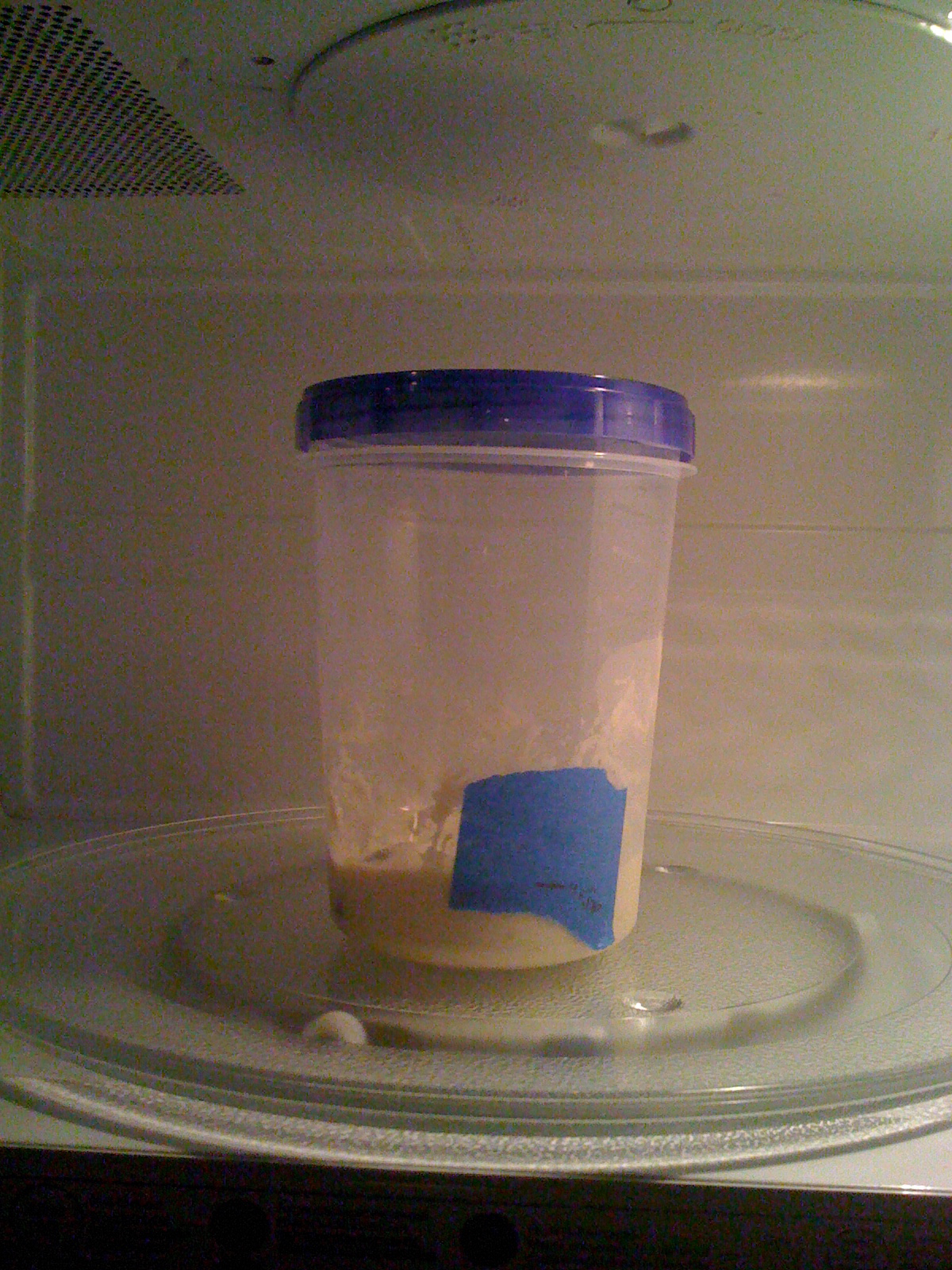
Levain at 4 hours
Okaaay … raise your hand if your room temperature in January is 75-78F?? Anyone? No, didn’t think so. 68F, yes. Not 78F. So, right there I know this levain will take some steady watching; I can’t rely on just watching the clock. This photo shows the levain at 8pm – four hours into the process. The mark on the blue tape records the levain’s original level. You’ll see it’s risen maybe one or two microns …
Oh, you’ll also see that it’s in my microwave. It’s a bit warmer in there. And, as soon as I’m done posting this, I’m going to heat a cup of water to boiling and keep that in there with the levain. The dissipating heat will warm the microwave hopefully 1o degrees or so and keep the levain warmer for a few hours.
If all goes as planned, we’ll have rye bread just in time for the Super Bowl. And a levain to nurture for years to come.
Trout with Rainbow Chard & Roasted Tomato-Caper Salsa Over Cous Cous
January 19, 2011 § Leave a comment
“One of the best meals you’ve ever made.”
Who doesn’t like to hear that from their partner? It was a seriously delicious meal, I agree. Did I have my doubts while I was cooking? There have been times when I’ve deviated from a recipe—as I did in this case—and it turned out terribly wrong. Terribly. Wrong. I dunno, maybe I have a new confidence in the kitchen. And, I gave myself plenty of time to cook. Rushing never ends with good results for me.
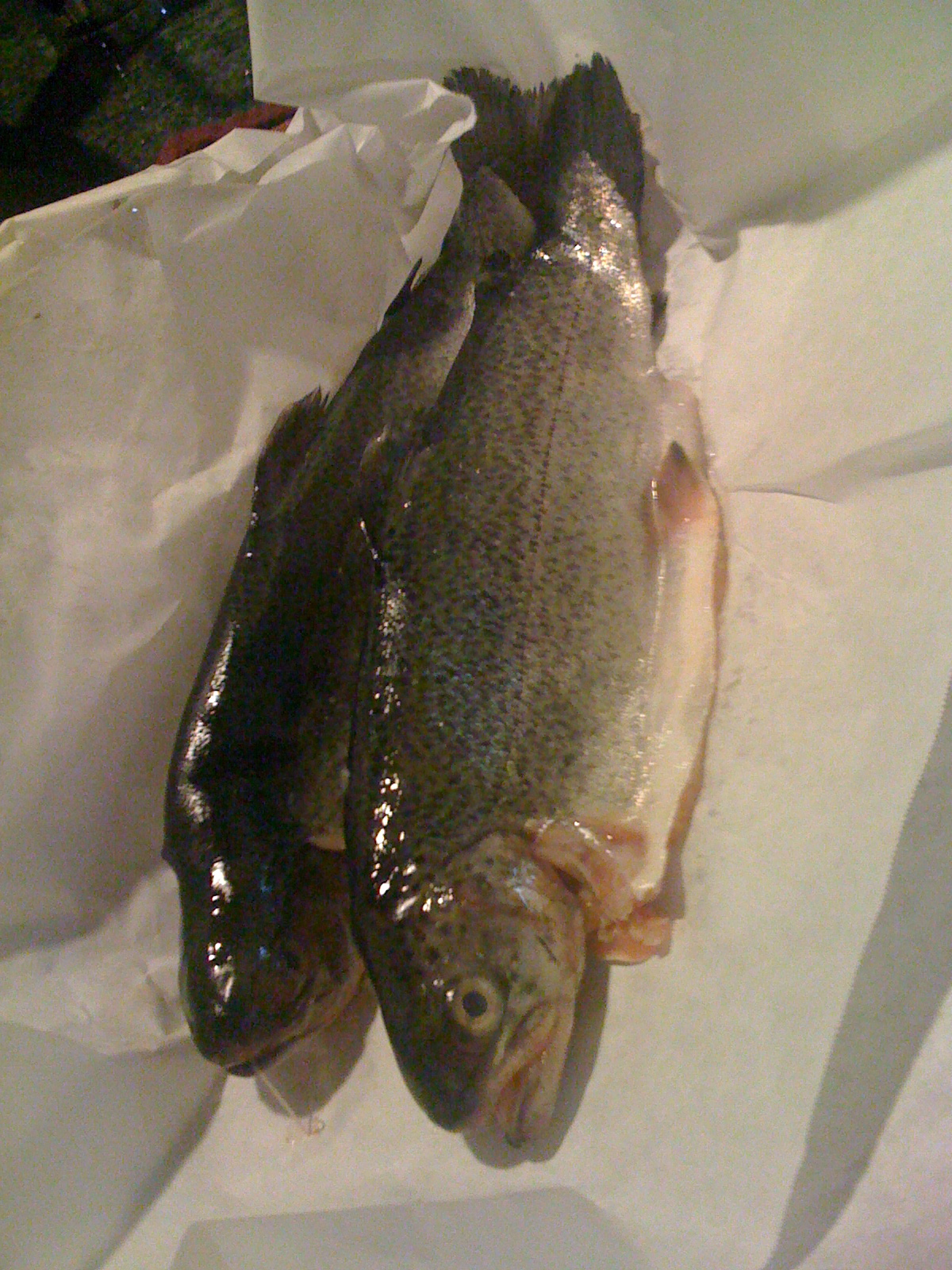
Cute lil' fishies
This meal was based on a recipe we saw once on a Food Network program hosted my Michael Chiarello, Lunchbag Swordfishwith Mediterranean Tomato Sauce and Linguini. Except sans swordfish and linguine. Morse Fish Market didn’t have swordfish, but they did have these cute lil’ whole filleted trout. Foodie’s had rainbow Swiss chard on special, especially ideal since eating your greens is a very healthy thing. And, last deviation, no one needs linguine when whole wheat Israeli cous cous makes such a nice side dish.Oh, wait – the last deviation: There was absolutely no lunchbags used in preparing this meal.
I did stick pretty close to the “tomato sauce” recipe, but prefer to call it a roasted salsa.
Recipe for Trout & Tomato-Caper Salsa
(the salsa roasts along with the trout!)
- 3 cups plum tomatoes, cored and thinly wedged
- 1 tbs chopped fresh oregano
- 1 tbs chopped parsley
- 3 cloves garlic, minced
- 1/4 cup or less of minced red onion (my red onion was a bit strong, so I used less)
- 2 tbs drained capers
- 1/2 of a large red pepper, chopped (original recipe calls for 1/2 cup roasted red pepper – didn’t have time to roast!)
- Juice of whole lemon (original calls for 2 tbs – oh well)
- 4 tbs EVOO
- 2 8+ oz. whole trout fillets
- 1 lemon sliced thinly
- 2 tbs parsley, finely chopped
- kosher salt & pepper
-Set oven to 450-ish.
-Prepare and combine tomatoes, herbs, garlic, red onion, capers, red pepper, lemon juice and EVOO in a medium bowl. Add a couple turns of a pepper mill. Set aside for at least 30 minutes, stirring occasionally.

The tomato-caper salsa sits for about 30 minutes
-Remove fish heads and tail (and reserve for stock). Rinse fish and pat dry. Working with one fish at a time, season the inside of whole fish with salt and pepper (the two fillets just kinda flap open – easy to do!). While fish is still open, layer lemon slices (remove any seeds you see) and sprinkle with about 1 tbs of chopped parsley. Close up fish. Set aside. Prepare next fishy.
-After tomato-caper mixture has married for about a half hour, place it in the bottom of a rectangular glass baking dish. Salt and pepper fish where they are, then flip them upside down onto the salsa. Salt and pepper them again.
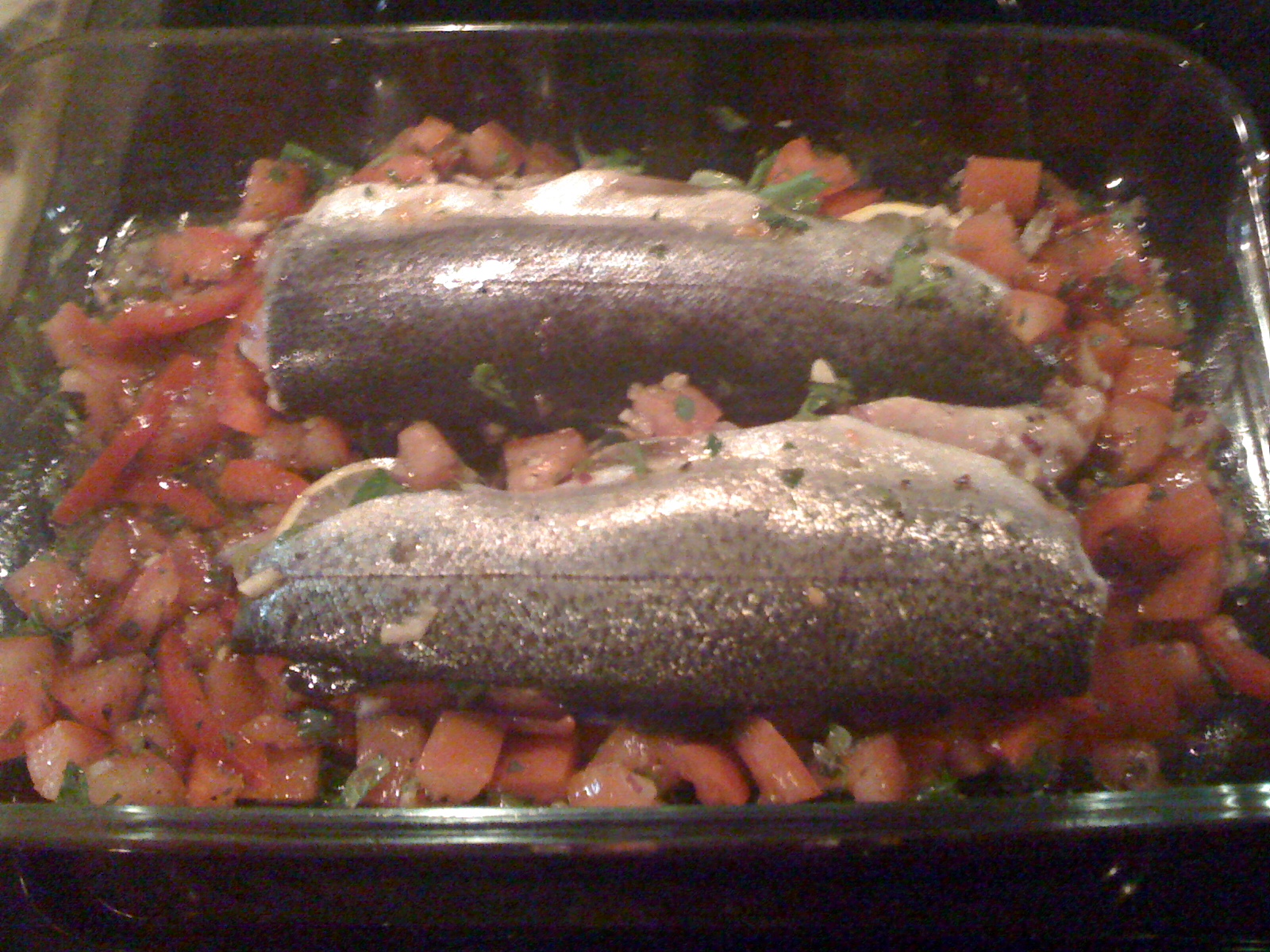
Trout overtop tomato-caper salsa before it hits the hot box
-Place in the oven for about 16 minutes, checking occasionally after about 12 minutes.
While the salsa is sitting, you can get your ingredients ready for the chard and cous cous so everything is ready to go. Timing is always one of my biggest hurdles!
Recipe for Rainbow Chard and Israeli Cous Cous
For best timing, set liquid for cous cous to boil a couple minutes before putting fish in the oven. And start cooking chard while the fish cooks.
- 1 1/4 cup (or less by just a tad) boiling water or chicken stock
- 1 cup Israeli cous cous (it’s the larger-sized cous cous – more substantive, that’s why we like it)
- 1 small swig EVOO
- 1 clove garlic, minced
- 1/2 bunch of rainbow Swiss chard, washed and patted dry, roughly chopped
- a touch of chicken stock
- salt and pepper
-Add cous cous to boiling water in a small pot. Cover. Let sit until the rest of the meal is complete.
-Add EVOO to a medium sauce pan and turn on heat to medium. Let that heat up a bit. Add garlic – it should sizzle a tad – and give it a good shake or two. Let that saute until fragrant – less than a minute.
-Add chard. Sprinkle in a dash of salt and pepper. Toss it around in the garlic and oil with tongs. It will wilt a bit right then. Add a glug of chicken stock so the chard has something to steam in. Cover. Let cook 5 minutes or until leaves are tender and stalks still have a tiny bit of crunch. If leaves are black-black, you’ve gone too far!
The whole meal came together pretty much at the same time. Yay!
Plating
This is where I learned two lessons. The chard was divided between the two plates, and the fish was placed on top. Next, each plate received a big scoop of cous cous, and that was topped with some of the roasted salsa from the baking dish.

Whole trout with rainbow chard and roasted tomato-caper salsa over Israeli cous cous
Here’s where that might have been improved.
1) I couldn’t access my chard easily. Remember, the fish still had its skin and was filled with lemon. There was a lot of manual labor to be done on that fish, and placing the fish to the side of the chard would have been better. Had that fish been a skinless single fillet of something else, I think it would have been okay.
2) The roasted salsa was juicy – flavorful, but juicy. I’m not a big fan of juice running all over my plate. Use a slotted spoon!
Overall, a delicious meal. And today I have fish heads and tails in the freezer for a future batch of fish stock – even better.
Fridge-tata: Going recipe-less with breakfast
January 18, 2011 § 3 Comments
Long weekend away in a ski house with friends + cooking in + stuffed refrigerator = “fridge-tata”
If you’re not an egg lover or have not gone out to for brunch in 15 years and aren’t familiar with a frittata, it’s the Italian take on the classic French omelette: Beaten eggs in a hot skillet, but with the fixins in them and presented flat, not folded. And finished off in the oven. Served in slices. Come to think of it, it’s like a slice of egg cake. Filled with sausage or salmon, chicken or chopped tomatoes, their many formulations stuff recipe sites and cookbooks.
I’m telling you now, throw out the recipes and create your own on auto-pilot. It’s as easy as opening your refrigerator.
We’ve been members of a gay ski house up in Vermont for going on eight years now. On any given fall or winter weekend, the house is filled with boys from NYC and Boston, boyfriends flying in from elsewhere and occasionally a few girls. There can be up to 12 or 14 folks sitting around the dinner table. The New York boys have a reputation for preparing over-the-tops meals – usually creatively fueled with several apre-ski cocktails. Caviar shows up on the menu several times a ski season.
At least one breakfast each weekend is something I’ve dubbed a “fridge-tata.” While I can take credit for the name, I can’t take credit for the process. That would go to the likes of Hal and Steve. They stare into the open fridge, assess the leftovers, and pull out the fridge-tata’s fillings. Chicken and green beans? Tuna and asparagus? As long as they have six or more eggs and that huge skillet (it must be 16 inches), they can create a breakfast fortified enough to fuel a day of downhill.
Personal-Sized Fridge-tata
On Sunday, I created my own single-serving fridge-tata for a post-snowshoeing snack.

I used only a portion of these leftovers for my personal-sized fridge-tata
- leftovers of salmon, rice (created from some seasoned packet and a half can of chopped tomatoes) and beans
- two eggs, beaten with salt and pepper and a touch of milk
- mango key-lime salsa to taste
-Using a small, 8-in. skillet set on medium, I heated up the rice and beans. Meanwhile, I whisked up my eggs with salt and pepper.
-After beans and rice formed a bit of a crust on the bottom, I broke it up a bit and added my little hunk of leftover salmon. I waited because I didn’t want the salmon to be cooked to much more than it already had been.
-With the salmon in there for about 30 seconds, I added the eggs and turned the heat down to medium low.
-I let the eggs set a bit – enough so that I could lift the sides with a spatula. This took only two to three minutes.

The eggs need to set up a bit
-The top of the fridge-tata needed to set, so I put a lid over the skillet for a minute or two.
-Serve with salsa.

The finished fridge-tata
I could have used another egg or two to make the fridge-tata thicker. But then it would have been too much for me to finish. Had I cooked a more massive fridge-tata in that larger 16-in. skillet, I would have used way more eggs – probably eight or more. And, I would have cooked it on the stovetop until the eggs set up, covered it and set it on medium low for maybe 14-15 minutes, and then put it under the broiler for a minute or two to make sure the top was crisp.
It’s not the gourmety-est dish. But it’s the perfect way to deal with leftovers when roughing it in a ski house.
Croutons Are Always an Option
January 12, 2011 § 3 Comments
They are facts of life: milk goes sour, lettuce wilts, and bread gets stale.
There’s only so much you can do with sour milk and wilted lettuce. Actually, the only thing I can think of is to pitch them. Stale bread, on the other hand, has more options. You can take your stale bread to the park and feed the pigeons, I suppose. You can save up a bunch of it and make a stuffing.
Or, my fave—make croutons. In fact, sometimes I make bread just for the crouton possibilities.
That oh-so-yummy loaf of whole wheat bread I baked up yesterday will get a bit dense in a couple of days, I know that. I could exclusively eat sandwiches or snack on toast spread with peanut butter for the next 48 hours to make sure the cursed touch of Stale never approaches. I also don’t want to spend all my time on the treadmill burning off the extra.
Instead, I’m perfectly fine with letting the bread take its natural course to staleness. Croutons are always an option.
Recipe:
Croutons are super simple. Give cubed bread a little oil, add salt and pepper to taste, and toast. All that does is give your salad or soup a bit of crunch – maybe not so much flavor.
Guy Fieri’s recipe for croutons gives the toasted bread a flavorful kick. It calls for (word for word):
* 1/2 teaspoon salt, plus more for sprinkling
* 1 teaspoon freshly cracked black pepper
* 1/4 teaspoon cayenne
* 1/2 teaspoon paprika
* 2 teaspoons dried parsley
* 1 teaspoon dried basil
* 2 teaspoons garlic paste, (2 cloves garlic smashed with the flat side of a knife and a sprinkle of salt, to make paste)
* 1/3 cup extra-virgin olive oil
* 4 cups cubed stale Italian bread, cut into 3/4-inch cubes
Mixed the oil and herbs together. Add bread and toss, put on baking sheet. Toast at 325F for 20-ish minutes. Toss to expose other sides half way through.
Now, that’s all very fine and good. I riff on this recipe quite a bit. We never seem to have dried basil and parsley – only fresh during the gardening season, or only frozen parsley and pesto at other times. I’ll sub in a generous shake of Italian seasoning if I need to.
Plus, I proportion this down to maybe two cups of stale bread—after all, I’m eating as much of that loaf as possible before it gets stale. Watch the oil amounts—you really don’t need that much.
And, when you’re dealing with smaller amounts of croutons, there’s no reason to heat up an entire oven. Toaster ovens are perfect for this. BUT, since the mini oven heats up so much faster, 20 minutes will get you dark brown nuggets instead of flavorful toasties. DO set the toaster oven to 325F, but DON’T step away from it for too long. After 5 minutes, give ’em a look-see and a quick shake. At 10 minutes, consider taking them out to coast in and cool.
Hmm … I should have a photo. Let me get through this loaf of bread first.
Half Whole Wheat Bread
January 11, 2011 § Leave a comment
It’s about time I bake some bread, wouldn’t you say?
It’s a lazy-dozen days into the Year of Ellen Baking and flour hasn’t yet been sprinkled on the kitchen counter. I rolled out of bed this morning and decided to remedy that. Measuring cups and the mixer were in use within 15 minutes of my alarm going off.
It’s not like I have a lot of time to make bread today. The pile of work on my desktop is pretty steep. Making a poolish (a dough starter) and then going through the hours of rising and deflating and proofing and on and on – the protocols for my most flavorful breads – just isn’t in the day’s agenda.
Luckily, I have a quick, one-rise recipe I keep in my back pocket and pull out when time is tight. I found the recipe at Principia Gastronomica last summer. Easy enough to remember. Easy enough to prepare. Easy enough to adjust.
Here’s the ingredient list:
- 3 cups flour
- 1 tsp fast-acting/instant yeast add straight to the flour (I increase by 1/3 tsp – not sure why but it works!)
- 2 tsp salt (I use kosher)
- About a cup of warm water (your finger should feel comfy when inserted into it)
The thing I like about this recipe is that the blogger had suggested to add whatever proportion of flours you wish – all white, half white/half wheat, some spelt – whatever. Just make it 3 cups flour. Baking isn’t known for it’s flexibility; quite the opposite in fact. I like the freedom to try my own thing.
I vacillate between a strict 50/50 white-whole wheat ratio and one where I use 1.75 cups of whole wheat (King Arthur Flour’s whole wheat, which is on the fine side of wheat flours). Today’s bread is the latter.
Don’t have time to make bread in the morning? Dainty Dot does it this way:
- Mix flour(s), yeast, salt in bowl of Kitchen-Aid mixer. Attach a paddle (oiled with Pam or something like that) and secure bowl to mixer.

My must-have tools for bread baking
- While mixer is on low, add about a cup of warm water. When dough becomes shaggy (less than a minute), stop mixer, take off paddle (clean off dough that sticks and put back in bowl) and attach oiled (with Pam etc) dough hook.
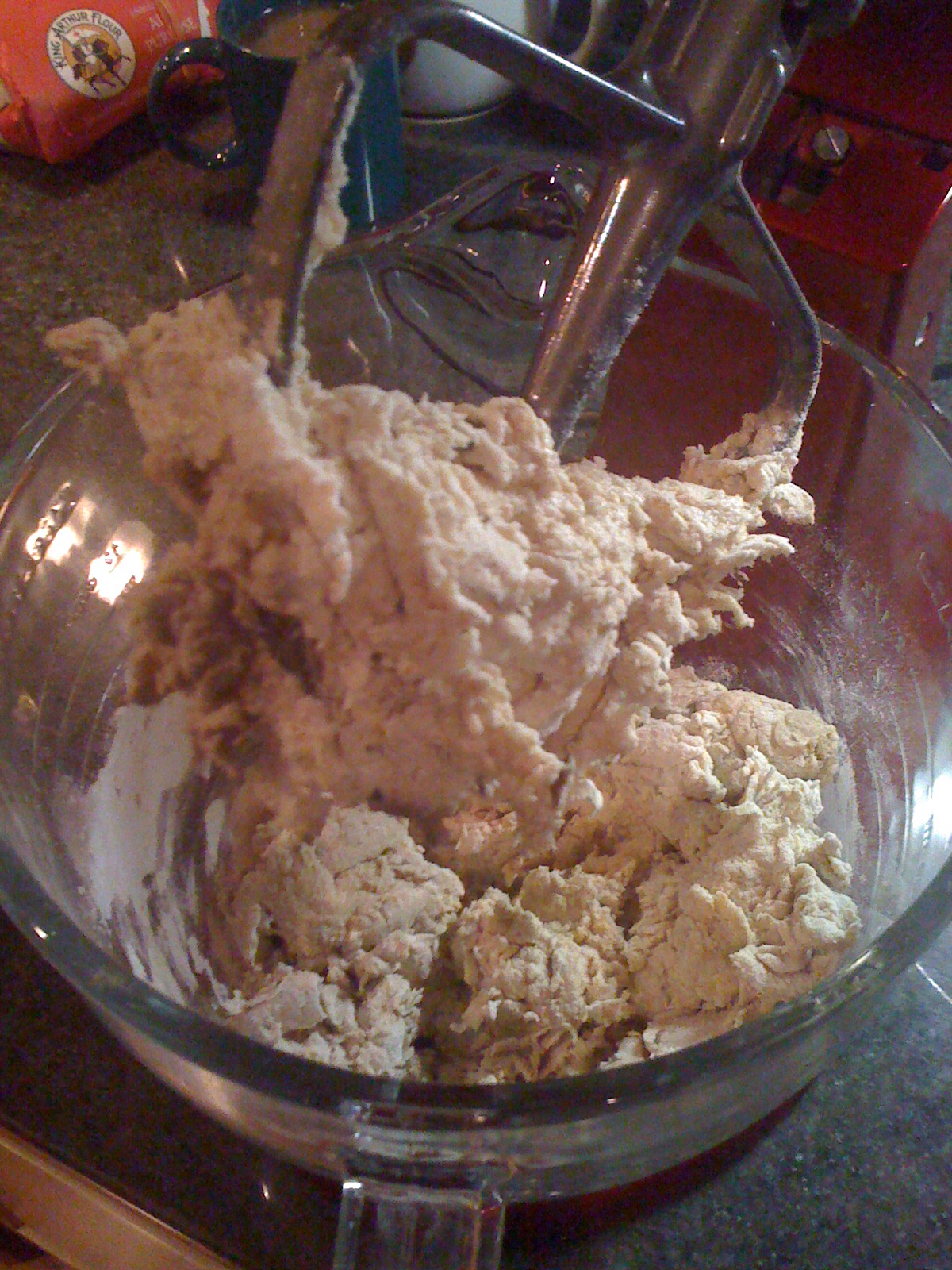
Less than a minute after adding warm water to the dry ingredients, the mixture becomes a shaggy mass.
- Why I oil paddle/hook: Makes it easier to clean dough off paddle, and helps prevent dough from creeping up to top of hook. Alton Brown’s suggestion, not my own genius, unfortunately.
- With hook now on, turn mixer of medium low. Let the hook and dough do their thing. IF the dough is looking a tad dry – if it looks like that dryness would hurt if you were a lump of developing dough – I add squigges of warm water ’til it softens up a bit.
- If dough does creep up the hook, stop the mixer and adjust dough downward.
- After about 5 minutes, the dough should look like it’s swollen just a tad and look a bit like a soft baby’s bum. At this point, take out the dough and put into an oiled (or Pammed) bowl. I like to put my in a large (2 quart-sized) plastic measurer with markings. That way you can tell how much the dough has risen. Next, cover the container with plastic wrap. Put in a warm draft-free space.
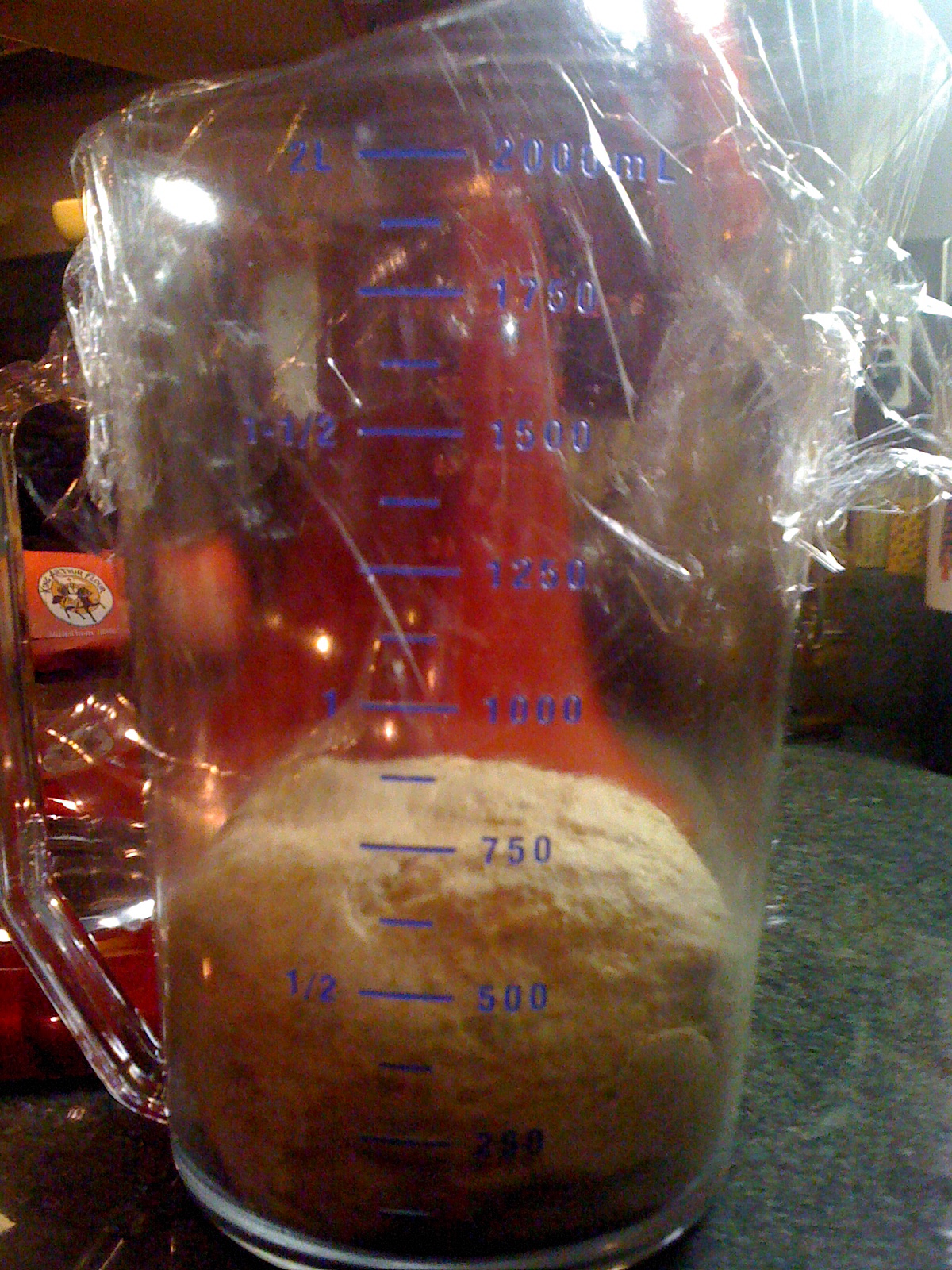
Dough ready to rise.
- Warm? In January? I’m a frugal gal myself. My house is nowhere above 68F at any time between August and June. How the heck do I find a warm space that’ll make my baby snuggly and happy? Here’s the trick: Boil a cup of water in the microwave. Put the dough bowl in the microwave with the just-boiled water. Close door. You’ll have a warmish space for the next hour or so as the water releases heat as it cools down.
- The original recipe says to let the dough rise an hour or so. I take mine a but further – up to two hours. The dough is likely to double in that time.
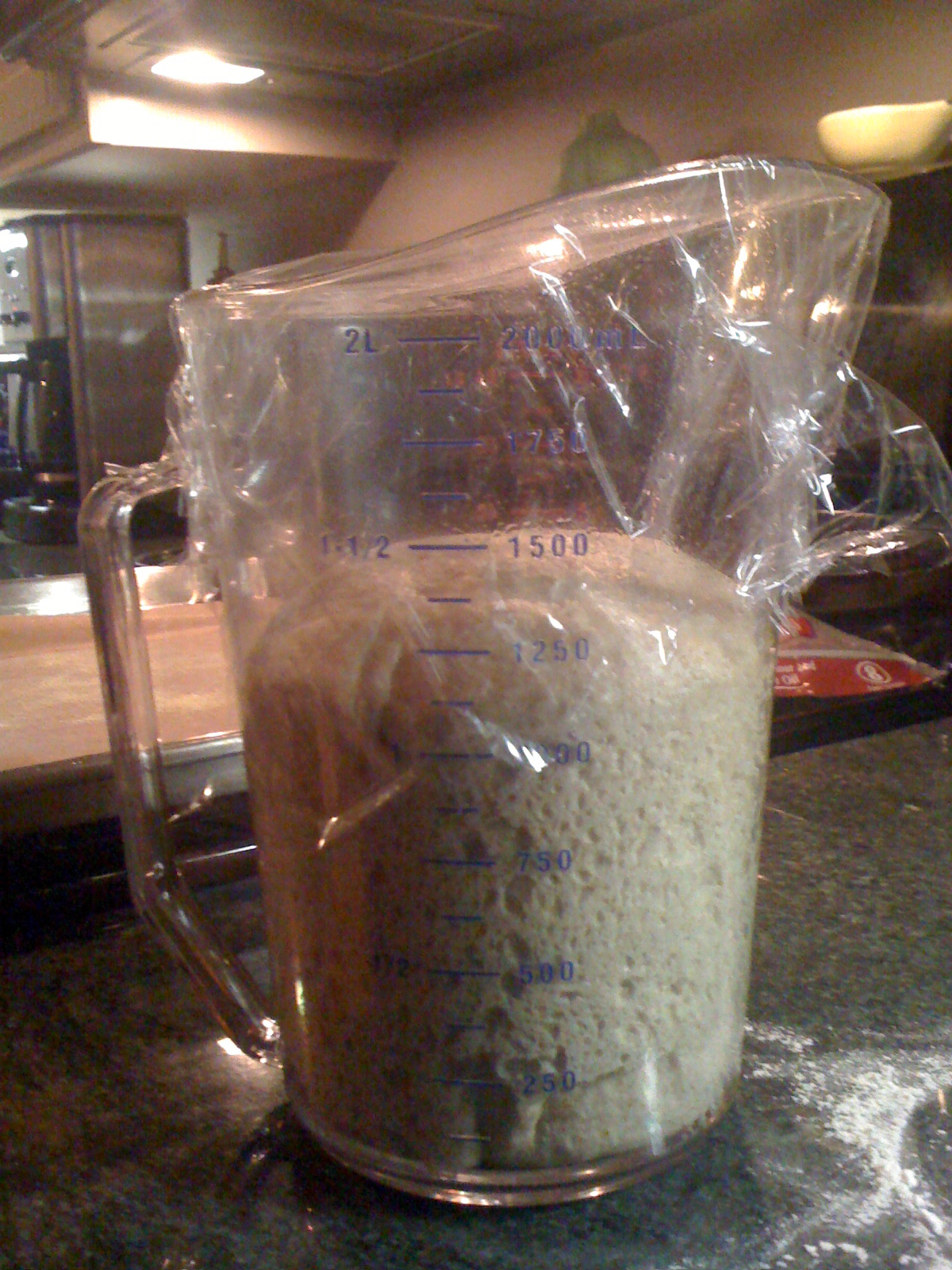
D'oh! It's doubled!
- Spill the somewhat-puffy dough onto a lightly floured surface. The light pull of your hands on the dough coaxing it out of the container is pretty much enough handling to count toward a light “punch down.” You don’t want to let too much of that air out – this is a one-rise dough, after all.
- Actually, you can even skip the “lightly floured surface.” Why? This is a dry dough – a quick dip of your fingertips in some flour is more than enough to prevent the dough from sticking to your fingers. And, in this next step you actually want the tackiness of your surface to work in your favor.
- Pull in all sides of the dough into the middle of a round ball. Try your best to pinch them all into one spot. Top should be a smooth rounded surface, and the bottom should look like puckered lips.

Pull in all the side of the mass of dough into the center and try to pinch together. I admit, I pinched one more time after this photo.
- Next, put the ball bottom side down. Put both hands on either side of the ball, cupping it from the top, and rotate the ball under your hands – kinda pushing up with your left while pulling down with your right. The tackiness of a flourless work surface pulls the dough taut. And, it helps in drawing in those “puckered lips” and sealing it closed as best as possible. Do the push-me, pull-you thing about 10-20 times. When the “skin” of the ball starts to pull very very tight, STOP!

Pushing/pulling the dough in a clockwise direction seals the dough together on its bottom. Pretty cool!
- Put the dough ball on a sheet pan lined with parchment paper that has been lightly sprinkled with corn meal. Cover with that plastic wrap you used previously (waste not, want not, right?). Let it sit while the oven warms up to about 420F (recipe says 425F but my oven runs a bit hot). In fact, I’ll let it sit for up to 1/2 hour.

The dough sits for up to a half hour before heading into the oven.
- Five minutes before you’re ready to put the dough into the oven, throw in some ice cubes. This creates steam, and a humid, steamy oven helps create a nice crunchy crust.
- Right before inserting the dough into the oven do these two things: 1) slash the top of the dough lightly with a quick movement. This slashing will help prevent the crust from breaking haphazardly elsewhere as the dough expands. The dough is gonna split regardless – pre-slashing is like a controlled split. 2) Spritz the loaf 4-5 times with a water spritzer-thingy. Again, this helps create a crunchy crust. But I don’t go crazy trying to control the crust, not like I would if I were making French bread or a sourdough. This is a quick-and-easy bread recipe – the crust is what it is. I’m good with that.
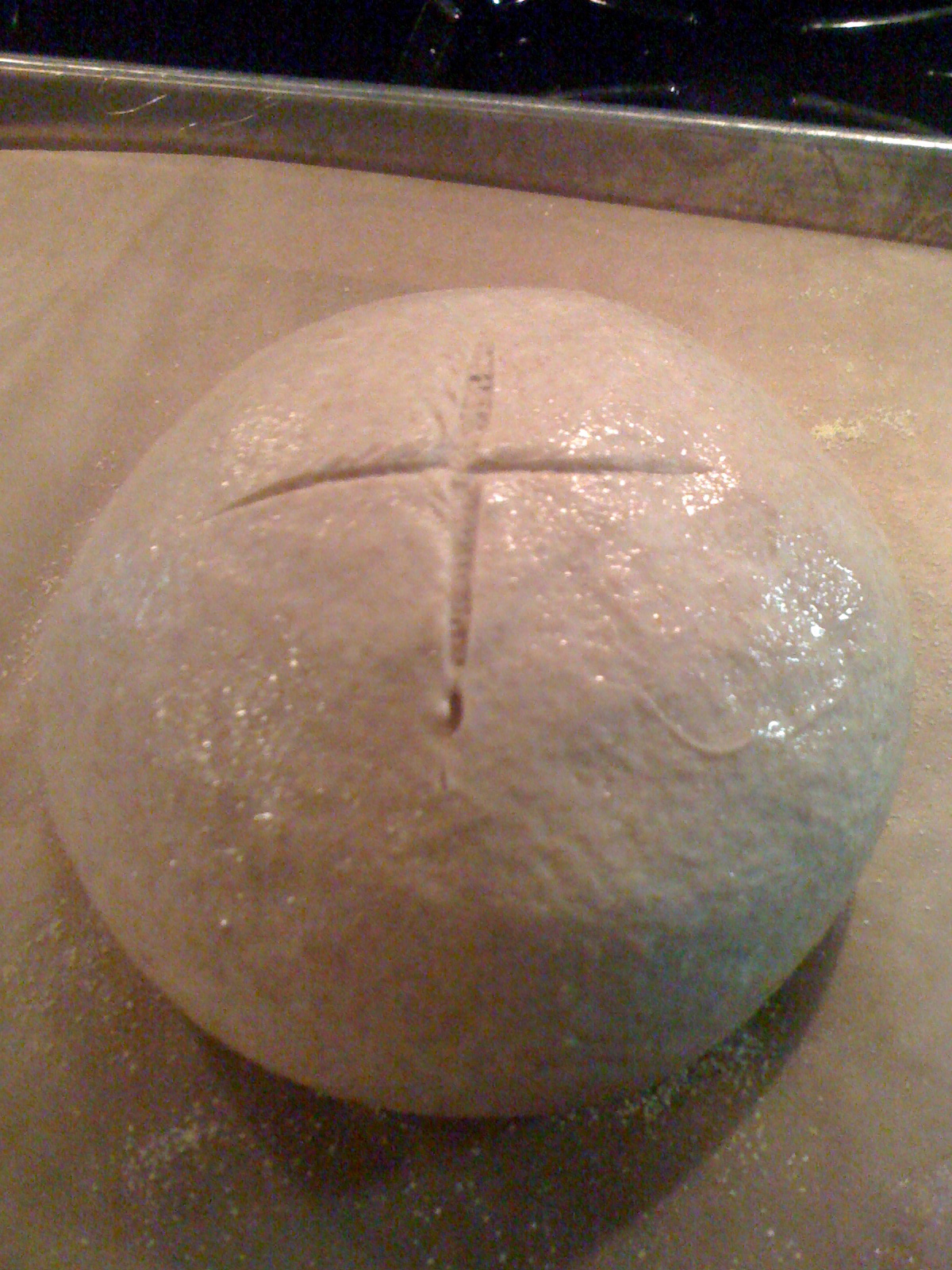
Slash!
- The recipe calls for the bread to bake about 40 minutes. Because my oven runs a bit hot, I take it to 35 minutes and then check its status. Check for doneness by thumping your thumb against the bottom of the loaf. If it sounds hollow, it’s time to set it free from the oven. What’s a hollow loaf of bread sound like? Good question. And I suggest you take a loaf out at 30 minutes, give it a good thump, and remember what that sounds like, and then keep comparing thumps every couple of minutes. Eventually the bread will be done and you’ll note the difference in sound. Well, that’s how I did it, anyway.
- Let it sit on a cooling rack for a while so it can finish cooking completely inside. If you can keep your hands off it, that is.
Using this recipe, I made a loaf of half-whole wheat bread 5.5 inches wide and weighing approximately 1 lb. 6.5 oz. in less than 4 hours. Fresh. Bread. Fast. Yum.
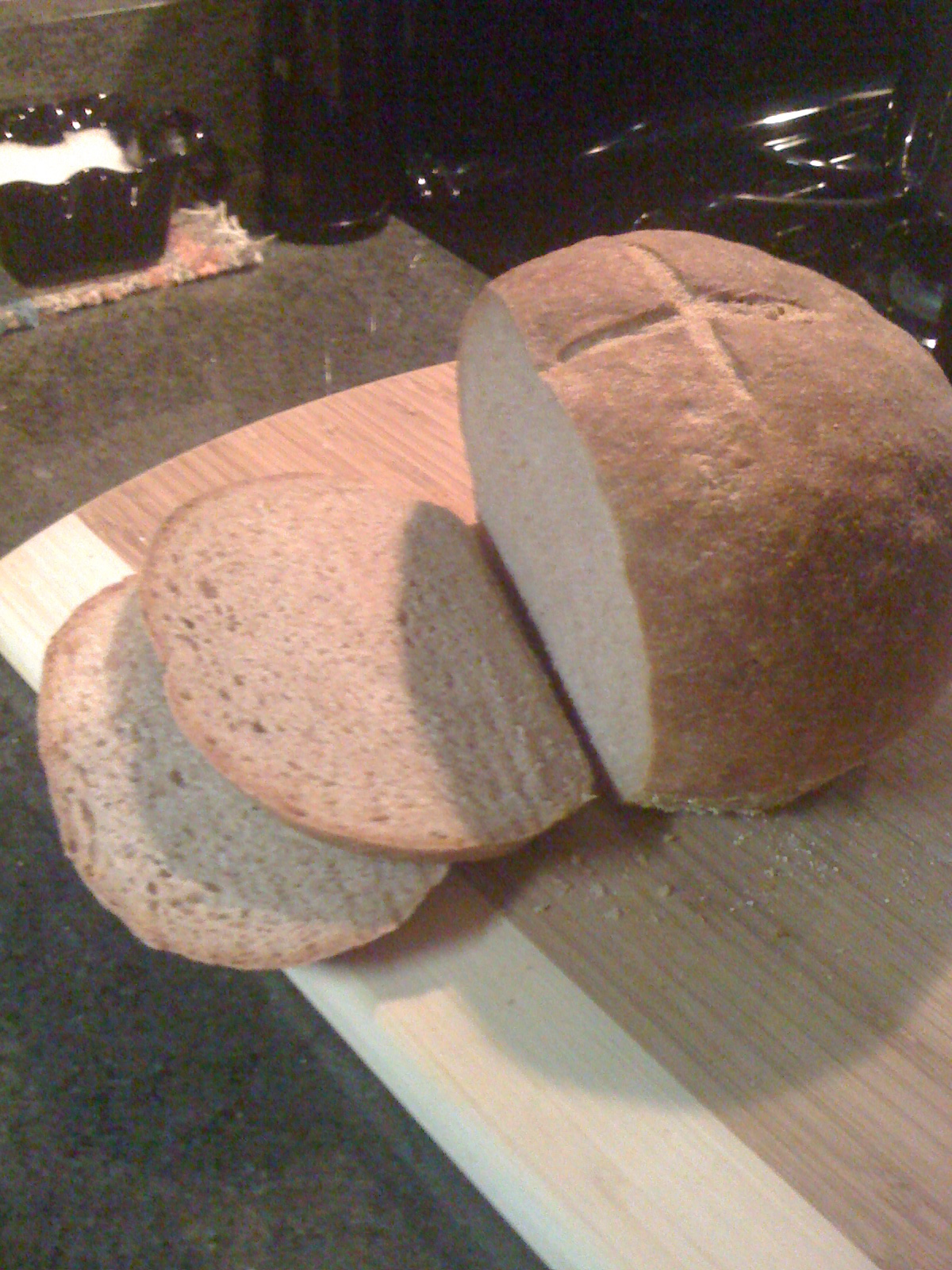
From flour to bread in under four hours - ya! And with minimal hands-on work, too.
Fresh, Homegrown Parsley
January 7, 2011 § Leave a comment
“Fresh garden parsley in January, yo.”

Parsley harvested in November still going strong in January, thanks to some prepping tips.
That’s from my “Linguine with Clam Sauce: The Payoff” post. I had bragged about how our homegrown parsley is like Methuselah—it just keeps on keepin’ on even after being in our fridge for nearly two months. What the hell kinda parsley are we using, after all? Plastic?
No, not plastic. In fact, it’s one of those no-named varieties of flat-leafed parsley seedlings we bought from a pop-up garden center back in May. It’s the most gutsy plant we have in our community garden plot, and we couldn’t kill it if we tried. I planted pretty much every seedling that was broadcast-sown in the 4-in. pot we purchased—and every single plant survived.
Here are the growing instructions: Nothing special; water now and then.
I’m not kidding you. Nothing special. And, as a result, the two rows of parsley grew into a small hedge. In fact, it’ll probably come back from the dead when the soil warms this spring.
Just as the living stuff is indestructible, so too is the harvested parsley. Here’s how we prepared and stored the herb:
- Gently wash with cold water.
- Remove stems. Reserve stems for your stash of veggies for making veggie stock.
- Lay leaves flattish on towel to air dry excess water. Best thing about parsley as a plant is that it’s sturdy—it’ll dry before it begins to wilt.
- Once dry, store loosely in zip-lock freezer bag. Put in refrigerator. Since the storage bags are a bit thicker, I think that helps prolong the parsley’s life.
We also stashed six or eight of these zip-locks in the freezer, where it forms frozen sheets. When we run out of the fresh stuff, we’ll break off a corner of the frozen parsley sheet and add it to soups, stews, pasta, and so forth.
More importantly, this is what we DON’T do: Store the parsley wet, wrapped in a moist paper towel in a sealed bag. The humidity just seems to build up along the bag’s sides, eventually making the leaves black and slimy. Sure, we’ll do this if we’re in a hurry or we know we’ll use the whole batch quickly. But it’s not something I’d do for long-term storage.
Will our parsley-storage technique work with the store-bought stuff? I don’t know—we haven’t had to buy the fresh stuff in years. But please do give it a try and let Dainty Dot know the results.
And did I mention, we also have fresh dill from the garden still going strong in the fridge, as well? It’s like a magic tomb, that refrigerator of ours.
Ellen Bakes
January 6, 2011 § Leave a comment
“I really like to bake.”
Those very words can be found in my profile, and I’ve yet to write anything about baking on The Dainty Dot. This is, after all, the Year of Ellen Baking. As a comparison, 2010 was the Year of Ellen Sleeping and 2009 was the Year of Ellen Not Sending Cards. I decided to put a more positive spin on the “Year ofs” during this turn around the sun.
In fact, this blog was originally going to be called “Ellen Bakes.” Imagine when I heard that Martha is premiering a new show later this month called “Martha Bakes.” Coincidence? She must have bugged my house …
Am I baking today? No. This week? Probably not. Blame it on a preparation for a business trip/presentations coming up in a few days. But don’t you fear – I’ll be baking (said with a slight Arnold Schwarzenegger/Terminator affect).
Year of the Pie?
Coincidentally, I heard a buzz that 2011 will be the year of the pie. Sweet pies, savory pies, hand pies, round, square, pan—you put a crust of any sort on it, in it, around it, call it a pie and it’s a rock star this year. And, not to steal Martha’s catch phrase but … that is a good thing. Because Ellen bakes pies. Always have.
Pie crust is an amazing canvas. And really, I’m fixated on perfecting that canvas. I’ve in no way come even half way to making a top-notch crust, but I love the challenge. Fillings? Yeah, ok – it’s the stuff of the pie. But I always remember the crust.
Best pie crust ever is my mom’s crust from my childhood. The flakiest ever, thanks to lard. Rendered from our own pigs. Didn’t mean to skeeve you out but when you grow up on a farm you can expect that sort of thing. Alas, no more lard for mom and dad. Doctors orders.
The loveliest pie combination: Peach-rhubarb, also from fruit grown right on the property. “Peaches? Rhubarb? How are they ever in season at the same time?,” you ask. They aren’t. But as the peaches come on, along with every other fruit and veg roundabout August, and you’re looking for room to store stuff in the chest freezer, you spot the frozen rhubarb. “Hmmmm … let’s make a pie,” is the natural solution.
Flour Bakery + Cafe
Down the block from me is a bakery that is pretty well known – Flour Bakery + Cafe, run by baking’s “It Girl,” Joanne Chang. Awesome place. the line is pretty much always out the door – which is why I don’t really go there too very often. But when I do, it’s oh so good.
Joanne has recently published a cookbook based on recipes she uses at Flour. Bitten with the baking bug, I had to get myself a signed copy, just in time to bake for the holidays. Now, I’m not really a sweets baker – pies are the exception – but the recipes for grown-up oreos and pop-tarts are really spectacular. Every reason to name the book “Flour: Spectacular Recipes from Boston’s Flour Bakery + Cafe.”
Okay, folks – I gotta go get a move-on with that presentation. But, let me leave you with a drool-inducing image of my apple cinnamon pop-tarts baked word for word (almost) from the Flour cookbook. Yum ….

Pop tarts, from Joanne Chang's awesome new cookbook
Hello, ‘cello
January 5, 2011 § 5 Comments
Sunshine in a bottle.

'cellos give any gathering a citrusy kickoff
That pretty much describes the essence of lemoncello and orangecello (and limecello and … ), that quintessential citrus aperitif of Italy. (Did I just say “quintessential”? Who am I?)
In Dainty-speak, these ‘cellos rock it. For a bunch of reasons:
- They give alcohol a tasty, refreshingly clean kick in the pants.
- They bring back memories of an awesome tour through the Amalfi Coast. (Never been? It’s a must.)
- And, best yet, they can be made at home – no distillery needed. That’s brilliant!
Not that I’ve made ‘cellos, of course. But they’ve been given to me, as recently as this past holiday. It was a double gift – lemoncello and a blog post in the making. I like that.
During our New Year’s festivities in Provincetown, where 11 compadres destroyed convened on our friends’ home, Karen gave out a bottle of the liquor – made in her very own kitchen – to everyone in the crowd, with a spare to give New Year’s Eve a celebratory kick start.
The goods:
- 12 decorative bottles purchased at The Christmas Tree Shops (i.e. inexpensive and cute!)
- 100% proof good-quality vodka, enough to fill said bottles
- oranges and lemons (how many? she didn’t tell me), zested separately
The low-down:
- Soak the zests (one batch orange, one batch lemon) in the alcohol for four to five days
- Strain out zest and discard
- Add simple syrup* to infused alcohol
- Bottle and insert cork!
You’re wondering, “Yo, dude, what’s the ratio of alcohol to simple syrup?” I had the same question. Here’s a direct quote from the ‘cello maker herself:
“The mixture of alcohol and simple syrup is a matter of taste and courage … the more you mix, the sweeter and lower alcohol content you have. The less you mix, the more lethal it becomes!”
Gift-giving tip
Karen made both lemoncello and orangecello. Which bottles contained what? The ribbed bottles were filled with one flavor, the bumpy bottles had another flavor.
*A simple simple syrup recipe: Boil together 1 cup water and 1 cup white sugar until sugar is dissolved. Cool. You’re done. Make more or less depending on how much you need. Keeps for a few days in the fridge.
 The Dainty Dot