
Beets: From Seeds to Roasted
August 2, 2011 § 1 Comment
I love me some beets. Love love love.
I know beet love is not a universal thing. I don’t belittle that. There are reasons to not like them. Sometimes there’s a metallic dirt after-taste. They can stain your hands—and cutting boards and dish towels—like you just murdered someone and stored them in the freezer. Then there’s that whole … nah, I’m not gonna go there.
My first beet love was a dish an old roommate would make in summer. Fresh, julienned beets with minced garlic, evoo and balsamic. Had a real nice crunch. Tasty, but only if you’re not dating someone.
Jennifer has an awesome beet soup – that’s my second beet love. It has the kitchen sink in it, too. I don’t want to hold out on you, but when the next beet harvest comes along, it’ll go up on Dainty. That okay?
My daily beet love goes out to the roasted variety. Simple. Delicious. And really quite beautiful.
New to Dainty!
Yeah for new! I’m including growing instructions. Yup, that’s what I said. This urban farmer is going to show that you—yes, you, city kid!— can take some seeds, grow them, and put them on your tasty table.
Growing Beets
What you’ll need: Beet seeds. A patch of soil/dirt, or a big, wide, deep container. Some way to water them.
Step 1: Beets can take cool weather. And hot weather, too. Another reason to love them. Get out in the garden early in spring—Aprilish for New England peeps—to sow your seeds. OR, start some seeds in early- to mid-August (ahem, NOW!).
Step 2: Beets’ big bulbousness develops underground, in case you didn’t know. It helps if your soil (I never called it dirt, but you know what I mean) isn’t rock hard. Is your soil like cement? Then go to the DIY store and buy a bag of “garden soil,” spread it on top of your “dirt,” and dig it in with a shovel or hoe. Sounds like work … it is! Don’t worry, it doesn’t take long.
Step 3: Beet seeds. Never beet “seedlings” because root vegetables (like beets and carrots) don’t like to be moved once they begin to grow. So, get yourself some. There’s all different types. Choose whichever tickles your tastebuds.
Step 4: Sow the seeds according to the seed packet instructions. Here’s a tip: Plant them in several rows maybe 6 in. apart and in a chess board-type pattern. You can squeeze more in the space that way.
Step 5: Water the seeds in … gently. And keep the soil moist as they germinate.
Step 6: Now, you’re going to wait weeks and weeks … watering and even fertilizing with an all-purpose fertilizer (go to the store and ask for it – you’ll get something good). Your seedlings may be too close together. And when that happens, the beets under the ground kind of grow into each other. It’s ok to sacrifice some of the smaller seedlings. If one seedling is too close to another, just pull it up and discard.
Just a warning: If you spot something on your beet leaves that look like random squiggly lines, you’ve got a pest called Leafminer. These little guys tunnel between the top and bottom of the leaf surface. Crazy! They are the bane of my spring garden—because they also love spinach and chard. If you spot a leaf with these markings, remove it … from the entire garden! Put it in the trash. Do not compost. You want these suckers dead and gone far away. You’ll eat those beet tops later … or the chard or the spinach. You don’t want these guys getting to it first, do you? If you are so inclined, look along the squiggly line and you just might be able to spot the white-ish larva. It’s really gross. Okay, on second thought, don’t look.
Step 7: As your beets get bigger—yay, how awesome is that?!—they may push themselves a bit above ground. Just lightly cover with some surrounding soil to keep the beet covered. Don’t want it to get sunburned, right?
Step 8: Harvest! Pull those beets up whenever you want. You can get a good idea of the size by taking your finger and going around the top of the beet under the soil. After a few months you’ll have small beets that will be good for pickling. Three months, and you’ll get a decent beet—the size you’ll see at a market. Don’t go for massive. No one needs massive beets.

Beets! and chard, too.
Step 9: Time to roast!
Roasted Beets
- beets, 3-4
- olive oil
- course salt, pepper
-Set oven to 425F. Cut off a 1 ft. length of aluminum foil, place in a cast iron pan.
-Wash beets. Cut off tops just above beet. Reserve beet tops for … well, you can saute them for pasta or as a side dish …
-Arrange beets on the foil. Glug olive oil on top of each beet – don’t need a whole lot. Sprinkle with salt and a turn of pepper. Fold foil around the beets so they are snug in the packet. You’ll want the moisture to stay inside.

Beets oiled and seasoned
-Slide into the oven. Cook 45-60 minutes, depending on the size of the beets. When are they done? When you can just insert a paring knife deep into its heart.
-When the knife slides in, remove the pan. Let cool until the beets can be handled. Actually, just wait until they are room temp. The skins of beet will be soooo much easier to remove when they are completely cool. And then just rub off the skins! For a cool visual, you can keep the short tops on the beet and rub the rest of the skin away if you want.

Beets, cooling.
What to do next? Store in sealed container in the fridge for 3-4 days. Cube or slice and eat with salads. Goat cheese is in love with beets, too, so be sure to pair them whenever you can.

Naked beets, ready to be sliced or cubed. How beautiful!

Roasted beets are fabulous on a salad.
Salad from a City Garden
July 29, 2011 § Leave a comment
Remember yesterday?
Remember that haul of produce I brought home from my city community garden plot? All of it—the lettuce, the chard, the beets, the tomatoes and whatever else I gathered—is washed/bagged/roasted/drying/sitting in a hydrator.
Are you interested in how I saved the lettuce/chard/etc? There’s a way to do it. I can tell you about that later if you want …
But for now, let me tell you about my lunch. 
-Lettuce from the garden.
-A half of a beet from the garden, roasted.
-Cherry tomatoes from the garden.
-A half of a zucchini from the garden, roasted.
–Greek Salad Dressing, made with oregano from the garden.
-Boiled eggs, from our backyard hens (Oh, please. Who do I think I am? Jayme Jenkins?).
–Pickled red onions, pickled myself!
-Green lentils and bulgur – okay, I didn’t grow them but at least I boiled them myself.
-A slice of bread I made using my wild yeast sourdough starter.
I’m full. I need a nap.
First Big Harvest from Community Garden Plot
July 28, 2011 § 2 Comments
This …
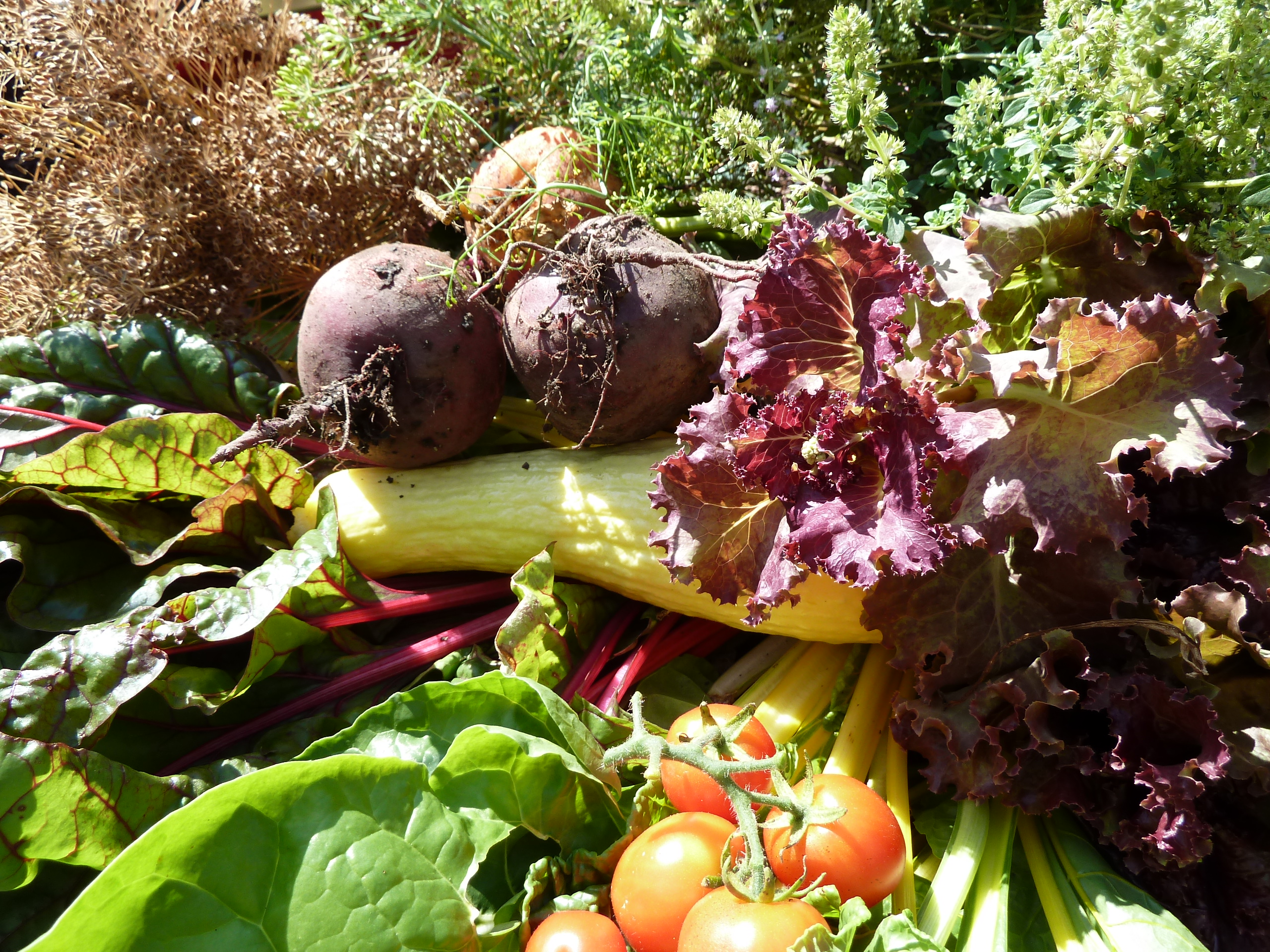
harvest from Dainty's community garden plot
This is what it’s all about. The seeds planted in April. And replanted in May. The battles with bugs. The constant fretting over the weather. The worry while on vacation. This haul is worth the wait, worth the time, for sure.
Red and golden beets. The last of the lettuce. Most of the red and yellow chard. A big ol’ yellow squash. The first—the very first!—cherry tomatoes. Thyme and dill. Oh, and I shouldn’t forget to mention this is all in a 15′ x 30′ urban community garden plot. Call me a city farmer.
It’s not like we haven’t harvested anything at all up until now. Not true. We’ve snipped plenty of herbs. Fresh dill sprigs went into some homemade pickles a few weeks ago, for instance. We’ve pulled up a beet here and there. Just this Monday we took home three larger-than-intended zucchini and a couple of yellow squash. And, we’ve had lettuce for months.
But now, the last week in July, is when everything comes together.
Look for a whole lotta zucchini recipes coming your way.
Greek Salad Dressing
June 23, 2011 § 3 Comments

Lettuce and spinach from the garden
Did I mention it’s salad season? We have a plot in the Washington-Rutland Community Garden, right across from Flour Bakery, and it’s spitting out lettuce at a pretty good clip now. What we have most of now, actually, is spinach. It’s late June, and considering the warm temps, its the end of the spinach season. As my garden neighbor said, we had March until Memorial Day, then we had August. No normal spring weather – cool days and nights – to get a really good spinach crop going. Just cold and wet, not very good for seeds to germinate. And when they did finally come up, the seedlings didn’t like the heat. They sent up flower stalks immediately – at just 2 inches tall. Yikes. So what fills my salad spinner now are small, small spinach leaves. But a lot of them. Along with some of my larger lettuce leaves.
And did I mention I recently trimmed our oregano plant? It’s massive, and it was about to flower. To keep an herb going strong through the growing season, I trim off any flowers that pop up. I have a big bag of oregano clippings wrapped in moistened paper towel and sealed in a ziploc bag, sleeping nicely in the fridge. My recipes this week are leaning towards oregano.
What to drizzle over my spinach and lettuce leaves? The Lemon Oregano Vinaigrette is fabulous, but we need a little variety now and then. I found this recipe for a Greek-style dressing online at The Food Network site – it’s by a guy named Ernie? Never heard of him, but he’s got a knack for dressing, that’s for sure.
Ingredients
- 1/4 cup red wine vinegar
- 1/8 cup white wine vinegar (equals 2 tbsp)
- 1 teaspoon Dijon mustard
- 1 teaspoon salt – it calls for “fine salt,” but I used kosher and added a bit more to compensate
- 1/2 teaspoon fresh ground black pepper
- 1/4 teaspoon crushed red pepper or dash of cayenne, optional
- 1 small clove garlic
- 1/3 cup extra-virgin olive oil
- 1/2 cup canola oil
- 1 tablespoon chopped fresh oregano leaves
-Use a blender to combine the vinegars, mustard, salt, pepper, red pepper, and garlic on the puree setting. With the motor running, very slowly pour in a steady stream of olive oil to make a smooth dressing. Repeat with the canola oil.
-Transfer the dressing to a glass storage container and mix in the oregano. Season with salt and pepper to taste.
Start Seeds This Weekend
April 15, 2011 § 1 Comment
What kind of crafty, homey, cooking, gardening type of person do I think I am if I can’t find somewhere in our condo to grow some seeds??
Yes, we live in the “garden level” unit (think Laverne and Shirley). Yes, we have zero natural light. Yes, we have your average city person’s complaint of lack of space. BUT! What Dainty has is a will to get things done and a complete hatred of whining that I can’t do something.
So, instead of letting another spring pass by during which I complain about not being able to start my own veggie seeds, I decided to create space somewhere, anywhere.
While we have your typical South End rowhouse-type one-floor apartment that has VERY little storage, we do have a 3-ft. wide by 18-ft long storage closet that is a GEM. It’s unbelievable. Storage like this is unheard of here. And, it’s one of the reasons we bought the place. It’s stuffed to the gills with pantry items, jackets, sporty-spice stuff, a small freezer, bins of guest sheets towels, and even our wine. There had to be some extra space in this room to start a bunch of veggie seeds. And I found it.

This is a small space about 18 inches wide and tall and about 2 ft deep. I had a bunch of duffel bags sitting on top of some towel-containing storage bins, in a Metro Shelving-type coat rack kinda space. Just to the right of the bins are hanging a bunch of jackets. If I remove the duffel I get a nice flat surface.
Next I bought an 18-in. long fluorescent light, some chain and some S-hooks. I hung the light from the top rack using the S-hooks. It’s important to have the lamp hanging like this so when the plants grow taller, you can move the light up. Having the light at the very top to start with will make the little seedlings “leggy”, that is, they’ll get thin and stretchy. Not good. You want the light close to the seeds when the germinate.
Okay, next I planted some seeds in some pots. Got an old plastic yogurt container? Old milk container? Old pots? You can use anything that can contain soil, so use it. I happen to have a bunch of Cow Pots—yes, they are made out of cow poo but they don’t smell, check out their web page—so I used those. Oh, and they are plantable, too. The seeds will germinate in them and when the plants are big enough you can plant the entire thing into the ground or into a patio container. Pretty cool.
I filled the Cow Pots—which are 6 connected little pots better known as “packs”—with a special soil for starting seeds. I happened to pick up something from MiracleGro. Any good quality potting mix should do the trick. Then I put the filled 6-packs onto an old baking tray and then filled the tray to the rim with water. The pot and soil sucks up the water. Capillary action, remember that from school? Anyway, give them about 30 minutes to absorb the water in the tray.
During that time, plant your seeds! All I do is make a little divet in the soil with my pinky. The larger the seed, the larger the divet. These little pots are about 3 inches square. I made three divets in each cell. And I put two seeds in each divet. Am I even spelling divet correctly? Hmmm … Be sure to label what’s in which cell. If you’re mind is going like mine is, you’ll forget what you did within the hour, so make a record of it.
Once the water was all absorbed, it was safe to move the trays and pots to their new home. Voila! A seed starting area set up and going in nowhere and in no time at all. Now, all I have to do is wait.

Seed starting area
What Did I Plant?
It’s still cold outside folks. Nights still get chilly here, and only some plants can take it. Chard, spinach, beets, carrots, lettuce, cabbage and such can be planted outside now. Seeds can be sown directly into the soil, too.
But, the big bonanza plants just can’t survive quite yet. Those would be veggies like tomatoes, squash, peppers, melons, zucchini, beans, pumpkins, corn. You can sow their seeds, but the chill isn’t going to do them any good. Better to start them inside now – or even a couple of weeks ago – so they’ll be a good size to plant out in the garden at the end of May. That’s right, I said end of May for most everyone here in the Northeast. It’s not that they’ll die at even the slightest chill. They just really really prefer to grow with some heat. Wouldn’t you? Anyway, the weekend before or during Memorial Day is a good time to plant these outside. You could and can do it a bit earlier, but I prefer to give them optimal growing conditions. May’s it for me.
I’ll post updates of my little babies as soon as they hatch!
Spring Blooms in California
April 5, 2011 § 6 Comments
(Psst: At the end, there’s a contest opportunity!)
It’s cold and drizzly here in Boston, but it’s definitely spring in California. That was my conclusion after my recent 10-day business trip out there. Okay, eight days of business, two days of relaxing. But, still, the weather out there was decidedly un-New Englandish.
One of the … I’m loath to call it a perk or benefit … hmmm, okay, let’s instead say this: One of my day-job responsibilities is to travel to California each spring and drive from San Diego to San Jose (or vice versa), visiting plant breeding companies along the way. This designated week is the flower equivalent to the Detroit Auto Show, and each company displays their latest and greatest ornamental plant varieties. It’s me, my boss and colleague, and about a thousand other folks looking at flowers. Seriously, it’s actually a tough job. You have no idea.
Now, I’m not sure if I’d be revealing any industry secrets if I tell you, for a lot of these new plant varieties, it’s not that the plant is a new color or can do some sort of trick. Oftentimes it’s “more compact and uniform with better branching.” Man, if I hear that phrase one more time … It means this crop can be grown as “bench run,” or the commercial grower can grow whole benches of this stuff and ship it out all at once, and they can ship it safely (because it’s compact and well branched) without damage during transport. I.e., they’re increasing their margins. And when you sell your flowers to a big box stores, you need all the margin you can get. Think about that the next time you buy your 99-cent geraniums at Big Orange.
The real point with this post is that I did see some some unique flowers and ornamental plants that deserve a mention—even some new patio-sized veggies. Many of them won’t be available until spring of 2012, but I thought I’d share.
Now, about that contest: I have about three packets of cherry tomato seeds to give away. Feel like trying your hand at sowing and growing them? The 5th person to comment gets them!
The Really Slow Food Movement
March 18, 2011 § 1 Comment
Slow food – either in the home or in a restaurant – is something I believe in. It’s flavorful, aromatic, enjoyable and really hits all the senses. I get that – and I absolutely love it.
I am, however, a big big believer in the really sloooow food movement. In fact, I’m working on a spinach salad right now. Should be ready in about 40 days, if we get some good weather.
You guessed it – I’m growing the spinach myself.
Spinach is one of those cool-season crops that you can start as early as March. It’s a tough character and can take chilly weather. Think of it as a Patriots linesman at Gillette in January with short sleeves and lovin’ it. Yes, it’s mild outside today – what plant doesn’t love 65F? – but temps will drop, believe me. And spinach will be able to handle the temp fluctuations.
I have a garden plot in the Washington-Rutland Community Garden – aka the Gazebo Garden – right across the street from Flour Bakery in the South End. Our plot is one of about 40 in the fenced-in lot, former site of I believe three rowhouses from back in the day. At roughly 15 ft x 30 ft, it’s one of the largest plots in the garden. And, after more than three decades as a community garden, I’m still finding bits of broken glass and the occasional spark plug while digging around.

My garden plot is within the two railroad ties on the left and right, and ends right beyond that white bag.
I know I said spinach can handle coldish weather, but it certainly does respond when given a bit of warmth. I’m helping my spinach seeds along by creating some warmth with a coldframe. This is the concept: It’s an enclosed space topped with a clear material like glass or plastic. When I was a kid my parents made a coldframe by creating a rectangle with hay bales and then putting old glass windows on top. Sunlight comes in, heats up the space, and the plants grow while the air outside is still chilly.
Hay bales? Old window frames? I’m not down on the farm anymore – I needed to find another solution.
Last year I made a 2ft x 3ft x 2ft wooden box, filled it with organic soil and grew my carrots in it. Why I did that is a story for another time. But, there it was, sitting there in my garden, unused and topless. And I had one of those light-bulb-going-on-over-my-head moments: Put a piece of plexiglass on top and make a coldframe!

My awesome coldframe!
So, the plexiglass top has been in place since Sunday, covering newly sown rows of carrots and spinach. I checked on it today and the soil was nice and warm – something that seeds trying to germinate would really appreciate. I propped the lid open just a tad, too. More for the photo than to cool down the interior. And, because the top was on during Wednesday’s rain, I had to water it, too.

So, here it is propped open. In a perfect world, the plexiglass would be attached to the frame and there would be a device that would allow the top to be opened in varying increments. Actually, in a perfect world the top would open automatically in response to a solar and temperature sensor. But, this’ll do.
About those spinach seeds: I sowed just one row last Sunday. This weekend I’ll sow another, and so on until the end of April. That way I’m not stampeded by a crop of spinach all at once. I may let the first two batches mature in the box but eventually the box will fill up. At that time I’ll just transplant the seedlings out into the ground. If this year’s crop is anything like last year’s, I may have some to share with you.
Paperwhites: Fresh Color For the New Year
January 8, 2011 § 2 Comments
“I don’t do well with houseplants.”
Really? Is that really your excuse for not adding some living color – literally, living color – to your home? Come on, having houseplants isn’t like doing brain surgery. And, if you do mess up with a houseplant, you can always get another one. Another brain? Not so sure about that.
But specifically, let’s talk paperwhites, aka Narcissus tazetta (I had to google that, don’t be too impressed). Houseplants? Not really. They’re actually bulbs, and the bright, papery-white mini daffodil-shaped flowers will eventually die, the green leaves will fade. Rather than label them houseplants, let’s call them temporary residents, instead.
You see paperwhite bulbs for sale beginning any time after Thanksgiving and into January or so. Why? It’s just the right time of year to force these bulbs into bloom. Forced early in December, the bright white flowers go well with the Christmas holiday decor. Set against the red of a poinsettia, and the white makes the red look even more Christmassy. They make a good pair.

Paperwhites really do make the color of poinsettias pop.
Wait – I think I have to define a word here, “force,” just in case you don’t catch my meaning. You’re not actually using force (or anger or intimidation) to make these bulbs pop their buds. To “force” means to … encourage, yeah, that’s it … you’re encouraging these bulbs to produce leaves and flowers for you at a time when Mother Nature would dictate they sleep for the winter instead.
Okay, back to business.
Begin forcing paperwhites in mid December, and they’ll bring you a whole different experience. At least for me. As you’re dismantling your tree, taking down the decorations and removing all hints of the Christmas holiday round about New Year’s Day, the paperwhites are pushing out their petals. The house is not suddenly stale and cold. There’s life in full flower on the windowsill.
Plant up some paperwhites every weekend from mid December through mid January or whenever your bulb supply runs out, and the narcissus blooms should take you right up until Valentine’s Day, when a color of another sort may appear if you’re lucky.
Paperwhite How-Tos
You don’t have to plant your paperwhites as I do. This technique – potting up the bulbs in water – works for me. And is a lot easier to clean up than potting the bulbs in potting soil.
For one container of paperwhites:
- three paperwhite bulbs – I found mine at Mahoney’s Garden Center in Brighton.
- glass vase big enough to fit said bulbs
- polished stones, glass or similar from a craft store
-I use any sort of clear-glass vessel I can find that has a) an opening big enough for me to squeeze my hand through and b) is at least 6 inches deep. An 11-in. tall vase – the standard kind you get with a nice bouquet delivery – is ideal and I’ll tell you why later. An 8-in. vase is a tad too short. Explanation to come below.
-Place stones/glass/whatever in the bottom of the vessel to create a layer at least 2 or 3 inches deep.
-Place each paperwhite bulb on top of the stones, nudging them in just a bit. Don’t bury the bulbs, just make sure they are securely on the stones. Bulbs can touch, don’t worry. Oh, and place the bulbs GREEN SIDE UP! Your bulbs should have a visible root side and emerging green stemmy-looking side. If you put the green side down, god help you son.
-Place on a windowsill or somewhere they can get some light – they are plants, after all.
-Add water to the vase to just about the bottom of the bulb. The bulbs can sit in a bit of water, but don’t flood them.
-Next, watch them grow.

Even the paperwhite roots are cool to see. Looks like I need to add some water to the vase!
Got a cat or dog? Adding water to their water bowl? Well, check if your pet paperwhites need water, too. It may take a week or so to see some activity. You’ll see it first in the water – brownish white roots will emerge from the bulb. That’s a good sign. Once that happens, the top will start elongating and long leaves will grow by leaps and bounds each day. And eventually a stalk will pop out of the bulb with a thin membrane-encased bunch of baby flowers. Ah, birth!
So, the explanation for why I prefer an 11-in. vase. Simple. These leaves and flowering stalks get pretty tall. The shorter the vase, the more easily the tall stuff slumps over. My paperwhites in the taller vase don’t even think of slumping. Looks much neater. However, if you like the paperwhites-gone-wild look, go for it.
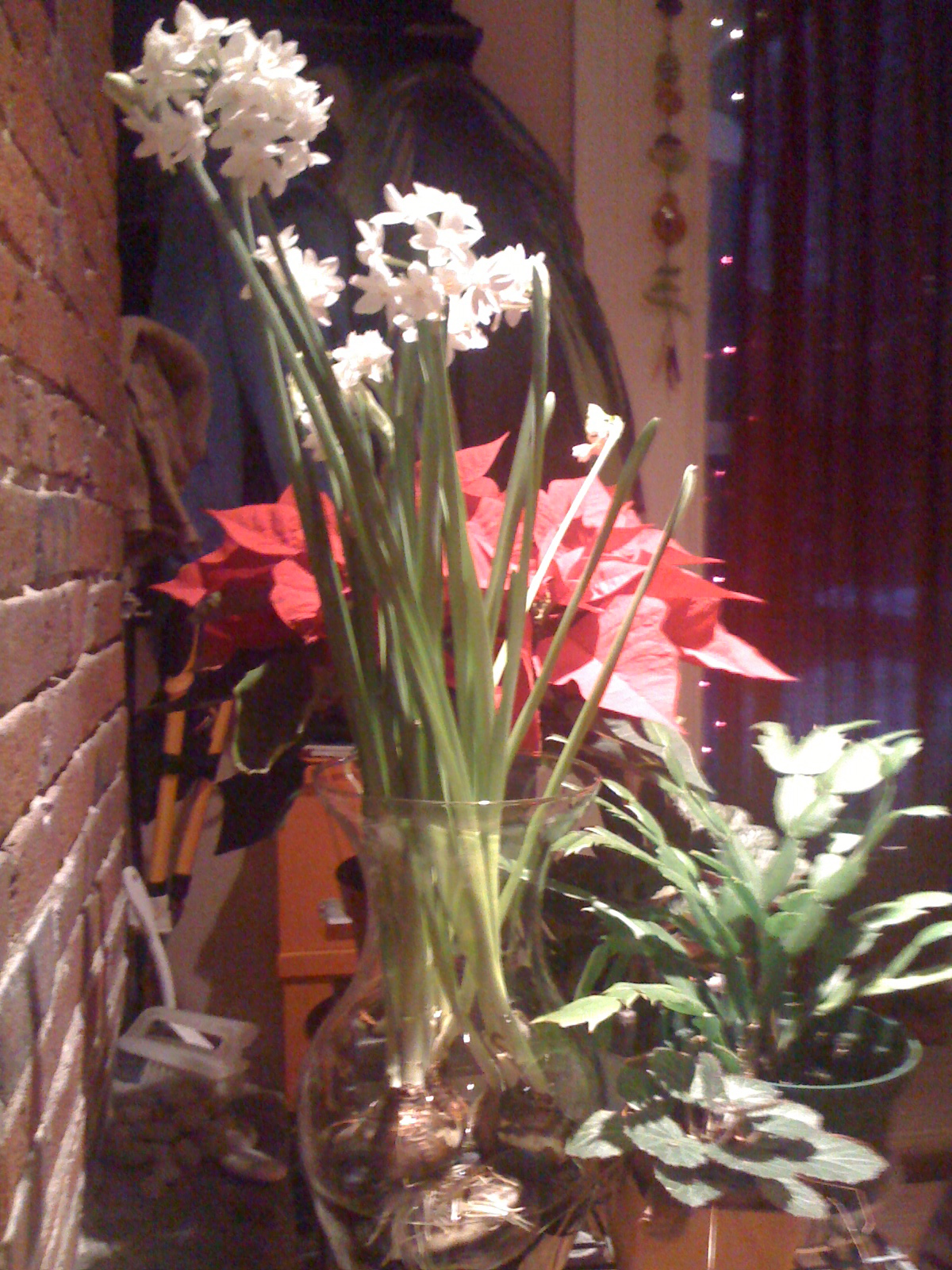
A tall vase helps keep the stems and leaves stand straight.
What Can Go Wrong?
Good question.
-One BIG bummer I experienced last year was a batch of bad bulbs. Not sure what happened to them, but they didn’t emerge more than an inch or two, and they never did flower.
-You can add too much water and your bulbs will get icky. Icky as in moldy and soft.
-You can have too many bulbs in too shallow a container. And your top-heavy flowers will tip over. Is it apparent I’m speaking from experience?
-Not that this is too horrible of a problem but … check out this photo. The emerging leaves and stems couldn’t quite make it up and around the curve of the vase. They had nowhere to go but where they were. So, I ended up with flowers inside the vase. Actually, it looks pretty interesting to me.

These paperwhite flowers couldn't quite make it out of the vase.
Oh, one thing you may want to be aware of: Paperwhites have that same effect on people as cilantro – you know, where people either like the taste of cilantro or think it tastes like soap. The paperwhite fragrance is kinda/sorta the same way, except it’s not soap it will smell like. But don’t let this dissuade your trying paperwhites. It was my duty to tell you.
Fresh, Homegrown Parsley
January 7, 2011 § Leave a comment
“Fresh garden parsley in January, yo.”

Parsley harvested in November still going strong in January, thanks to some prepping tips.
That’s from my “Linguine with Clam Sauce: The Payoff” post. I had bragged about how our homegrown parsley is like Methuselah—it just keeps on keepin’ on even after being in our fridge for nearly two months. What the hell kinda parsley are we using, after all? Plastic?
No, not plastic. In fact, it’s one of those no-named varieties of flat-leafed parsley seedlings we bought from a pop-up garden center back in May. It’s the most gutsy plant we have in our community garden plot, and we couldn’t kill it if we tried. I planted pretty much every seedling that was broadcast-sown in the 4-in. pot we purchased—and every single plant survived.
Here are the growing instructions: Nothing special; water now and then.
I’m not kidding you. Nothing special. And, as a result, the two rows of parsley grew into a small hedge. In fact, it’ll probably come back from the dead when the soil warms this spring.
Just as the living stuff is indestructible, so too is the harvested parsley. Here’s how we prepared and stored the herb:
- Gently wash with cold water.
- Remove stems. Reserve stems for your stash of veggies for making veggie stock.
- Lay leaves flattish on towel to air dry excess water. Best thing about parsley as a plant is that it’s sturdy—it’ll dry before it begins to wilt.
- Once dry, store loosely in zip-lock freezer bag. Put in refrigerator. Since the storage bags are a bit thicker, I think that helps prolong the parsley’s life.
We also stashed six or eight of these zip-locks in the freezer, where it forms frozen sheets. When we run out of the fresh stuff, we’ll break off a corner of the frozen parsley sheet and add it to soups, stews, pasta, and so forth.
More importantly, this is what we DON’T do: Store the parsley wet, wrapped in a moist paper towel in a sealed bag. The humidity just seems to build up along the bag’s sides, eventually making the leaves black and slimy. Sure, we’ll do this if we’re in a hurry or we know we’ll use the whole batch quickly. But it’s not something I’d do for long-term storage.
Will our parsley-storage technique work with the store-bought stuff? I don’t know—we haven’t had to buy the fresh stuff in years. But please do give it a try and let Dainty Dot know the results.
And did I mention, we also have fresh dill from the garden still going strong in the fridge, as well? It’s like a magic tomb, that refrigerator of ours.
 The Dainty Dot