
Mini Mint Oreos ala Flour Bakery
March 17, 2011 § Leave a comment
From now on—for the rest of my life—whenever I say the word “oreo,” I am exclusively referring to the oreo as envisioned and interpreted into chocolate cookie and filling by Joanne Chang of Flour Bakery. Have one bite of the Flour Oreo and you will agree. That other … cookie … it’s a dime-a-dozen cookie. Flour’s oreo is a treat.
If there is one negative I have to nail onto Flour’s oreo, it’s that the chunk of dark chocolately heaven is too big. Is it possible? Slightly. That’s why I had the idea to make them smaller.
Last December I promised I would bring homemade oreos to a holiday party. The recipe – which is a slice-cookies-from-a-dough-log type of cookie – makes about 18 cookies. Definitely not enough for a holiday party. “Minis!” I thought. And why not add some peppermint flavoring for that added holiday pizzazz.
They were the hit of the party.
Well, Erin Go Bragh, it’s now St. Patrick’s Day. For St. Patty’s Day, you’ve got to do something green. Well, let’s add green food coloring to the oreo filling. And if the filling is going to be green, the eater of the cookie is expecting mint. Right?
Green Mint Oreos for St. Patrick’s Day. And minis, too.

Mini Mint Oreo Cookies ala Flour Bakery
Adjustments to Oreo cookie recipe ala Flour cookbook:
Dough log: After leaving dough to firm up for 1 hour, divide dough into 4 equal batches. Roll it into a 1-in. log on parchment paper, as opposed to the instructed 2.5-in log.
Mint: Add 1/2 tsp. peppermint extract. That’s enough! Seriously. All you need.
Green: Add 3-5 drops green food coloring. You can’t tell from the photo, but it’s a nice medium green.
The one thing that I would adjust next time … because the mixer really needs to beat in the food coloring, it makes the filling a bit softer than I’d like. I may decrease the addition of milk from 1 tbs to 1/2 tbs next time.
Bread Cracking in the Oven—Solved!
March 14, 2011 § Leave a comment
Last summer I discovered the joys of bread baking. I guess you’d call it my hobby now. And I say hobby because … well, unlike putting a Pop Tart in the toaster and waiting for the ding, there are levels of complexity at every step. There’s practice and skill and problem-solving and continual learning from mistakes. Described that way, it seems more like a sport. And, considering I currently have three different sourdough ferments tucked snuggly in the warm and draft-free microwave, perhaps I’m also a collector.
Yesterday, I had one of those “Aha!” learning experiences. I made a batch of Country Sourdough from the Amy’s Bread cookbook. It was my first time making this recipe and considering my firm levain wasn’t so firm and I substituted in my sourdough starter, I wasn’t so sure the recipe would work properly.
I made the dough, let it autolyze, formed it into a ball, let it rise, punched it down, let it rise again, separated into two doughs, formed boules and let them rise again – seam side down – in floured baskets. The dough looked and felt great. So far, so good.
Now, in Amy’s instructions, typically once you get to this point in the recipe it’s almost as if they copied and pasted the remainder of the instructions for each and every recipe. At least for the handful of recipes I’ve tackled so far. BUT, this time she had a slightly different twist in the instructions. She said to tip the boule out of the basket onto the prepared parchment paper so the seam was now on top. Hmmm … I had not encountered that in previous recipes. All others were seam side down. Why would you put the seam up?
I had two boules – I thought, “Let’s try one seam side up, one seam side down, and see what happens. I scored both loaves on top, put them in the oven, and let them go.
Here’s what came out of the oven. Can you guess which one was which?
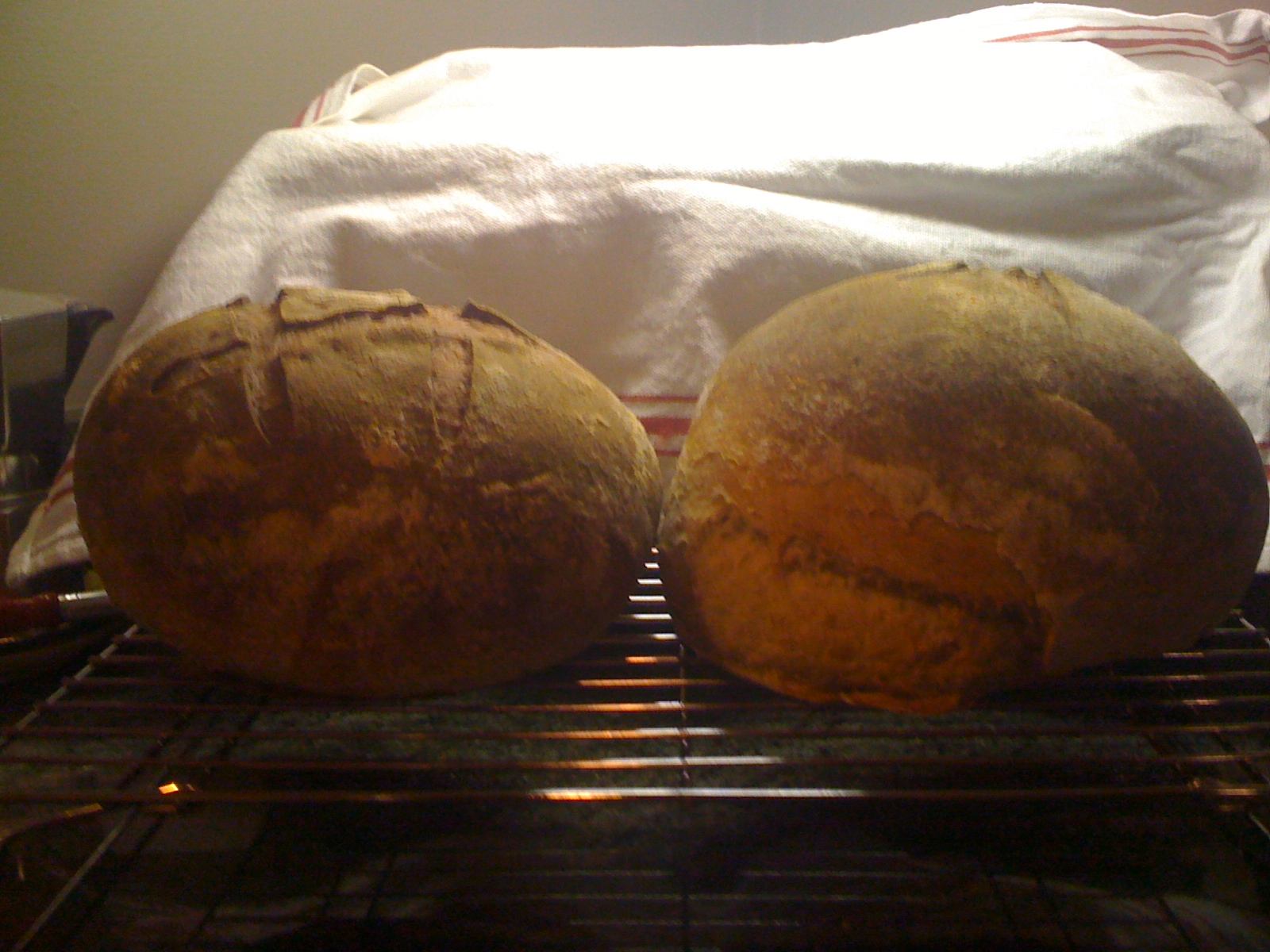
Seam side up on the left, seam side down on the right.
The one on the right was the seam-side down. Even though I scored the top, the steam escaping the loaf escaped through the seam on the bottom, causing it to tear.
For the boule on the left, the scores through the seam on top let the steam escape. Not having a weak spot—a seam on the bottom—prevented the bottom from bursting.
I tried to seal that seam as tightly as possible, but apparently not enough. This doesn’t happen with all of the breads I’ve made, but I have had this happen before. And now I know why. Problem solved.
Peanut Butter Cookies a la Flour
February 19, 2011 § 4 Comments
I have a new baking strategy. About once a week I walk over to the nearby Flour Bakery, scan the luscious goodies within the glass case, and pick something. Just one thing. The intention is try my best to replicate Joanne’s tasty treats.
The first was the oatmeal raisin cookie. If you didn’t get the low-down on this oatmeal experience, look over there in the previous posts. It was an unscheduled lesson in the importance of expiration dates.
But, this is a new day. And a new cookie. Peanut butter. Mmmmm … peanut butter. Hers is a big, wide cookie. Dotted with bits of peanut. Crisp. A hint of salt and, surprisingly, a tad greasy. And a nice peanut butter flavor.
What baking lesson will I learn this time?
I’m happy to report that no catastrophes occurred with this recipe. I followed the recipe to the “t.” All the ingredients were fresh. And the cookies turned out fabulously.(Want the recipe? Buy the Flour cookbook!)

Mmmmm .... peanut butter cookies
But, did I replicate the cookie? No. My batch was lighter in appearance, a bit softer, less salty, and not as greasy. And they didn’t spread as much.
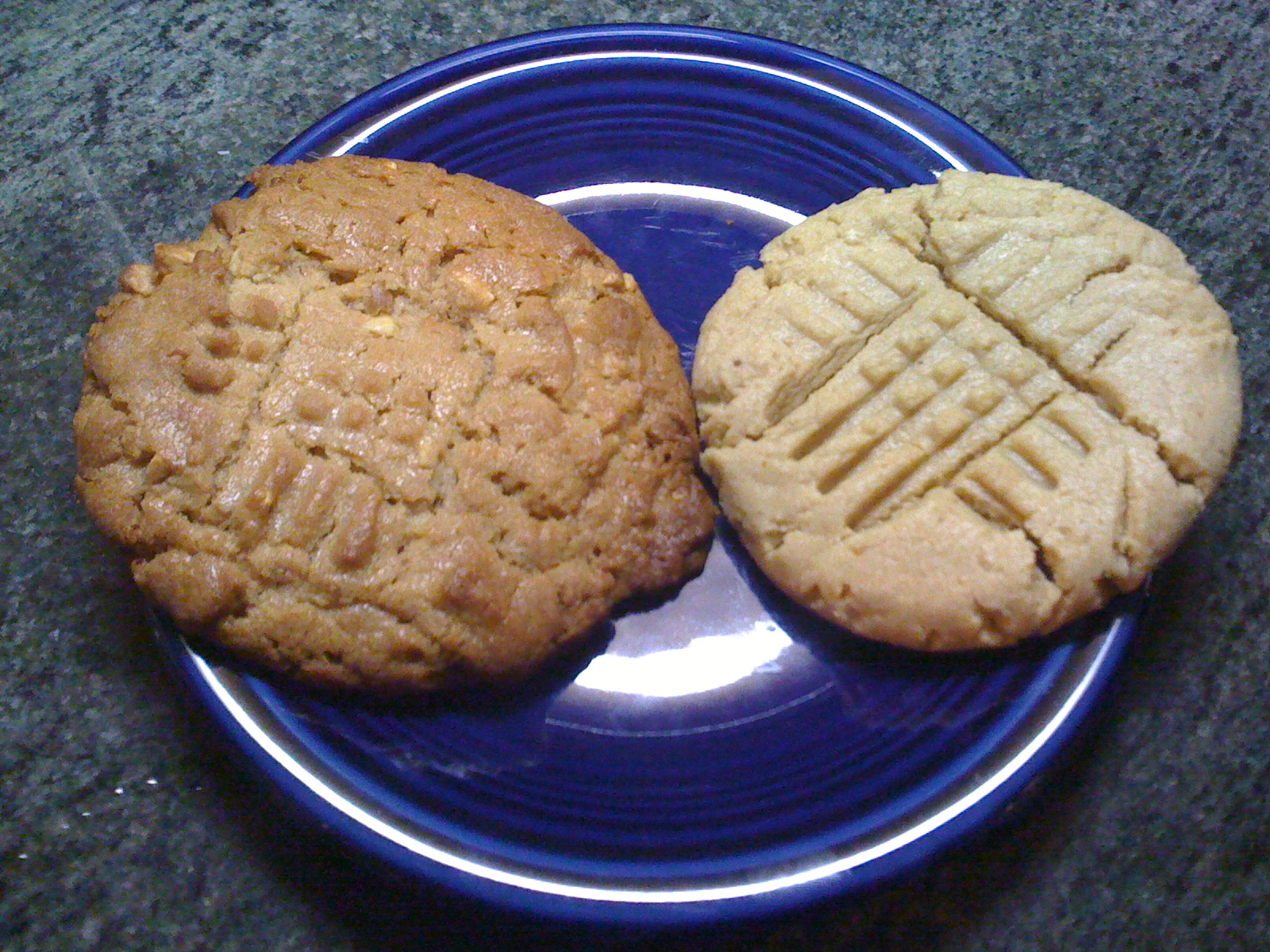
A Flour peanut butter cookie and one of my own
Why? Two reasons. First, the baking process. The recipe says to bake 18-20 minutes (as I recall, I don’t have the book nearby). But because ovens are always fickle things, I prefer to go by the look of the cookie. Joanne says to remove cookies from the oven when the just start to turn golden around the edges, with the middle remaining lighter (again, I don’t have the book with me, but I’m pretty sure that’s what she recommends). And because I prefer a slightly undercooked cookie, I took them out the millisecond I saw the edges browning up. Yes, I crouched on the floor staring through the oven’s window.
Second, and what I account as the major factor in the differences between the two cookies … the peanut butter. The recipe called for a chunky peanut butter. I happened to have smooth. And unsalted. I had a jar of Teddie natural peanut butter, which tends to be thicker and less oily than those childhood favorites Peter Pan and Jiff. Whatever is in those brands that make them smooth and creamy, Teddie doesn’t have it. And I’m kinda glad it doesn’t. Those cookies rocked.

Apple Sourdough: Updates
February 11, 2011 § Leave a comment
No, I’m not obsessing over this apple-based sourdough. Not in the least.
But … I did keep an eye on it throughout the day on Tuesday. Good stuff was going on inside that quart container. Liquid pockets continued to build up around the apple chunks. I could see bubbling going on in there – they’d form lines from the base of the pocket going upward. Occasionally some bubbles would burst forth from that area, not unlike some undersea activity where bottom feeders send up the intermittent belch. The surface of the starter was covered with tiny bubbles, too. And, it smelled nicely fermenty. All good signs.
Wednesday, 5:57 a.m.: The layers have separated completely. No bubbles. Flour looks settled. Hmm … this happened to the grape starter, too. So, I move on to the next step, which calls for me to remove the apple chunks and add 36 grams flour. Stir well.
8:06 a.m.: I took a peek—bubbles seem to be appearing again. Bigger bubbles on the surface this time. But fewer. So far. A quick temperature reading says it is 75F. The starter pulls a bit as I bring up the thermometer. Fingers crossed.
Friday, 6:30 a.m. So, I just poured the starter down the drain. Again. Calling it starter is not correct—it was a mass of watery flour, that’s all. No bubbles. No yeasty activity. Nothing.
I don’t understand where I’m going wrong. I look online and I see all sorts of success with wild sourdough starters. Lots of bubbling! Lots of yeasty stuff going on! And me? The starters just … stops.
I will try again! I will. I just won’t blog about it—I’m getting sick of it.
BUT, if anyone out there (is anyone out there? anyone?) has some advice or a wild sourdough recipe or some suggestions of where to look for success, please let me know. Help a girl out, yo.
Obsessing with Sourdough Starter
February 8, 2011 § Leave a comment
There’s a fine line between baker and mad scientist. And I’m walkin’ that line.
I hate to fail. Hate it. And when the sourdough starter recipe from the Amy’s Bread cookbook failed miserably—TWICE—I was a volcano inside. Watch out, sourdough … I’ll get you yet.
The Amy’s Bread sourdough is, as I envision it, the sourdough the pioneers relied upon. They didn’t have a packet of Fleischmann’s Active Dry tucked into their bonnets. They used yeast, baby … real yeast just floating around in the air or found on … things. Like grapes. This is where I stop envisioning – I don’t want to know what else they used as yeast sources.
The Amy’s Bread sourdough used grapes as the yeast source. Organic grapes. Well … Okay. This is where I admit I went wrong with the recipe. I used conventionally grown grapes, not organic. I went to two or three different Whole Foods! Even the HUGE one in Legacy Place – nada! According to one produce manager, organic grapes are sparse this time of year. Conventional grapes didn’t have that yeasty bloom. What else could explain my lack of bubbling?
What to do …
This is where Dainty the Mad Scientist makes her appearance. Jennifer had related to me a scene from one of Anthony Bourdain’s books. Apparently he had a mad scientist of a baker who worked under him at one point. He was a drug-addled guy, but a baking genius. All sorts of funky smells emerged from his underground yeast lab. He had to be using all sorts of … things … to source his yeast. So, in the middle of the Whole Foods produce department I thought, “What would a drug-addled baker use?”
I didn’t go too crazy in my problem solving. I just looked around and picked what I thought would harbor the most yeast. I chose an organic apple. I figured that, while the smooth part of the apple would have been wiped or polished in some way, the indentations on both ends of the apple would have something native still hangin’ out in there. Now that I think about it, I bet an organic fig would be a good bet, too.
I added 113 grams of 75F-78F water, 72 grams all-purpose flour to a quart container. I chopped the apple into about a 16 pieces and added mostly the end sections to the other ingredients. Stirred vigorously. Put the cover on. Heated some water in the microwave to create a warm environment. Put the container inside at around 3pm on Sunday.
Monday: I checked on the dough periodically throughout the day. Small bubbles started to appear around the apple chunks. Pockets of liquid appeared later on. Lines of bubbles and flour appeared through those pockets. I heated the water about three times during the day to maintain a warmish environment. Hmm … could this possibly be working?
Tuesday, 5:57 a.m. 39 hours later, there’s definitely yeast activity in the container. The bubbles are bigger with the mixture. And there’s small bubbles – like someone took a straw and blew bubbles – on the surface. And, it smells like fermenting apples. Good sign! I stick an instant-read thermometer into the mix and it reads 70.7F. Not bad. Plus, when I pull it out, the substance is a bit gooey and pulls up with it. Yay!!
I move on to the next step – my first refreshment. I add 113 grams of 76F water and 72 grams of flour. Stir vigorously. Close container. Stick in a warmed microwave. Cross fingers.

The sourdough with apples begins to bubble.

Liquid pockets and bubbles appear around the chunks of apple
Oatmeal Raisin Cookies
February 7, 2011 § 3 Comments
That’s Jennifer’s favorite cookie. So when presented with the roughly 18 cookie recipes in Joanne Chang’s Flour cookbook, I made it a priority to bake these. (I did make the oreo recipe first – how could I not attempt oreos??)
About three weeks ago, when I decided to make this recipe, I bought an oatmeal raisin from Flour Bakery in the South End, luckily just a couple blocks away. It was a sturdy cookie, but flexible. Easily chewed – and I chewed quickly. The flavor was unbelievable. The sweetness was exposed with just the right amount of salt. And, most appealing to me – the taste of fresh nutmeg.
Oh, yeah. Looking forward to this recipe.
I cracked open the cookbook, read over the recipe, and followed the instructions word for word. Three hours with the dough in the fridge to firm (that was a brutal waiting game), 1/4 cup dough scooped onto a baking sheet (or the volume of an ice cream scoop). 19-20 minutes in the oven. A couple of nibbles on the cookie dough assured me I was on the road to cookie oatmeal raisin perfection.
Not so.
What emerged from the oven was a cookie – yes. But it was a flat cookie. Not the sturdy cookie I had purchased from Flour the day before. They had spread too much and had cooked into each other. I can take blame for that last bit – I may have put my dough scoops too close together. BUT! why had the flattened into oatmeal raisin pancakes? You know exactly what kind of cookie I mean – flat, with remains of sugary bubbles on the surface. They tasted phenomenal, by the way, but come on, I followed the recipe word for word. . What happened?
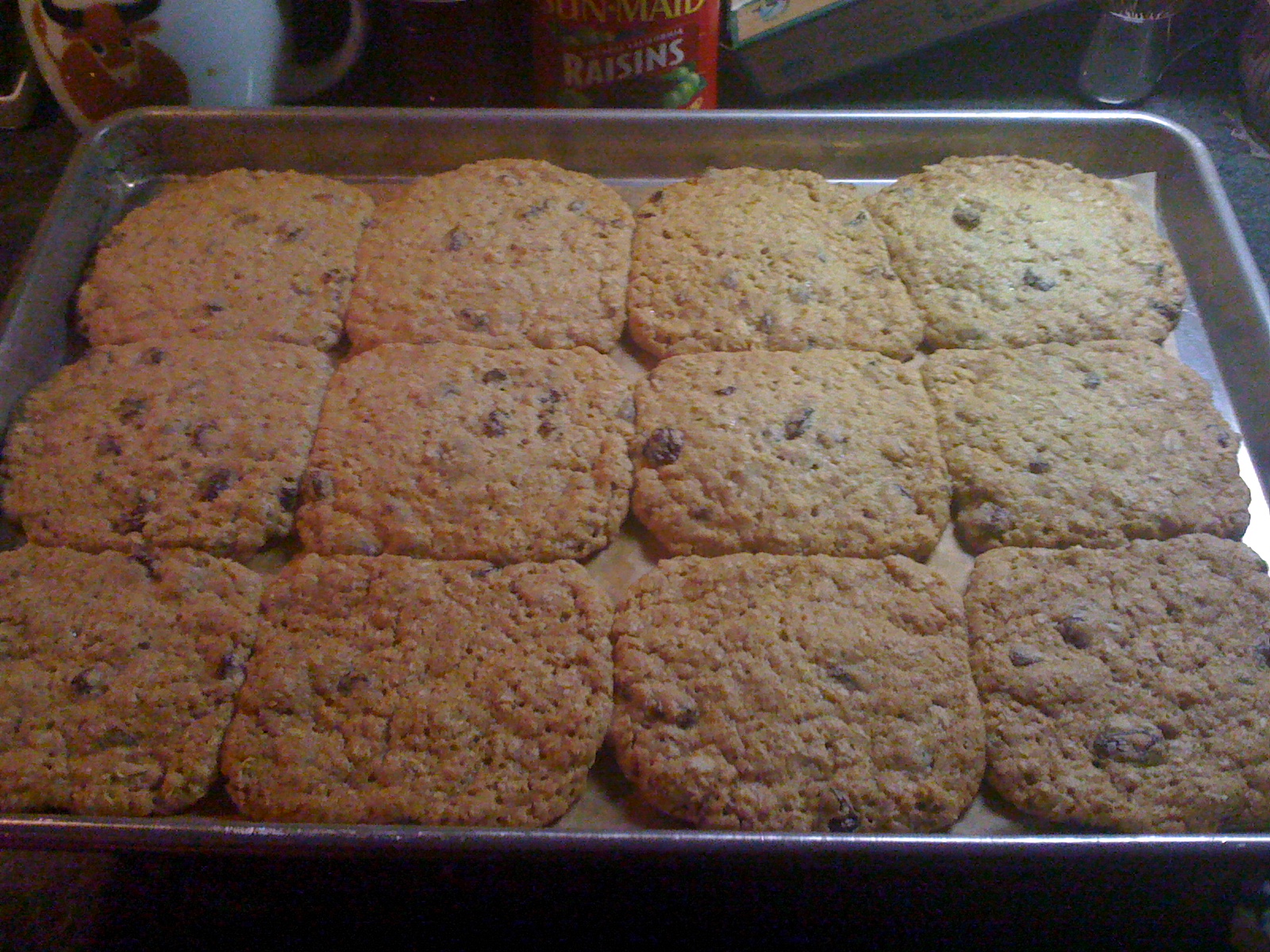
Oatmeal raisin cookies, flat as pancakes
I did a little Googling, a little tweeting, searching for reasons why my cookies ended up like thin crisps. Baking soda. The problem lay in that little golden orange box. Expiration date: 2006.
It has an expiration date, really? I mean, I knew it had a date on the box. But those dates are just … made up to cover their asses in a lawsuit or something. I don’t know what I thought. Apparently, my baking soda’s effectiveness stopped four years ago. What a knucklehead.
A fresh box later, my second batch of oatmeal raisin cookies turned out to perfection. Really. They were perfect.

Perfection!
Again, I bought a sample from Flour to compare. Okay, so the original was perfectly round. And a tad bit lighter in color than my first half dozen – perhaps a minute less in the oven. But I have to say – comparing taste and consistency, my cookies certainly matched or exceeded Flour’s. Jennifer preferred my version – and she didn’t just say that because she loves me.
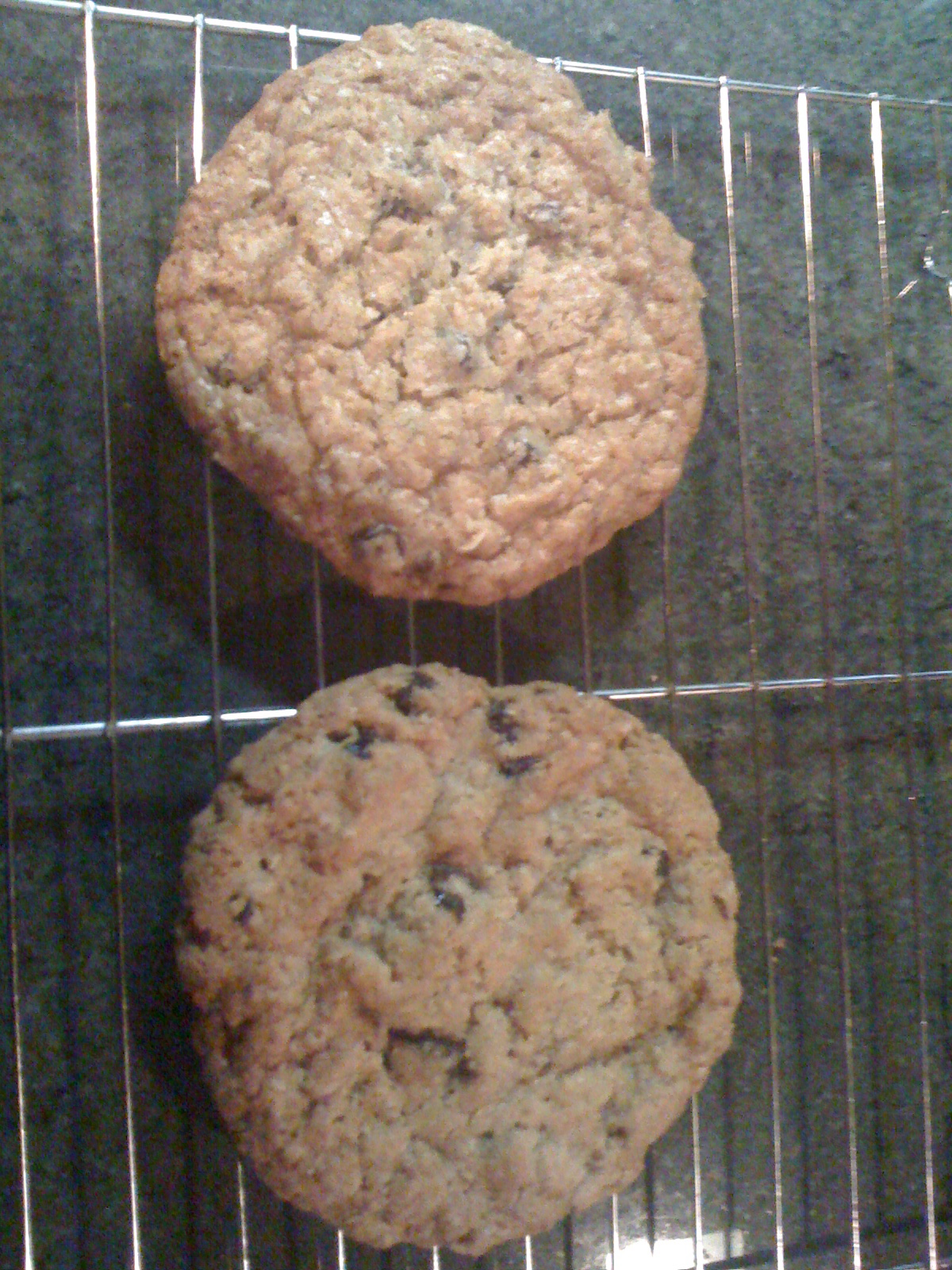
Which one is mine, and which one is Flour's? Both are delicious.
Four of these cookies became ice cream sandwiches last night for dessert. I scooped out … yikes, I’m looking through my measuring cups as a volume comparison … I’d say I put close to a 1/2 cup of softened French vanilla (from Whole Foods) between two of these 4-in. cookies and let them set for about hour. Firm cookie with firm, flavorful rich vanilla. I had been searching for cinnamon ice cream, but French vanilla was the perfect blank canvas I guess you could say to that featured the cookies’ profile perfectly.
No photos available – the cookie didn’t last long enough.
Most importantly, the point of this whole story isn’t that I made some really amazing cookies. The point for me is I had a success. In something. In a several week period where I’m feeling like an unaccomplished individual I did something right. I made something tasty. And although most of the Super Bowl crowd I hung out with last night didn’t eat my cookies, I felt pretty damn good about them myself. I may be a schlub when it comes to my day job, but I make a pretty fine ice cream sandwich.
Starting Starter, Again
February 5, 2011 § Leave a comment
Baby Dough is gone. Gone, Baby, gone.
On Friday morning I took Baby Dough out of his snuggly home in the microwave. No signs of life. No bubbles. Nothing. So I ditched him. My strategy of reinvigorating Baby with new yeasty grapes just didn’t work.
My main lesson here – just give the starter a bit more time I guess. See it bubbling away – and give it more time to bubble. It’s more of a fine art than I thought.
The other lesson – don’t name your starter. It makes it that much harder when you pour it down the drain.
Friday, 6:02 a.m. Wrapped 12 room temp grapes in a cheesecloth pouch – a few more than the Amy’s Bread recipe calls for. Smushed then a bit to break the skins. Put them in a 1-qt plastic container. Added 113 grams of 75F water and 72 grams all-purpose flour. Mixed it all together. The temp was about 73F. I screwed the top on the container and put it in the microwave with some boiled water. Remember, the heat dissipating from water warms the surrounding air – which, according to Amy, should be about 75F-78F. Like I said before, who’s house is that warm in February?
Friday, 4:58 p.m. Looking good. A thin thin thin layer of liquid is on top. But not bad. And it’s smelling a bit fermenty. Have boiled that cup of water throughout the day to keep the starter warmish.
Saturday, 9:16 a.m. There’s some bubbles – yay! So, there’s some yeasty activity going on. Smells more fermenty. Good sign. It’s been – let’s see – 27 hours. Recipe says to let it go 12-24 hours until it starts to bubble. I’m going to let it go a few more hours.
Saturday, 2:02 p.m. Hmm … bubbles disappeared. I’m thinking the yeast ran out of food to eat. So, I went on to the next step and added 113 grams 80-ish degree water and 72 grams flour. Gave it a stir. Pushed the grapes down in there. Fingers crossed!
Am I obsessing over my sour starter? Yes. I can’t help it – I can’t stand it when I fail. Can’t. Stand. It.

Sourdough Starter at 32 hours
Rye Bread: Do-Over
February 3, 2011 § Leave a comment
Thursday, 6:01 a.m. No signs of life in Baby Dough. Sad. So sad.
What did I do? Where did I go wrong? Tuesday morning Baby was full of life! Thick and gooey! Bubbly and giggly! Now … now it’s just some mass of water-soaked flour in a 1-quart container.
But, there’s no odor of death in there. It doesn’t smell toxic. Baby didn’t turn bad on me. There might not be a breathing and burping going on, but I don’t think there’s any rank, poisonous build-up taking place either.
So, I’m keeping Baby and attempting to do a Frankenstein-like operation here. I’m adding more grapes. Yeast – Baby has no more yeast (a good thing for a real child, but as a dough baby, it’s the stuff of life). Thinking back to Tuesday, Baby started going downhill once I removed the grapes. So, I’m adding them back in. Fingers crossed.
I saw a good idea from a YouTube video yesterday. Henrietta Homemaker put her grapes in cheesecloth for easy removal of the grapes. Brilliant idea. In those little grapes went, cheesecloth and all. It’s like Baby Dough has a diaper now.
So, Baby Dough is back in the microwave, tucked in there with some warm water. I’ll check on him tonight. Perk up, Baby.
Rye Bread: Day 3
February 2, 2011 § Leave a comment
Wednesday 7:37 a.m. Checked on Baby Dough. He’s supposed to be bubbly and active 12-24 hours after the last addition of flour, according to Amy’s Bread recipe. But he’s not so active. In fact, a layer of liquid has formed on top and he’s not gooey anymore. He’s runny. Hmm… Not quite sure what to do. Except put on my boots and shovel.
Wednesday 8:45 a.m. I gave him a good stir with a wooden spoon to see if I could incorporate that liquid. Big bubbles popped up right away then settled down a bit. It smells sourish – I guess that’s a good sign? I put him back in the microwave with some hot water. I’ll check back in around noonish.
Wednesday, 12:32 p.m. Baby Dough began to separate again with a layer of liquid on top. No bubbling means no yeasty activity. Hmmm… so I decided to take a leap of faith here and I went ahead and fed Baby Dough with 113 grams of 80F water and 72 grams of flour. I took Baby Dough’s temp around 11:30 and it was 77F, so that’s good. I don’t think he”s not warm enough. I just think he’s hungry. Or … maybe there’s no yeasty goodness left alive in there? Could that be? Let’s see what happens by evening.
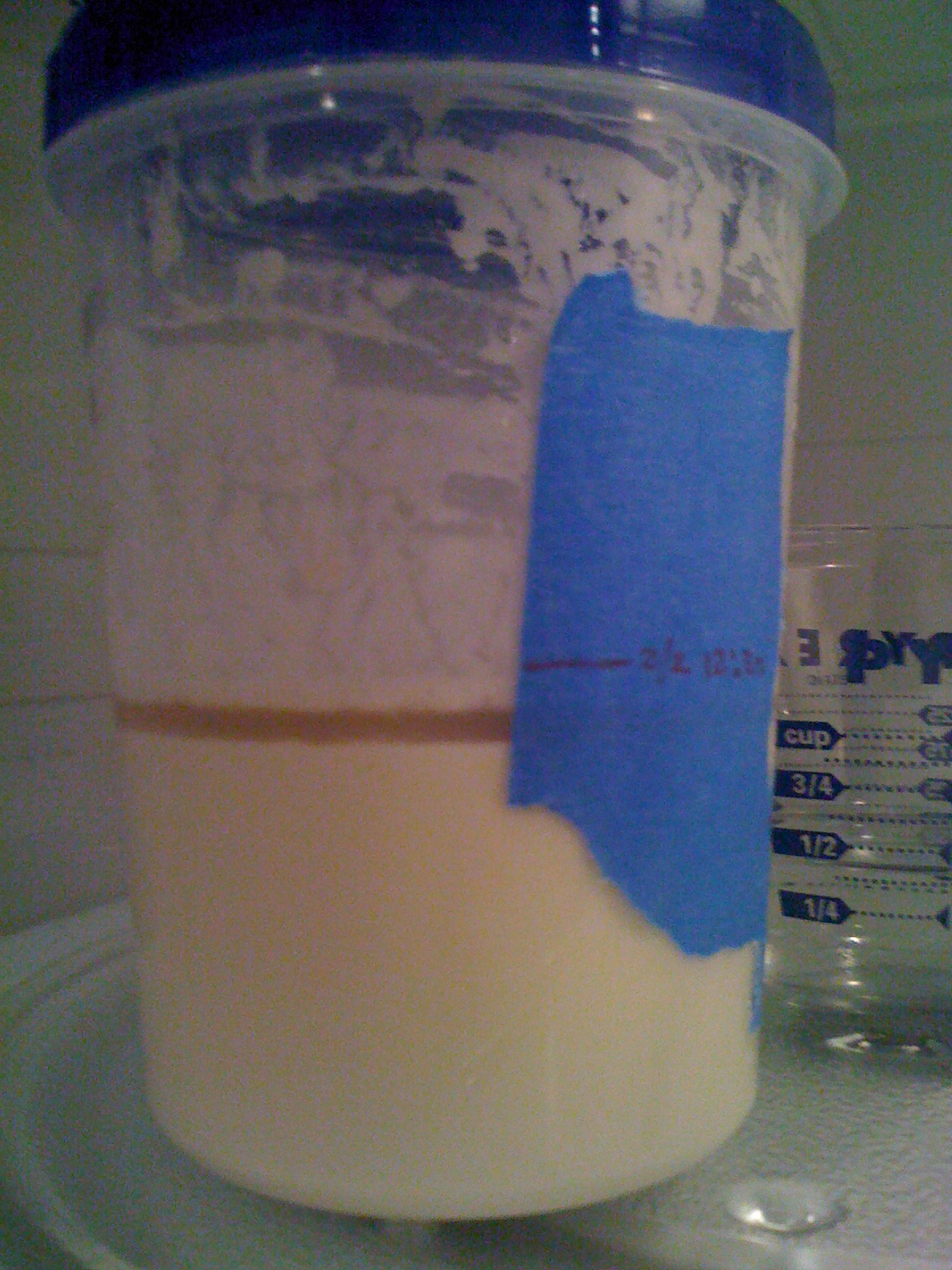
Baby Dough at 68 hours
Wednesday, 5:58 p.m. I did a little YouTubing. This liquidy layer is normal. I think. It was on YouTube, so it must be right, right? And Baby Dough is supposed to be a bit runny. I think. My thought is I don’t have a whole heckuva lot of yeasties in there so it’s not bubbling tons. But it is bubbling.
So, reading over the recipe just now, I see I was supposed to have discarded half of Baby Dough and add the 113 grams water and 72 grams flour. Hmmm… I think tomorrow morning I’ll do a do-over on this step and do it right this time.
Gave Baby Dough a good stirring. Tucked him back in the microwave with some nice warm water. Sleep tight, Baby. Bubble away.

After a good stirring, Baby Dough's blowing some tiny bubbles.
Rye Bread: Day 2
February 1, 2011 § 5 Comments
My friend Amanda’s comment on my Rye Bread: Day 1 post was this: “Amazing how you make this sound time consuming and gross… yet totally tasty and motivating!”
Little does she know what this mass of flour, water and punctured grapes has turned in to …
Here’s a brief journal of my sourdough starter experience. Consider it a journal of Baby’s First Days. And oh boy, if real babies are as slimy as this, I’m so glad I don’t have one.
(I skipped the first few hours. Perhaps I had a bout of postpartum depression.)
**
Monday. 11:21 a.m. Sourdough starter roughly 19.5 hours old. Microwave trick and dissipating boiled water have warmed the starter to 74F. The best I’m gonna get at this point.
Monday, 5:12 p.m. 25-ish hours old. Sourdough starter has turned into bubbly goodness! It smells like … grapes. Really. Yeasty. Grapes. Alas, work prevents me from tackling Step 2 at the moment.
Monday, 6:49 p.m. Still bubbly goodness, with a pleasant grapey-yeasty aroma. Added 113 grams room temperature water and 72 grams unbleached all-purpose flour. Stirred. Put back in microwave. Crossed fingers. Needs to bubbey away for another 12 to 24 hours.

Baby Dough at 26 hours
Tuesday, 6:02 a.m. Baby Dough’s big! Must have almost doubled in size overnight. Lots of big bubbles. Hmm… should I move on to the next step?
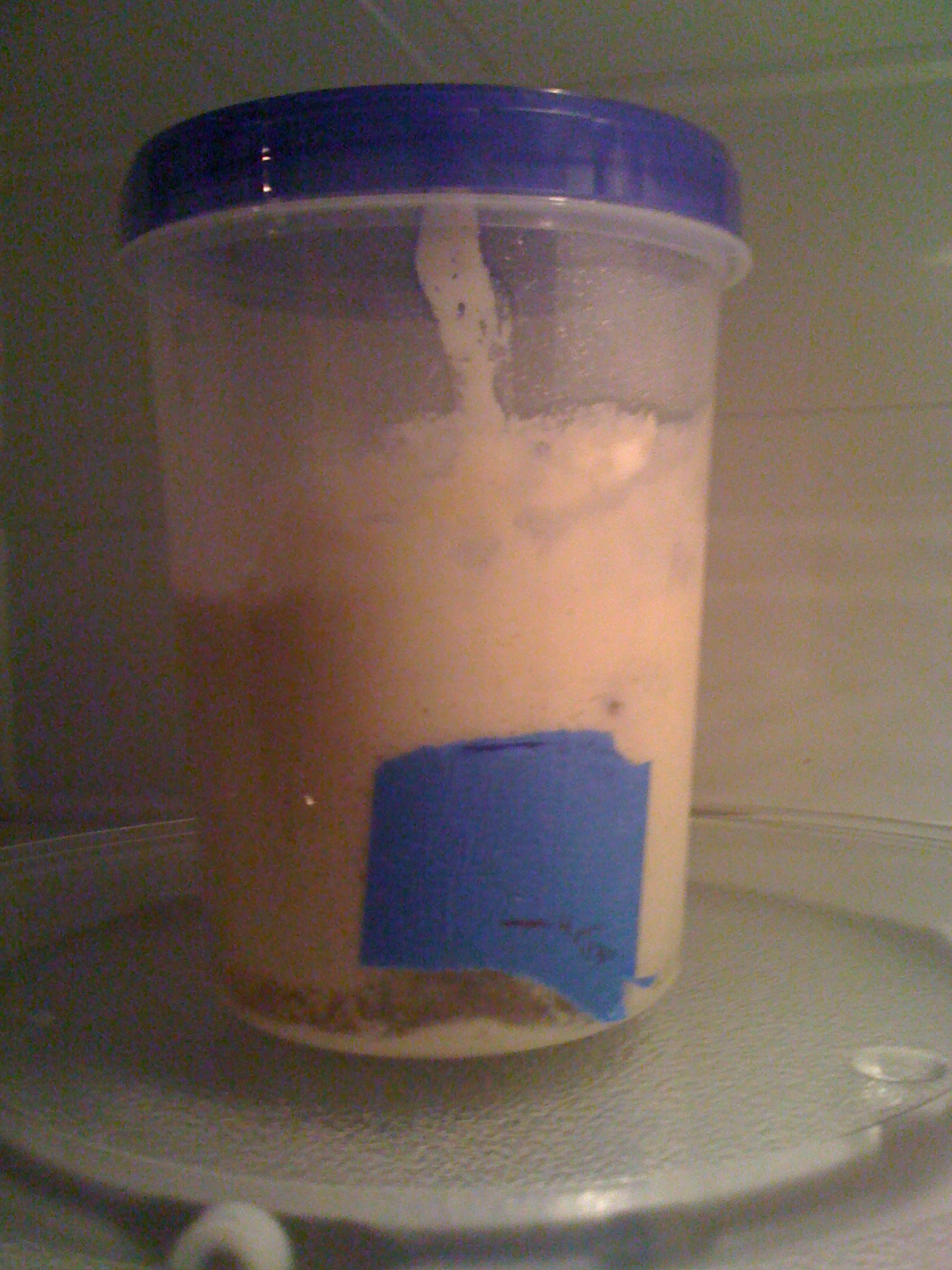
Baby Dough at about 38 hours. Such a big boy!
Tuesday, 8:27 a.m.: I decided to move on to Step 3 after only 14+ hours. It calls for scooping out the grape remnants and a bit of the starter. It’s snot. It looks like snot. It pulls like snot. It’s baby snot. Of course the grapes all settled on the bottom and I had to scrounge around with an iced tea spoon and pull them up through miles of gooey snot. Good thing was there was a layer of liquid on the bottom through which I could see all the grapes. Finding them all wasn’t so hard through the gooey yeasty snot.

Baby Dough at about 40 hours
Answer me this: Why would anyone EVER think this would be something yummy to add pulverized wheat to and then put in a container to cook over hot coals? That leap of faith from snot to baked goods—if you think about it, that crazy idea created civilization. Goo. Flour. Water. Heat. The wheel. The combustible engine. The Internet.
Added 36 grams flour. Mixed thoroughly. Put back in the microwave. Waiting another 12-24 hours.
Tuesday, 4:24. Baby Dough is 48 hours old – yay! Threw a little party, invite other doughs from the neighborhood. They are so adorable at that age …
Baby Dough’s looking a tad under the weather, a little runny. I snuggled him in the microwave with another cup of boiling water and will check back in later. For now, I’ll let him rest. Perhaps the party was too much.
 The Dainty Dot