
Vermont Cranberry Bean Salad
August 31, 2011 § 3 Comments
When I was a kid, my father would get a little stir crazy in winter and he’d do the worst thing a man with a 1-acre garden could do: Sit for hours with the Johnny’s Select Seed catalog. Fathers don’t get giddy as a rule, but I swear my dad would get as giddy as any school girl when the … um, somewhat large and heavy … box arrived. Sure, some of the seeds were for the farm: Seeds for 100 combined acres of broccoli, cabbage, cauliflower and pumpkins are a bit heavy. But then there were the items destined for our garden. Corn. Watermelon. Tomatoes. Peppers. Cucumbers. Zucchini. Squash. Yum. Yum.
But then … then there were the despised seeds: Peas and lima beans. And I swear, every single seed of those two crops came up and produced a bounty. Bleck and ugh … I really don’t like peas and lima beans. Really. Don’t. Like.
The worst part, really, and I don’t know how many of you can relate … the worst part was having to help my mother shell the bushels and bushels of pods these horrid plants would produce. You know how big a bushel is, right? It’s a lot. And now picture lots of lots. And having to take one lima bean pod or one pea pod, slicing it down lengthwise with your thumb nail, and then cajoling each pea or bean out of its home with said finger and into a pan. Pans and pans and pans of peas and beans. And Mom would blanch these mounds and mounds of peas and beans, put them into little plastic baggies, put the baggies in boxes, put the boxes in the freezers (yes, we had multiple freezers to store multiple upon multiple boxes), and then those boxes would come out of the freezer in the deepest, darkest of winter and end up on our plates. And then after dinner Dad would get out his Johnny’s Select Seed catalog and order more for the coming spring …
I really hate peas and lima beans. Really.
What did I find myself doing yesterday pre-lunch during my vacation? Shelling beans. Not a bushel, thankfully; just a gallon ziplock’s worth. The beans in question we grew in our garden this summer. No, not peas and not limas.They are Vermont cranberry beans. Beautiful pink and red speckly things. Gorgeous, really. No, I didn’t snap a pic pre-cooking. Sorry. But yes, we grew them this year—my garden plot neighbor has been growing them for years and loves loves loves them. Easy to grow. I’d tell you more about how to grow them except … well, okay, I’ll tell you. Sow the seeds about 2 inches apart in a row. Water. They will emerge. They’ll keep growing if you keep watering. I can’t even recall if I had to fertilize. It’s seriously that easy, people.
And the process at the other end of the line is just as simple, and way way way delicious. So very not a lima bean.

Vermont cranberry bean salad
Vermont Cranberry Bean Salad from Epicurious.com)
Serves 4
- 1 1/2 pounds fresh cranberry beans in pods
- 2 tablespoons salt
- 1/4 cup evoo
- 1 to 2 tablespoons fresh lemon juice, or to taste
- 2 tablespoons chopped fresh parsley or basil leaves
- ground black pepper
– Shell beans and place in a saucepan of boiling salted water. Salt the water! That way the beans really take in the flavor.Unfortunately, the boiling spoils the beans’ beautiful coloration.
– Boil the beans until they are tender. If all of your beans are picked at the same stage, they should all come along at the same time. Mine, not so lucky. To get the “more done” or more dry beans to a tender stage, the more fresh beans got a tad over-mushy. But, I kinda liked the variety within the dish.
– Drain beans and transfer to a bowl. While beans are still warm, toss with remaining ingredients and season with salt, if needed. Serve still warm for a fabulous flavor, or at room temperature.
I could eat this for days. And luckily, there’s a bunch more beans ripening when we get home.
This Morning’s Harvest, Next Week’s Meals
August 26, 2011 § 2 Comments
Okay, so I’m rushing for two reasons: 1) A big storm’s a-brewin’ and 2) leaving town for a week. What’s that mean? Gotta hit the community garden plot this morning and harvest.
Tomatoes are gonna get whipped in the storm. Pair that with the fact that they look like hell anyway (I think we have blight – that’s like having lice to me), I decided to harvest all the tomatoes except a few very green ones and rip up all the plants except the best two.
What else is on the list? Here it is:

Harvest it all! A hurricane's a-comin'!
- Cherry and slicing tomatoes in all stages of ripe- and unripeness
- Vermont cranberry beans
- Green bean
- Lettuce
- Sage
- Oregano
- Parsley
- Basil
- Yellow and green chard
- A cabbage
- A big ol’ purple carrot
- A zucchini – full disclosure: It’s not mine – another gardener gave it to me.
*Missing from this list are a handful of Hungarian wax peppers and a yellow squash. They were camera shy.
All of this will be processed in some form or another – along with a boat load of beets I harvested last week – in the coming week. Stay tuned!
Any suggestions? Anyone have experience frying sage leaves? What should I do with a huge purple carrot? Leave a comment, let me know.
Roasted Vegetable Lasagna
August 14, 2011 § 1 Comment
Sometimes … sometimes I just want to eat bad things. Good-tasting things but bad for you, or your waistline. Fried chicken. Wings. A big drippy pulled-pork sandwich. A pile o’pasta.
But if it’s homemade, I hear, it’s half as much calories, conveniently. At least that’s what I tell myself. And if it has vegetables in it, well … then it’s downright a health food.
So that makes our roasted vegetable lasagna not only calorie-free but good for you, too. And the best thing about this recipe is it’s a combination of three previous posts. Brilliant!
Recipe
- Roasted vegetables of your choice
- Homemade pasta
- Roasted cherry tomato sauce
- 1 lb. ricotta cheese
- 1/2 lb. chard
- 1 tsp nutmeg
- 3 balls of fresh mozzarella, thinly sliced.
- One rectangular casserole dish, what are they, 8×13?
NOTE: If you’re not making your own pasta … and really, you don’t have to … buy the lasagna sheets that you don’t have to pre-boil. A few cents more, but really, the convenience is worth it.
-Our roasted vegetables of choice for this lasagna are yellow squash. We sliced it into 1/4-in. slices, lengthwise. Glug of evoo, salt and pepper, and roast at 425F for 6 minutes each side.When done, set aside.
-Roasted cherry tomato sauce – just as the recipe says. You may want to puree it.
-Homemade pasta … prepare just as the recipe says. Make the sheets to fit half the width of the pan.
We have the sauce, the pasta, the veggies. Oh, wait – one more vegetable.
-Chard. Stem it and then steam it for 1 minute, 2 minutes max. Let it cool. Squeeze the water out of it. And chop. Set aside.
-Put the ricotta into a medium bowl. Add the chopped chard, nutmeg and a pinch of salt and combine. That’s your cheese filling.
Now it’s time to assemble! It’s all about layers. Get the layers, get the lasagna.
-Lay down a thin layer of sauce. Then top with two lengths of pasta sheets. If you crank out the pasta as you go, you can cut the pasta to the correct length. Top the pasta with some roasted vegetables. For the squash, we fit 4-5 lengths of squash per layer.
-Next, spread some of the ricotta – as much as you’d like – over the veggie layer. Dot with slices of mozzarella. A little cheese, a lotta cheese – whatever you want.
-Add another layer – sauce, pasta, veggies, cheeses. You can make as many layers as you have ingredients for. Three or four is typical. Just keep going until you fill the dish and have absolutely no more room.
-When you are done layering, you’re going to top with a layer of pasta, then a thin coating of sauce. Then top with as much mozzarella cheese as you like. And a dusting of parmesan, too. Done!

-Cover with aluminum foil. Pop into a 375F oven for 25 minutes. Remove foil and cook for another 15ish, or until the sauce and cheese are bubbling.
-Let it sit for 10 minutes.
Try not to make a pig of yourself at the dinner table. Really, you’re better than that.
Pasta Dough: It’s Easier Than You Think
August 10, 2011 § 6 Comments
Mmmm … fresh pasta.

Fresh linguini - the flour lightly dusts the pasta, keeping it from sticking together.
Have you ever had it? I mean fresh pasta. The kind someone has just made right there in the room. Not the stuff you buy in the refrigerated section of your local grocer. Okay, so that’s not dry pasta—but it’s not fresh fresh either.
What? Are you saying, “I don’t have time for that … “? Or, “Oh, that’s soooo complicated …”? It’s not. If you liked to make mud pies as a kid (and who didn’t?), then you can make fresh pasta.
Of course, I say this not having made fresh pasta myself. Jennifer is the pasta maker in our household. And she makes it look easy. She says it’s because it is easy. She first made it in a cooking class last year, and the technique below is from that class. The recipe comes from The Food Network’s Anne Burrell.
Try it. The only way you can screw it up is by making a horrible sauce.
Homemade Pasta Dough (from Anne Burrell)
- 1 pound all-purpose flour (get yourself a kitchen scale!)
- 4 whole eggs plus 1 yolk
- 1/4 cup evoo
- kosher salt – about 1 Tbs
- 1-2 Tbs water or more
-Set yourself up on a clean and dry work surface with plenty of room. Pile the dry ingredients (flour and salt) right on the work surface, and create a hole or well in the flour, making a doughnut-shaped ring about 8 inches wide.
-Crack all of the eggs and the individual yolk (I always do this in a separate bowl to catch the occasional shell) and add these to the well along with the wet ingredients—olive oil and water.
-Use a fork to beat the wet ingredients together. Then, you’re going to pull in the flour bit by bit into the egg mixture. I say bit by bit because you don’t want to pull too much of the flour into the center and break the ring’s side walls. Then your egg leaks out and it’s a big mess. As soon as the egg mixture has enough flour in it is no longer runny, you can put aside the fork and get your hands in there. Your hands are the best tools to combine everything completely.
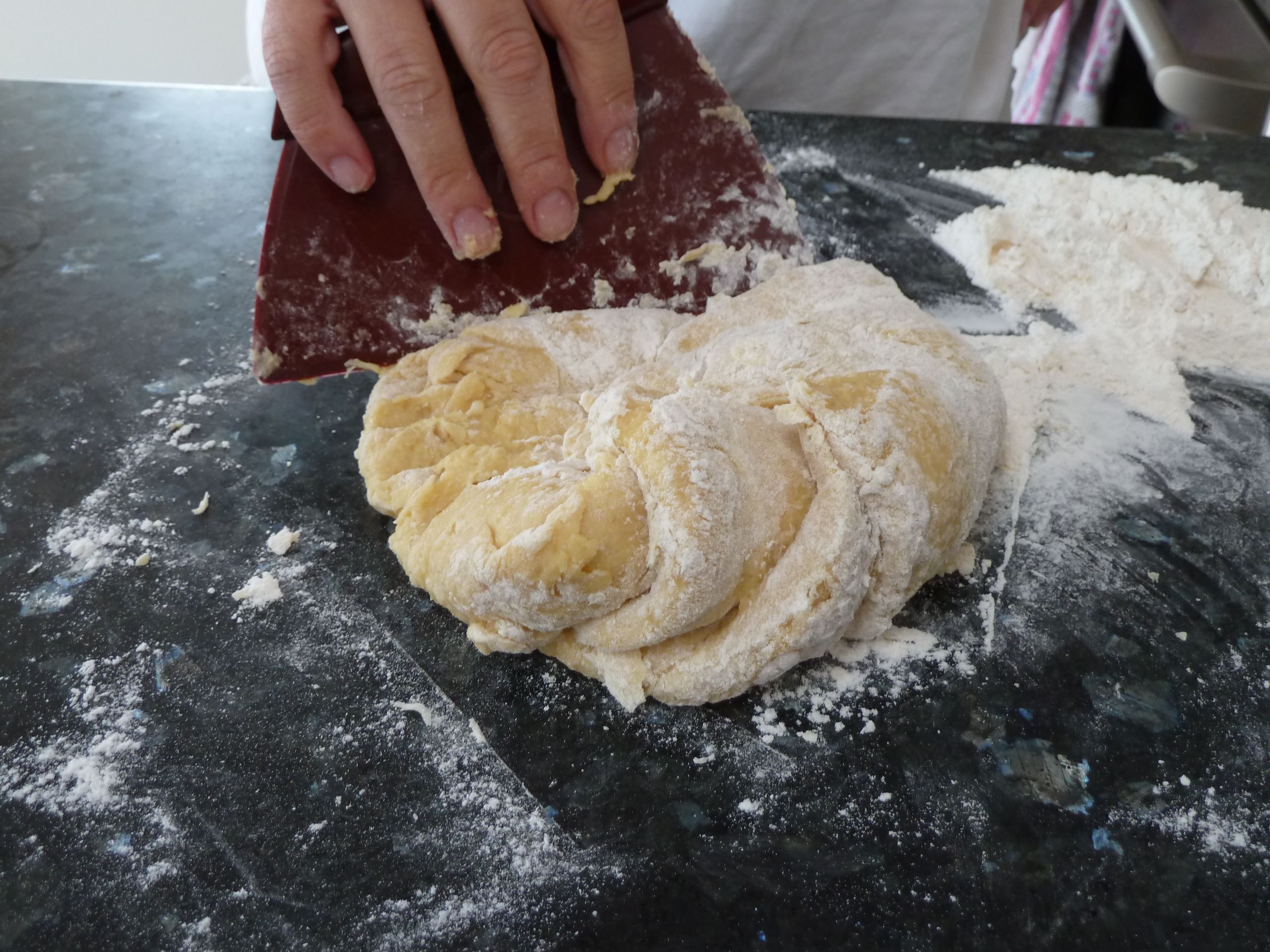
Incorporating the flour into the egg mixture
-When the mixture is completely combined, it’s time to start kneading the dough. Use your muscles! Get the heels of your palms in there push the dough away from you, stretching it but not tearing it. Push, fold, turn. Push, fold, turn. Put your weight into it, girl! Your goal is to create a dough that feels smooth and looks smooth. Warning: Eat an energy bar beforehand because you’re going to be kneading for 15-20 minutes. No kidding. But doing this by hand is the best way.

Knead it, girl!
-When you start thinking that perhaps you’re done, take a knife and slice the dough in half. Look at the inside of the dough—does it have small bubbles in it? Yes? Then keep kneading. You want the dough to be smooth throughout.
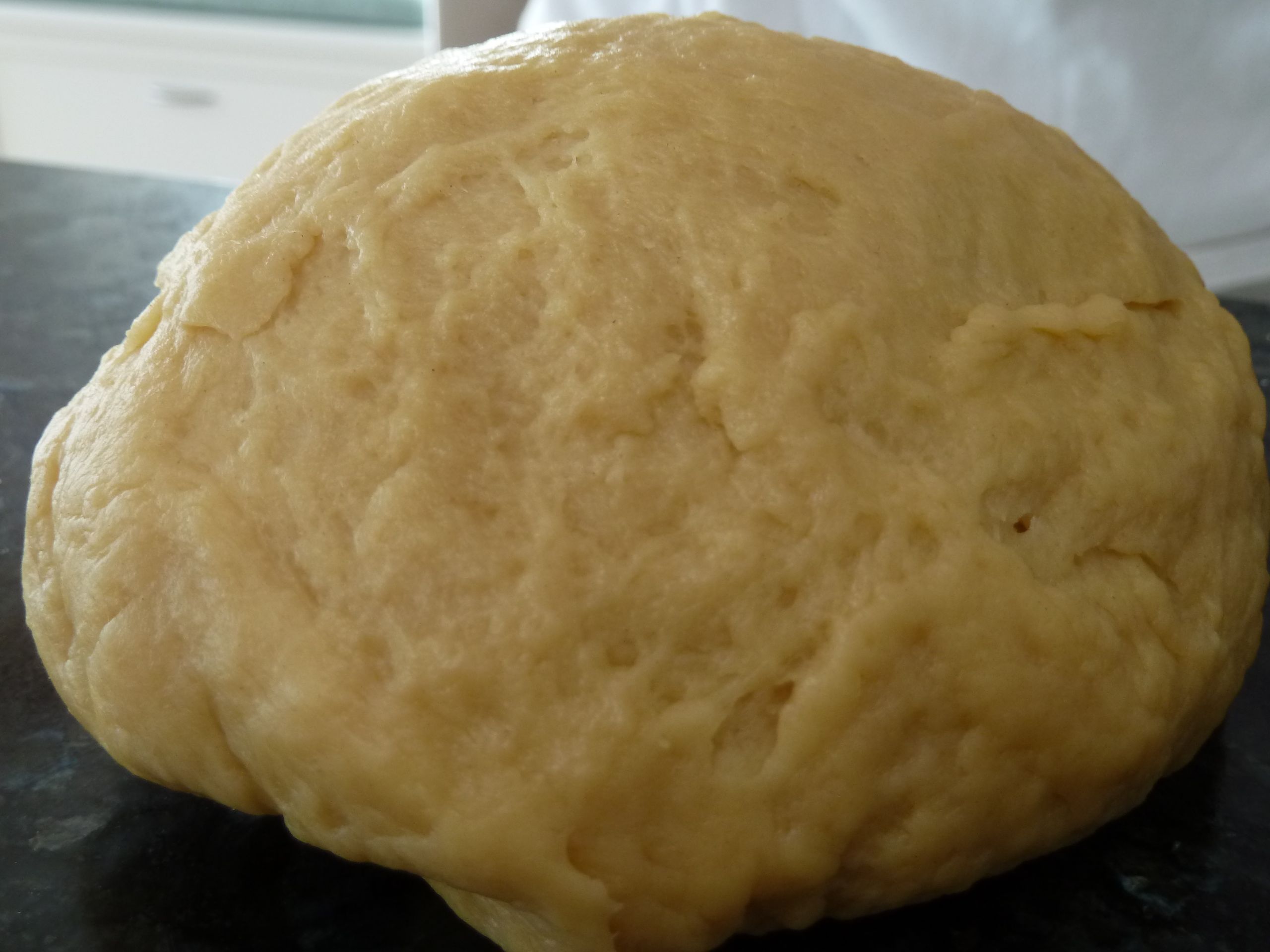
-Wrap the dough in plastic wrap and let it rest for 1 hour. Put it in the fridge until you’re ready to use, or use it right away.
What next? Get rolling! Usually this is done with a pasta roller. There are ones you can attach to your counter and crank by hand. We have one that fits on our Kitchen-Aid and turns automatically—so much easier. Either way, what you want to do is cut that ball of dough into quarters or eighths, pat it into a bit of a square shape of even thickness, add a touch of flour to make it less sticky, and run it through the pasta roller starting on the thickest setting—usually the number 7. Roll it through twice, then take it down one thickness, and so on, patting it with flour now and then. We usually go down pretty thin, usually to a number 2. As it gets thinner, it gets looonger. We usually cut it in half to make it more manageable, especially if you are cranking the roller by hand.
Going through the roller you end up with a flat sheet. Perfect for making lasagna or raviolis. Or, take that sheet and run it through the spaghetti or linguini cutter (an add-on that usually comes with the roller). Separate the noodles, lay them on a platter, sprinkle with dusting of flour, and toss to prevent sticking. Do one flat sheet at a time this way, each time dusting with flour.
And to cook, all you have to do is drop that pasta in boiling water for 2 minutes, max.
Now, that’s great pasta.
Spicy Eggplant Relish ala Moosewod
July 22, 2011 § 1 Comment
One of the things we do when we spend time in Provincetown is head over to the Saturday farmers market. This time of year the stalls offer some great fresh produce we haven’t seen locally since last summer. This time we picked up two smallish eggplants. Versatile! Yummy! Pretty! Eggplants are all of the above … And also a bit short-lived on the countertop, especially in weather like this.
What to do with them? We could grill. We could stuff. We could make lasagna. We could bread. And we did none of those. Instead, when they began getting “long in the tooth,” we turned to an old standby – spicy eggplant relish.
I pulled this recipe from my Moosewood cookbook a few years ago for a get-together and used it as a dip. It got a great response. We used the leftovers in numerous ways, such as a spread for sandwiches, and also as an eat-by-the-forkful snack. Can’t remember exactly which Moosewood cookbook it came from, possibly the original. Luckily its a popular recipe and we were able to find it online – hey, we’re on vacation, we don’t travel with old cookbooks.
Recipe
2-3 Tbs olive oil
1 medium onion
1 small red pepper, large dice
2 small-medium eggplant, small cubes, don’t bother peeling
Salt, pepper and cayenne to taste
-heat oil over medium-low. Add onions and sautée until softish, 4-5 min.
-add cubed eggplant and red pepper. The eggplant will soak up a lot of the oil. Stir really well to coat all of it. Let it cook low and slow. Add a generous pinch or two of kosher salt and several turns of fresh pepper.
-Let it cook down awhile – 5 min or so. Add in as much cayenne as is appropriate for you. Cook partially covered for another 4-5 min.
-is the eggplant soft? Take it off the heat. Season with salt/pepper if needed.
We ran into one small problem during this – there was no cayenne in the house. How is that possible? We made due with some chili powder and red pepper flakes. The chili powder gave it a smoky flavor, making it a bit more savory. It was a good addition, actually. I added a bit too much red pepper flakes. Adding a small sliver of cheese when serving on a cracker will take care of that. Looking forward to having this in a tofu wrap for lunch. Perfect beach food.

The Ever-Versatile Roasted Vegetables
May 11, 2011 § 7 Comments
I don’t share Dainty with my real-world colleagues as a rule. Not sure most would approve of Dainty’s exploits. But my super-awesome colleague Chris T.—the designer of the Dainty Dot logo up at the top of the page—is definitely Dainty worthy.
So when Chris T. told me yesterday that I use a lot of—too many?—ingredients, I considered it. Do I really? Salt, pepper, oils and vinegars not withstanding, I’m mentally going over my recipes and counting up. The Steel-Cut Oatmeal I’m currently eating definitely doesn’t have that many ingredients—oats, raisins, slivered almonds, maple syrup. Okay, yeah, that’s a lot for a simple breakfast. Plus, it takes 20-plus minutes to prepare. But at least you can shower while it’s cooking—that’s something.
Chris T., to show that Dainty can prepare a flavorful dish with simple ingredients and instructions, I humbly present this for your consideration: Roasted Vegetables.
It doesn’t matter what it is—beets, leeks, broccoli, and old tennis shoe—you add EVOO, salt and pepper, put it on a baking sheet or cast-iron pan in a 42F oven and you’re going to end up with something tasty. You can skip the oil maybe, but why? If anything, it helps prevent the veggie from sticking to pan. The salt and pepper add flavor, yes, but the salt also helps to draw out the vegetable’s own juices. The high heat caramelizes those juices, so you end up with a tasty savory sweetness. Want to get your children in the habit of eating veggies? Don’t serve them bland boiled bleck—lightly roast some carrots or cauliflower and let them have at it. I don’t have children and I’ve never tested this theory so it might be bunk, but you never know. Give it a try.
Roasting vegetables is my go-to method when it seems there is absolutely nothing left to cook with in the house. There’s always something—a sweet potato, an onion or leek, a pepper, something—laying around that, with a little high heat, salt, pepper and EVOO, can be incorporated into a meal. If anything, they can be tossed with penne for a simple pasta supper.
Do you need instructions? Really? Okay, here they are.
Roasted Vegetables
-Firm vegetables work best. Sweet potatoes, potatoes, cauliflower, broccoli, winter squashes, onions, leeks work really well. Summer squashes such as yellow and zucchini, are good, too. Tomatoes … I typically use cherry tomatoes and put them in a medium-sized cast iron. They’ll burst, beware. But the flavor is phenomenal. Be forewarned—the acid will mess up your cast iron’s patina a bit. Clean immediately.
-Set your oven to 425F. I never rely on the temp gauge—your 425 may be hotter than my 425. So keep an eye on the veggies the first time you roast them to get a good idea of how your oven works.
-Veggie prep: The secret is to cut the veggies into uniform pieces for even cooking. All the sweet potatoes should be about the same size. Easily enough to do. When chopping the onion, leave them in relatively big chunks. No dicing. Broccoli and cauliflower can be kinda tricky to get into even sizes. But if some get more crispy than others, hey, that’s ok—it’s all tasty.
-Put your veg in a medium to big bowl, depending on how much you have. Add olive oil—I tip the bottle down and go once around the bowl for a small amount of veg, two to three times for more veg. Add one to two large pinches of kosher salt and several turns of a pepper mill. Toss to coat. Your hands are fine, or a wooden spoon or tongs work too. I prefer hands. Spread out evenly into a single layer in a cast-iron pan or rimmed baking sheet. Single layer! You want each veg to get in contact with the hot metal. Put in the oven and close ‘er up.
Note: What’s a large pinch? It’s a pinch that uses your thumb and your index, middle and ring fingers. It’s one finger away from a small grab. Go ahead, try it.
-Roasting time: Well, now, that all depends on what you’re roasting. Broccoli—2o minutes. Cauliflower—20-25 minutes. Beets, same thing. Sweet potatoes—up to 40 minutes. Butternut squash—35-40 minutes. Onions, leeks—15 maybe? Same with summer squashes. Asparagus, maybe 10 minutes. The softer the vegetable, the less time it takes. For softies, I check them at 12 minutes and then gauge from there. The harder the veg—like sweet potatoes—the longer it takes. For broccoli and cauliflower, I check them at 10 and give them a shaky toss. If you’re roasting a two or more different veggies—like broccoli and onions—on the same pan, I separate them so it’s easier to remove one if it’s done ahead of the other.
-When’s it done? When they turn a nice golden color, especially around the edges. Broccoli’s florets will begin to get a bit dark. That’s ok. Are the stem parts firm yet edible? You don’t want them to be floppy, but you want to be able to chew them without an awful crunch as if they are raw. Squashes—you should be able to stick a toothpick or fork into it easily but it shouldn’t be mush. Get the idea?
This weekend we made a simple pasta meal with roasted broccoli and onions and sun-dried tomatoes. We took a small handful

Roasted broccoli and onions with sun-dried tomatoes over pasta
of the tomatoes and put them in a bowl of maybe 1.5 cups of boiling water. Let them sit there while the broccoli and onions roasted and the pasta water boiled. Just before the roasting was done, we took out the tomatoes and gave them a rough chop, then threw them in with the drained pasta, a 1/2 cup of reserved pasta water and the roasted veggies. We served with a bit of Parmesan cheese. Delicious. Want some meat with that, you meat-eaters? We’ve had similar dishes where we’ve added a link or two of Al Fresco chicken apple sausage cut into bite-sized pieces.
Pasta, quinoa, bulgar, rice … whatever you have, as long as you have a veggie or two around and know how to roast it, you’ve got yourself a meal. And one with not that many ingredients.
Potato Kale Soup
April 11, 2011 § 3 Comments
Dainty’s been back from California a week, but still hasn’t gotten in the groove. Catching up on work, volunteer meetings, dinners out, etc, have given me zero fodder for posting. And you’d think with a weekend just behind me, I’d have plenty to write about. I think maybe I made a batch of steel-cut oatmeal for breakfast—that’s about it. And a loaf of bread, but it was a workhorse kinda loaf—nothing spectacular.
I spent the weekend working on a homey project—painting the window well in the bedroom. Sure, I saved several hundreds of dollars doing it myself, but I sacrificed several million brain cells in the process (just say no to paint fumes). It’s a project that’s been on my list for about a year and I’m glad I got it done. And while I was scraping and painting, Jennifer was making a big batch of vegan soup to weekday lunches. And this is a good one.
Potato Kale Soup
- 1 tbs evoo
- 2 cups onions, chopped
- 2 leeks, washed and sliced thinly (chuck the dark green parts)
- 6 cups water
- 4 medium potatoes, cubed
- 2 tbs parsley, minced
- 3 carrots – whole
- 3 ribs celery – whole
- 2 bay leaves
- 1 tsp salt
- 1/4 tsp pepper
- 1/2 lb. kale, washed, torn and ribs removed
-Heat oil in large soup pot over medium heat. Saute onions and leeks until soft—abou 10-15 minutes.
-Add potatoes, parsley, whole carrots and leeks, bay leaves, salt and pepper. Boil, cover and simmer over medium low for 45 minutes.
-While that is simmering, cook kale in 2 cups boiling water in a skillet. Cover tightly and cook for 4-5 minutes until tender. Drain and set aside.
-After 45 minutes, remove carrot, celery and bay leaves from soup. Reserve the celery and carrots but chuck the bay leaves. Puree half the soup in a blender. OR, an immersion blender is awesome for this—just whirr up (who says that? Jamie Oliver?) half of it right in the pot. Stir in cooked kale. Chop up the carrots and celery and return to the pot. Heat the soup through again. Salt and pepper it if you need to.
Tada! A vegan alternative for lunch. Sounds like this could use some bread. I think I’ll do that right now.
Lentil-Bulgur Salad ala Moosewood
March 22, 2011 § 4 Comments
Bulgar? Bulgur? Bulghur? However you spell it, society at large has been hiding this absolutely spectacular whole-grain from me. If you are to believe movies such as The Adjustment Bureau, the men behind the curtains controlling my life have seen to it that bulgur shall never be placed in front of me. Ever. Never had it. Never saw it. Was never even tempted.
That is, until one Sunday morning a few months ago. I was tidying up the house with Food Network on in the background and Ba-Da-Boom Nigella Lawson made a bulgur dish to accompany a Moroccan meal. And if Nigella likes it, well … I gotta give this stuff a try.
Forget for a moment it’s a whole grain and nutritious and etc. It tastes good! It’s got a great consistency! And it plays well with others. In today’s recipe—and yesterday’s, too, actually—bulgur plays really well with lentils. So well, it’s like they are playing doctor, if you know what I mean.
This recipe is from the Moosewood Cookbook. I’ve eaten at the Moosewood, by the way, back in the mid 90s. And it’s true what they say—terrific food, the service coulda been better (they didn’t place my order. At. All. And that was just one of many examples). But, seriously good food. And if you can chop, you can make this stuff.
I made this for the first time Sunday. And my first reaction after tasting was, “ARE YOU KIDDING ME?? I just made this from that stuff??” I’m not kidding you, this stuff is taste on a plate.
A coupla notes: 1) Omit the feta and it’ll be vegan. 2) Serve at room temp – it has better flavor. 3) Stuff it in pita … yum. 4) I didn’t add the olives. I don’t think I had any and I forgot in general. 5) It’s a perfect protein. Oh yeah.
Lentil-Bulgur Salad
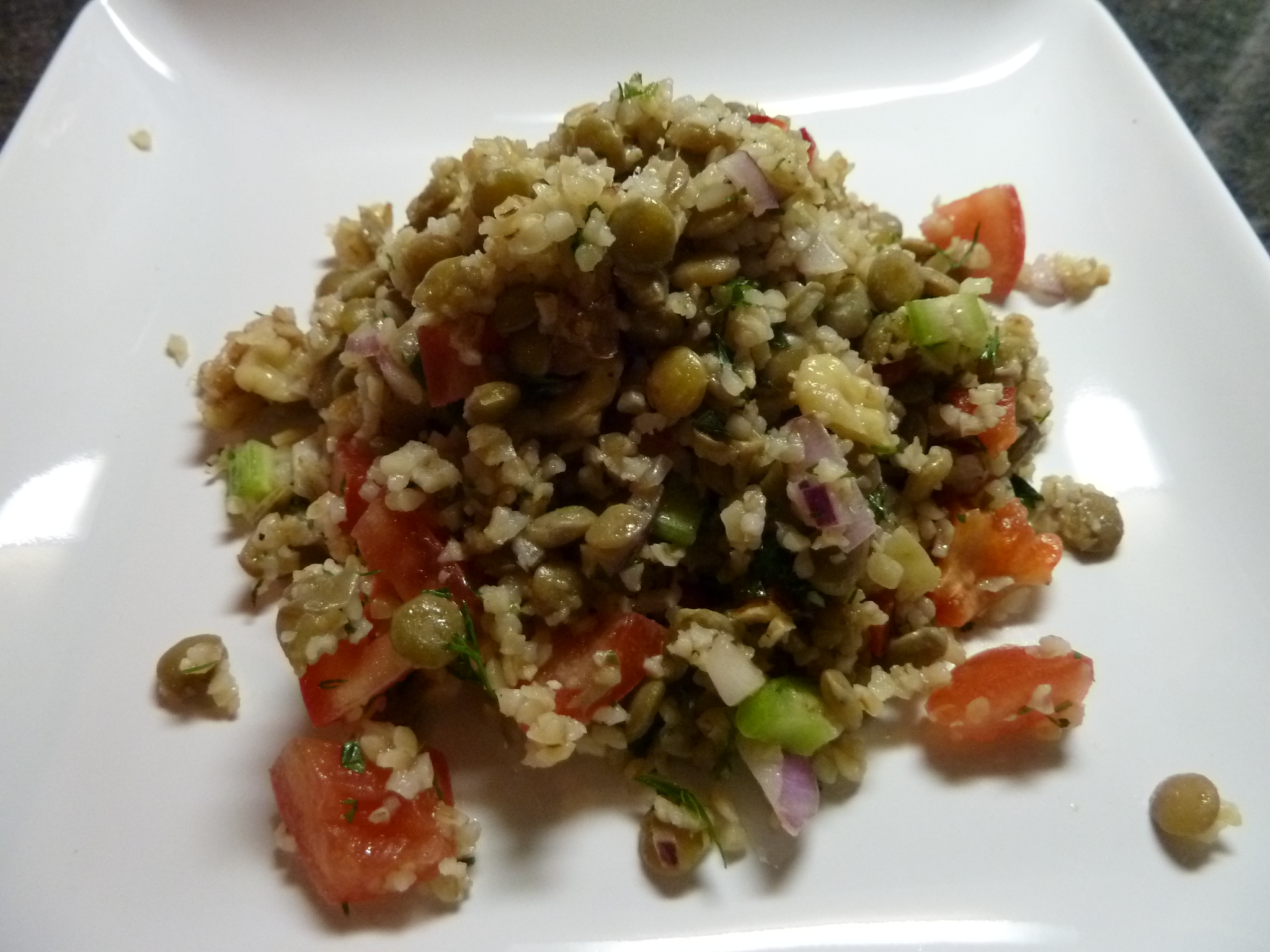
Lentil-Bulgur Salad
- 1 cup dry lentils (use green!)
- 2 cups water
Put lentils in small saucepan. Add water (and a pinch of salt). Bring to just boiling. Turn heat to low and simmer, partially covered, for 20-25 minutes until tender but not mushy. Drain well and place in a large bowl.
- 1 cup dry bulgur wheat
- 1 cup boiling water
Place bulgur in a small bowl. Boil a cup of water (microwave is fine) then add it to the bulgur. Give it a swirl. Cover the bowl with a plate. Let it sit for at least 15 minutes. That’s it.
Now comes choppin’ time. Add all of this to the lentils:
- 1/4 cup olive oil
- 1/4 cup lemon juice (I used juice of one lemon)
- 2 medium cloves garlic, crushed
- 1 tsp salt
- 1/2 tsp oregano
- 2 tbsp freshly minced (or 2 tsp dried) mint (do not skip this!)
- 2-3 tbsp freshly minced (or 2-3 tsp dried) dill
- fresh black pepper to taste
- 1/4 cup freshly minced parsley (I broke off a hunk of my frozen parsley)
- 1/3 cup minced red onion
- 1 small bell pepper
- 1/2 stalk celery, minced
- 1/2 cup crumbled feta
- 1/2 cup nicoise olives (oops, forgot those)
Stir those around and add the bulgur, too. Now add:
- 1 medium tomato, diced
- 1/2 cup chopped toasted walnuts
Fold that around. Give it a taste.
Right? I TOLD you. That’s flavor that’ll make your Greek grandmother weep.
Turkish Red Lentil Soup
March 21, 2011 § 6 Comments
So, about that two-thirds vegan diet … Oh, no worries, we’re still on it and still successful. Yay us! There is one small side effect, however, that I need to address. I get a vacant-minded, mad-hungry feeling around lunch time, and no matter how much I eat, I’m still kinda not all there. I’m thinking I may need more protein around then.
I’m no nutritionist, but I do know that a not-so-magical combination of certain beans and grains form a perfect (or close to it) protein. Do red beans and rice stave off the protein cravings enough so you don’t go chasing the nearest cow? I’m pretty sure they do.
In search of a protein-packed lunch option, two recipes found their way to me. The first just happened to be one of many Turkish recipes found in last Wednesday’s Boston Globe. Middle Easterners boy, do they know how to make huge flavors in vegan meals. Below is the recipe with a few changes as noted.

Turkish Red Lentil Soup
Turkish Red Lentil Soup (Ezogelin in Turkish)
- 2 tbs butter (I used a couple swigs olive oil)
- 1 small onion, chopped
- 1 tbs tomato paste (what to do with the rest of the can? freeze it)
- 1/2 cup bulgar wheat
- 2/3 cup red lentils
- 7 cups chicken stock (we used veggie stock)
- 3 tbs dried mint (couldn’t find any! so we used minced fresh, about 3tbs)
- 1 tsp dried thyme
- 1/4 tsp crushed red pepper
- salt & pepper to taste
-In a soup pot over medium heat, heat up butter or oil. Cook up onion until softened, about 5 min. Stir in tomato paste until blended in – 30-60 sec.
-Add bulgur, lentils and stock. Boil then simmer on low heat, pot covered. Let it simmer for about 30 min until lentils and bulgur are tender.
-Add mint, thyme, red pepper, salt and black pepper and simmer a few more minutes to meld the flavors.
Use RED lentils, not green. Red lentils tend to break down further than green, creating more of a mush or, when in a soup, it’s more of a thickener. You can use green but, well … I wouldn’t, not for this soup.
We actually had this last night for dinner, served with hunks of fresh bread (I’m still baking!) and a side of lentil-bulgur salad—another high-protein dish. I’ll give you that recipe tomorrow. That is a seriously tasty salad.
Lentil Soup with Spinach
March 14, 2011 § 2 Comments
It turns out—now that we are paying attention—a number of our on-hand recipes are vegan. While it’s nice to cruise online looking for appropriate recipes for our new two-thirds vegan lifestyle, we need only turn to our own recipe collection to find something without meat, fish, dairy, etc.
Jennifer’s Red Lentil Soup with Spinach, for example. She collected this recipe from a local adult-ed class on soup making she attended 10-15 years ago. She just recently found it again, after I had made a batch of the Moosewood lentil soup. Lentils are pretty friggin’ amazing, if you ask me. It’s my favorite dry bean, if only because you don’t have to soak it any more than 30 minutes, which you can easily incorporate into the cooking process (see below). The addition of the spinach is inspired, tasty and I am sure, good for you, as well.
Ingredients
- 1-2 TBS evoo
- 1 onion
- 1 large carrot, diced
- 2 ribs celery, diced
- 1 cup red lentils, rinsed (I guess green would be fine, too)
- 4-5 cups water
- 1/2 tsp EACH of thyme, oregano, basil
- 1 tsp salt
- 1 lb. spinach or Swiss chard, torn into pieces
-Saute the onion in the oil over medium heat. Add the carrots and celery and saute another few minutes until just soft.
-Add the herbs, lentils and 4 cups of the water. Bring to a boil, reduce heat, and simmer 30-40 minutes. Stir occasionally to prevent sticking on the bottom. If it’s too thick for your liking, add up to a cup of water.
-When lentils are soft, add the salt and spinach. Stir. Cook for another 2 minutes.
Jennifer likes to add a swirl of sherry vinegar on top of her bowl of soup. I add a dash of balsamic vinegar. Try it without the vinegar first, then with the vinegar. The addition really pulls out the flavor of the lentils and adds an acidic brightness. You’ll also want to keep a slice or two of fresh bread on hand for dunking.
You may want to double the batch. This soup is even better in subsequent days, and is nice as your vegan lunch dish.
 The Dainty Dot