
Homegrown Food Challenge—Days 6 & 7
October 21, 2011 § Leave a comment
No, we did not whither away and die from lack of food after Day 5 of our Homegrown Food Challenge. We survived quite nicely, thank you very much. I’ve just not been … well … in the blogging mood, I guess. If you’re a blogger, you’re pickin’ up what I’m puttin’ down. Hey, it happens. I’m back on track now, though, no worries.
Breakfast:
Day 6—it was all the way back last Saturday. I had promised we’d kick it up a bit with something for breakfast that was more interesting than yogurt. And we did—omelets! Not an omelet, per se, but more of a flat egg. That’s what my mom called them when I was growing up. It’s just two eggs, slightly beaten and NOTHING added to the eggs, as you would were you making omelets. Just a straight ol’ egg. We added in some local goat cheese and diced homegrown tomato right at the last second, folded and called it breakfast. A slice or two of toasted homemade bread made it a filling meal.

Lunch:
After, Jennifer took off for the weekend to attend to some business, leaving me to fend for myself. Lunch was … honestly, I can’t remember. Must have been the last of the grilled eggplant paninni … yum … By the way, that post was way popular. Way. Popular.
Dinner:
Dinner was when I got creative on Day 6. Earlier in the week I had cooked up some homegrown Vermont cranberry beans. Used the pressure cooker, actually, and the process yielded some terrific bean broth. Add some homegrown leeks, homegrown carrots, and a neighbor’s small bunch of homegrown celery, and it’s the beginning of soup! I added to that the leftover Vermont cranberry beans, some leftover homegrown/homemade tomato sauce, a fading homegrown zucchini and a couple of locally grown potatoes—along with salt, pepper, homegrown oregano and sage. Soup and bread for dinner—the end of a great gardening day.

Day 7
Our weeklong Homegrown Food Challenge ended not with a big banquet ala Julie and Julia, but on a much more common, everyday note. Plans for going out with a bang—lasagna of homemade pasta, homegrown broccoli, eggplant and kale—faded with the afternoon. Instead we hunkered down, ate our soup and toasted our accomplishment with the last of the local beer.
Next year … I truly wonder what that will bring.
Homegrown Food Challenge—Day 4
October 15, 2011 § 1 Comment
Day 4 … halfway through our week of eating and drinking stuff as homegrown and as local as possible. How’s it going? Great. In fact, we might have too much food. Well, we’ll make it to the end, definitely.
Okay, I had promised some scintillating breakfasts. Not happening on Day 4. The morning meal, to me, is utilitarian. I know, that’s the wrong way to think about it. You’re supposed to eat breakfast like a king, lunch like a queen and dinner like a pauper. Or something like that. I honestly don’t have the stomach for breakfast until, say, 9 am.
Day 4 was a whole two days ago. Let’s see if I can remember what we had.
Breakfast:
Flat Black coffee. Maine’s Own Organic Milk. And honestly, I may have had an apple. I know it wasn’t much. I was kinda busy and on a role with things, work-wise. Sometimes that happens. Kids, eat your breakfast and don’t be like Auntie Dainty.
Lunch:
Lunch … I have to say what I made for lunch was the best thing ever constructed out of two pieces of bread. Seriously. Some cookbook-writing chef is going to see my delicious creation and will put it front and center in his/her lunch options.

It’s a grilled eggplant and tomato paninni with smoky mayo. Recall the smoky mayo originally topped the broiled bluefish on Day 2. Imagine that spread not-too-thinly on two slices of homemade sourdoughish bread. And remember the eggplant on the grilled pizza from Day 3? Lay a couple of those grilled eggplant slices down on top. Add some sliced tomato, top with another mayo-slathered slice of bread. Put a bit of olive oil in a hot cast iron pan. Lay down the sammies. And add some wait to make them “pressed sandwiches.” In this case, I used a very heavy Dutch oven. Grill both sides to a nice crispness. Smoky mayo+grilled eggplant=the world’s perfect pairing. I wanted to share it with everyone and no one all at once.
Dinner:
We still had two bluefish fillets in the fridge from our Cape Ann Fresh Catch share on Tuesday. We did another round of Broiled Bluefish with Smoky Mayo since it was so good on Day 2. And we had a small side salad. See those beans on top? Vermont Cranberry Beans – the best homegrown beans. Ever.
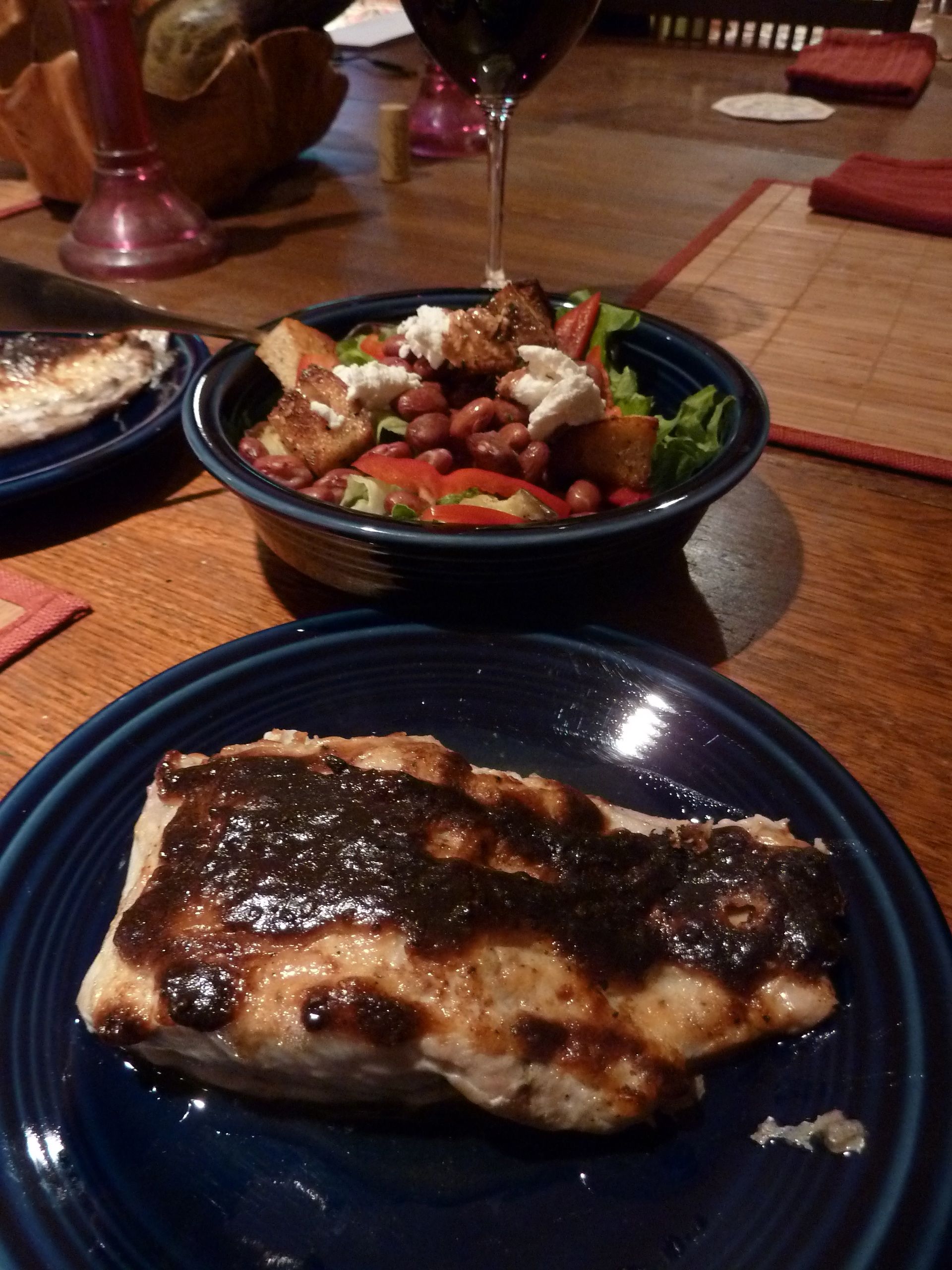
That was it for Day 4. We won’t tell you if we finish the remaining Topsfield Fair-made kettle corn. We’ll let you think on that.
Homegrown Food Challenge—Day 3
October 14, 2011 § 1 Comment
Day 3 on the Homegrown Food Challenge and no fish heads were lopped off on this particular day. But the grill did get lit, and that’s always a fun thing. Here’s how our day progressed.
Breakfast:
Starting to look very familiar. Flat Black coffee with Maine’s Own Organic Milk. Stonyfield yogurt with local apple, honey and a crumbled Effie’s oatcake. We’ll get a bit more creative with breakfast on the weekend, no worries.
Lunch:
Jennifer and I both had big salads with local stuff, similar to the one I had for lunch on Day 2. Local lettuce and red pepper, pickled beets, homemade dressing, etc etc. I even made some homemade croutons from homemade bread.
Dinner:
This is where the grill gets lit—finally! We cranked it up for some pizza made with homemade pizza dough. Two pizzas are usually enough to take care of dinner plus give us enough for lunch the following day.
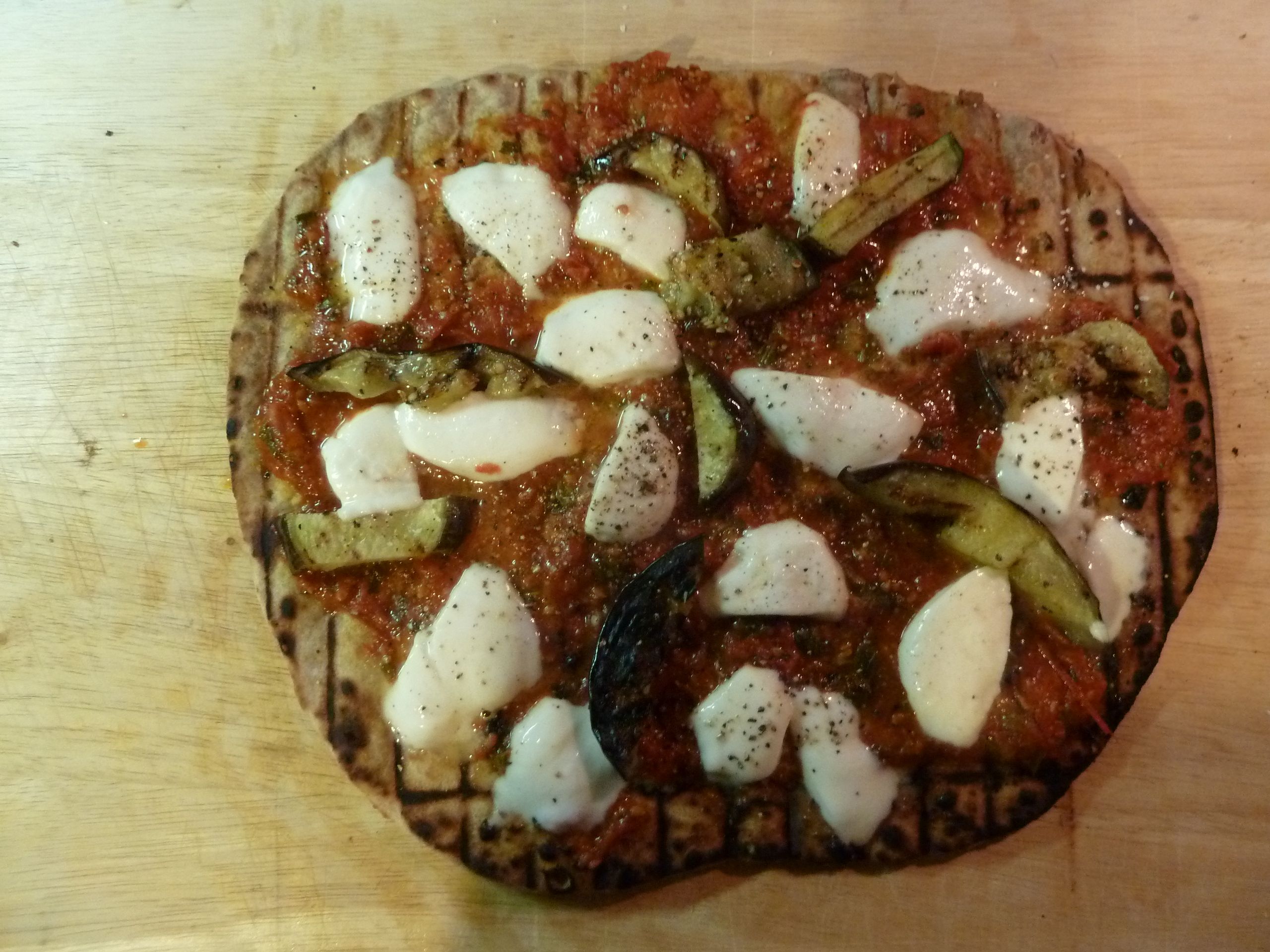
Pizza #1: Homemade sauce using slightly green homegrown tomatoes (similar to the roasted cherry tomato sauce I make), grilled eggplant (from farmers market) and locally made mozzarella.
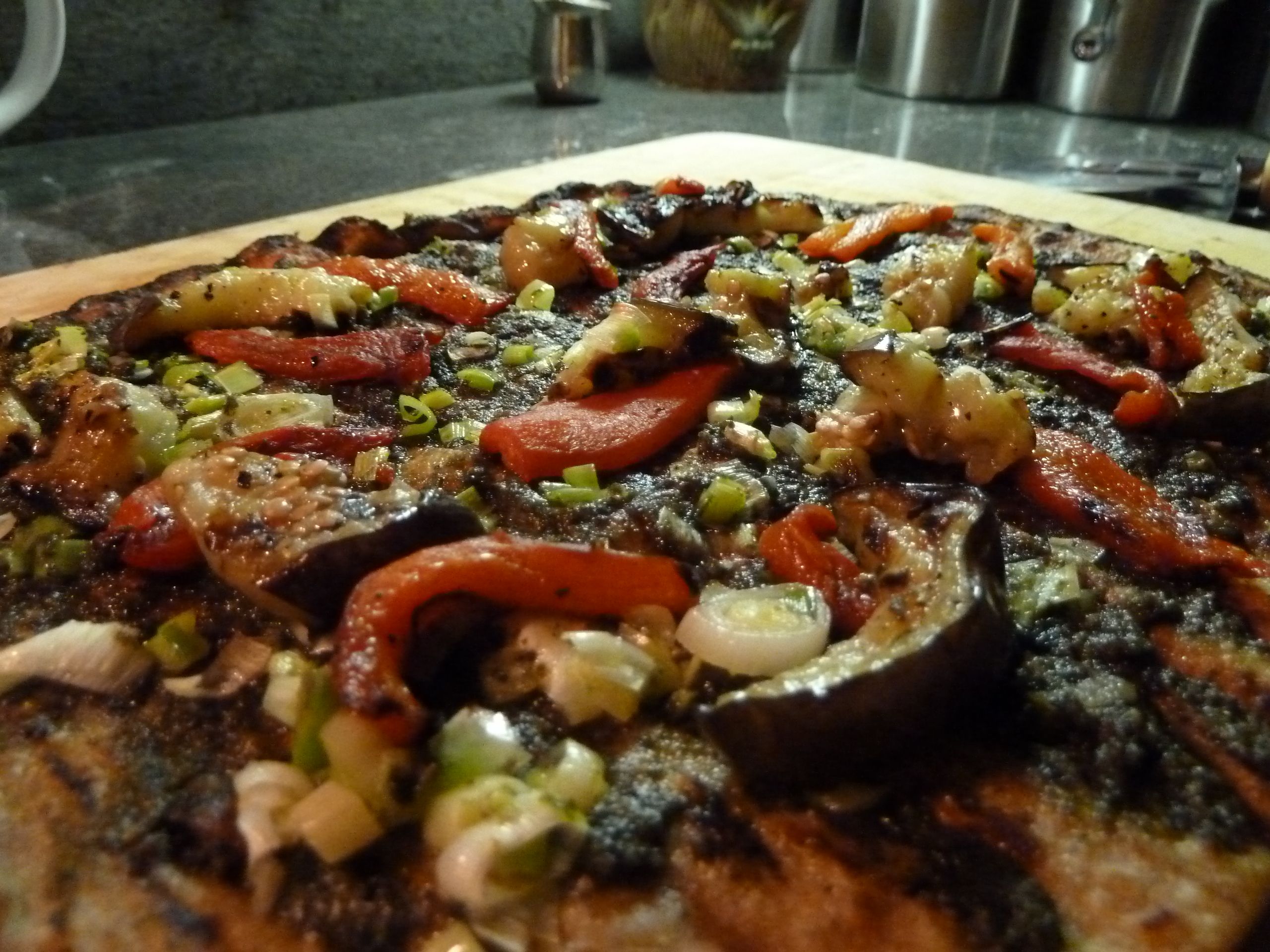
Pizza #2: Homemade pesto using homegrown basil, grilled eggplant, roasted red pepper (from farmers market) and caramelized homegrown leeks.
Can’t have pizza without beer, right? We had some Whale’s Tale Pale Ale from Cisco Brewers on Nantucket. Pretty tasty stuff!
As I am two days behind in posting, I can hint at what awaits you for Day 4: One of the most fabulous creations to ever have been sandwiched between two pieces of bread. Think I over-exaggerate? Oh. No.
Homegrown Food Challenge—Day 2
October 12, 2011 § Leave a comment
One day down in the Homegrown Food Challenge, and it went quite well. A local eatery and leftovers – we eased into it. Nothing wrong with that. Day 2, as I promised, was much more exciting.
Chopping a head off a fish-type of exciting.
But, alas, I’m getting ahead of myself. Let’s begin at the beginning.
DAY 2
Breakfast:
More coffee from our favorite local coffee roaster, Flat Black Coffee Company, with the Maine’s Own Organic Milk.
More Stonyfield plain yogurt with half a local apple, Topsfield-produced honey and an Effie’s Oatcake crumbled on top. Hey, they’re a local company. It counts. And I’m inspired to make my own oatcakes now.
Lunch:
A big ol’ salad using:
- lettuce and red pepper from the farmers market
- a homegrown carrot
- a local apple
- a boiled egg – the eggs are local
- homemade salad dressing – just something I whipped up, no biggie
- my very own and awesomely tasty pickled beets. That’s right, pickled beets on a salad. It was awesome.
- some shavings from a homegrown head of red cabbage
Filling and tasty. I washed that down with some home brewed iced tea.
Jennifer had the rest of the leftover pasta and a local apple.
Dinner:
This is where the fish head comes in. Or I should say, where the fish head comes off. Realizing there was way too much to say about last night’s dinner, I posted about the fish and side dish separately. (Click on the lick to check out the dish.) On the menu:

Broiled bluefish with smoky mayo and roasted romanesco
- Cape Ann-caught broiled bluefish with a homemade smoky mayo
- Roasted romanesco
- A glass of white wine. Okay, okay, it was Tohu from New Zealand. BUT, it had been opened a few days earlier ans was in the fridge. That counts as a leftover, right?
- I may or may not have had a handful (or two) of kettle corn purchased at the Topsfield Fair. It was popped on site! That’s local, right?
Day 3 is already two-thirds complete, and I’m happy to say we are both still on track with this Challenge. Tonight’s dinner is just an hour away. Grilled pizza is always a fun thing to make.
Broiled Bluefish with Smoky Mayo
October 12, 2011 § 4 Comments
Fish have heads.
That’s right. Fish aren’t just big slabs of fillets that motor around on their own in the ocean or in a river. They have heads. And tails, too. And fins. They even have guts. All of that—plus the nice fishy flesh—constitutes a whole fish.
And that’s what we signed up for when we bought a 5-week share in the Cape Ann Fresh Catch Community-Supported Fisheries (CSF). Whole fish one week, fillets the next.
Yesterday was our first fish pick-up.
“You know you’re getting a whole bluefish today, right?” said the pleasant assistant when I walked into the CSF pick-up location and proudly announcing this was my first-ever fish delivery.
“Yup, a whole fish.”
“You know how to fillet a whole fish?”
“Nope, but I’m gonna learn today, I guess.”
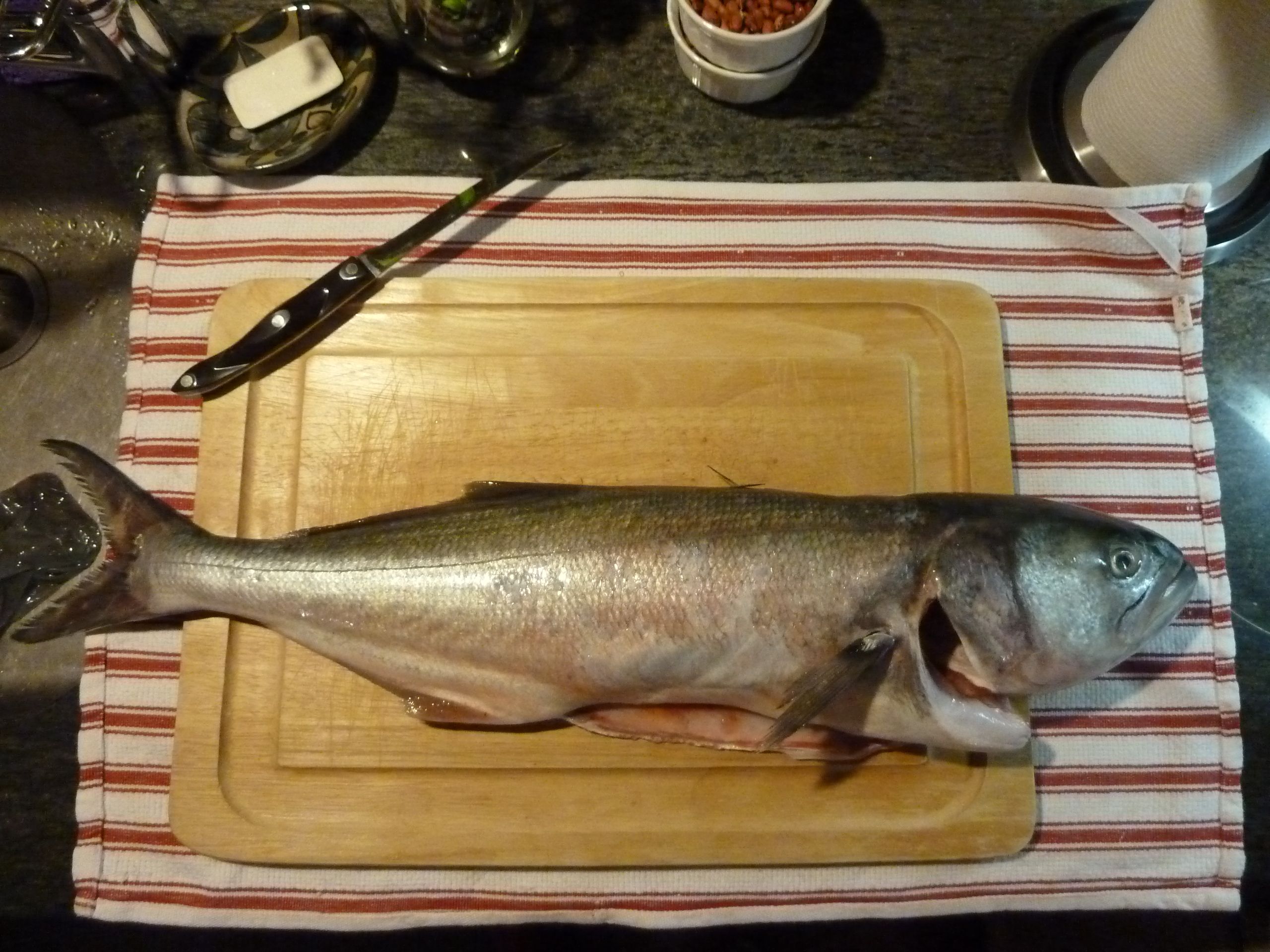
Meet Mr. Bluefish
Among the millions of dogs-learning-to-talk YouTube videos and clips of hormone-laden boys throwing themselves off suburban rooftops into holly-filled foundation plantings, there are videos that are quite instructional. A quick search for “how to fillet a bluefish” netted me two great videos by none other than Tony Maws, chef over at the Craigie Street Bistro in Cambridge.
Wanna learn how to fillet a bluefish? Check out Tony’s Part 1 and Part 2. He’s a great instructor—my fillets looked pretty nearly smooth for a first-timer. Tony, I did good!
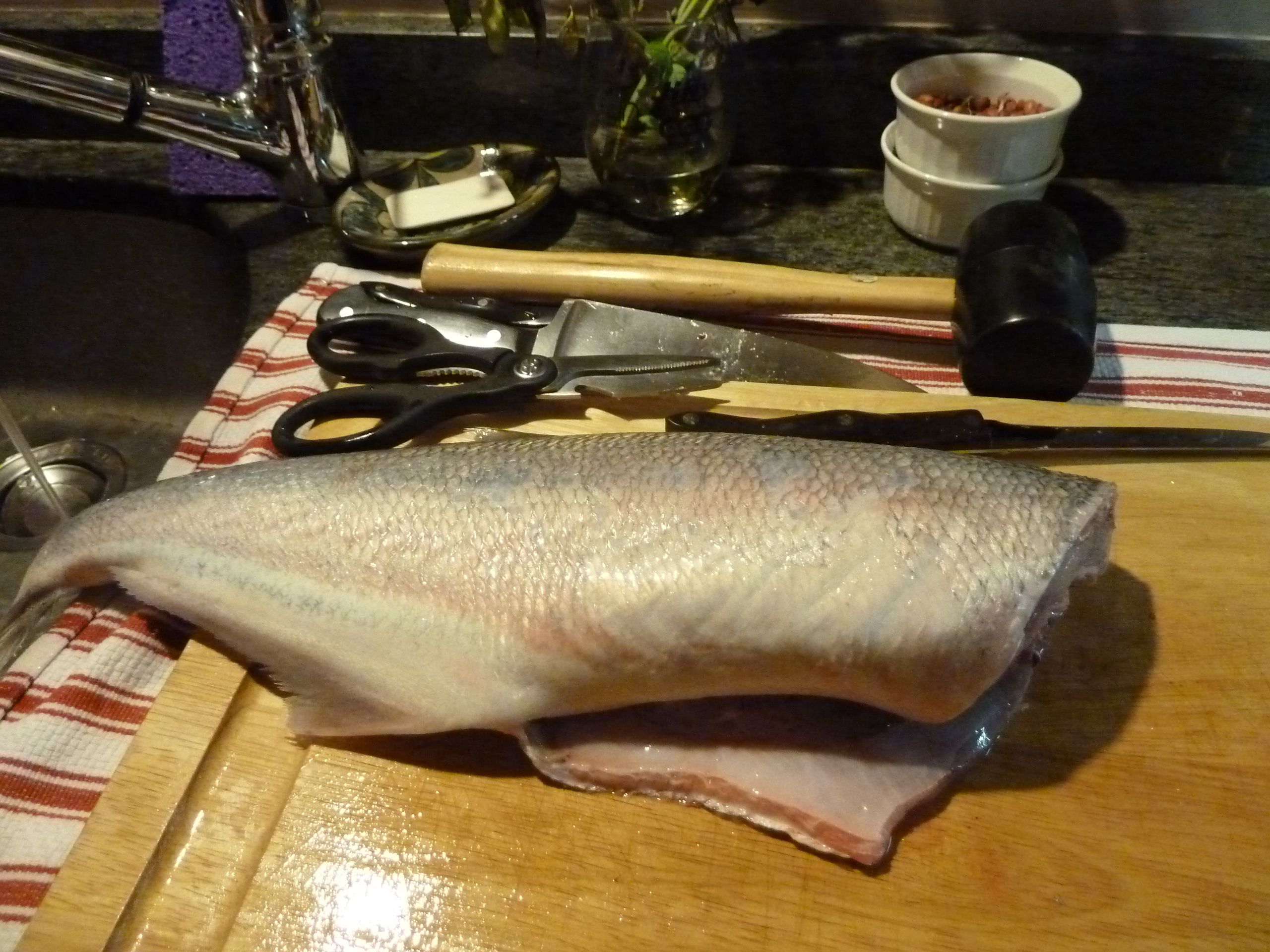
Compare this photo to the one above: Notice how many more tools I have? An 8-in. chef’s knife, a rubber mallet, kitchen shears. Not kidding. And that was just to remove the head.

In the end, I had two nice 1.5-ish pound bluefish fillets and …
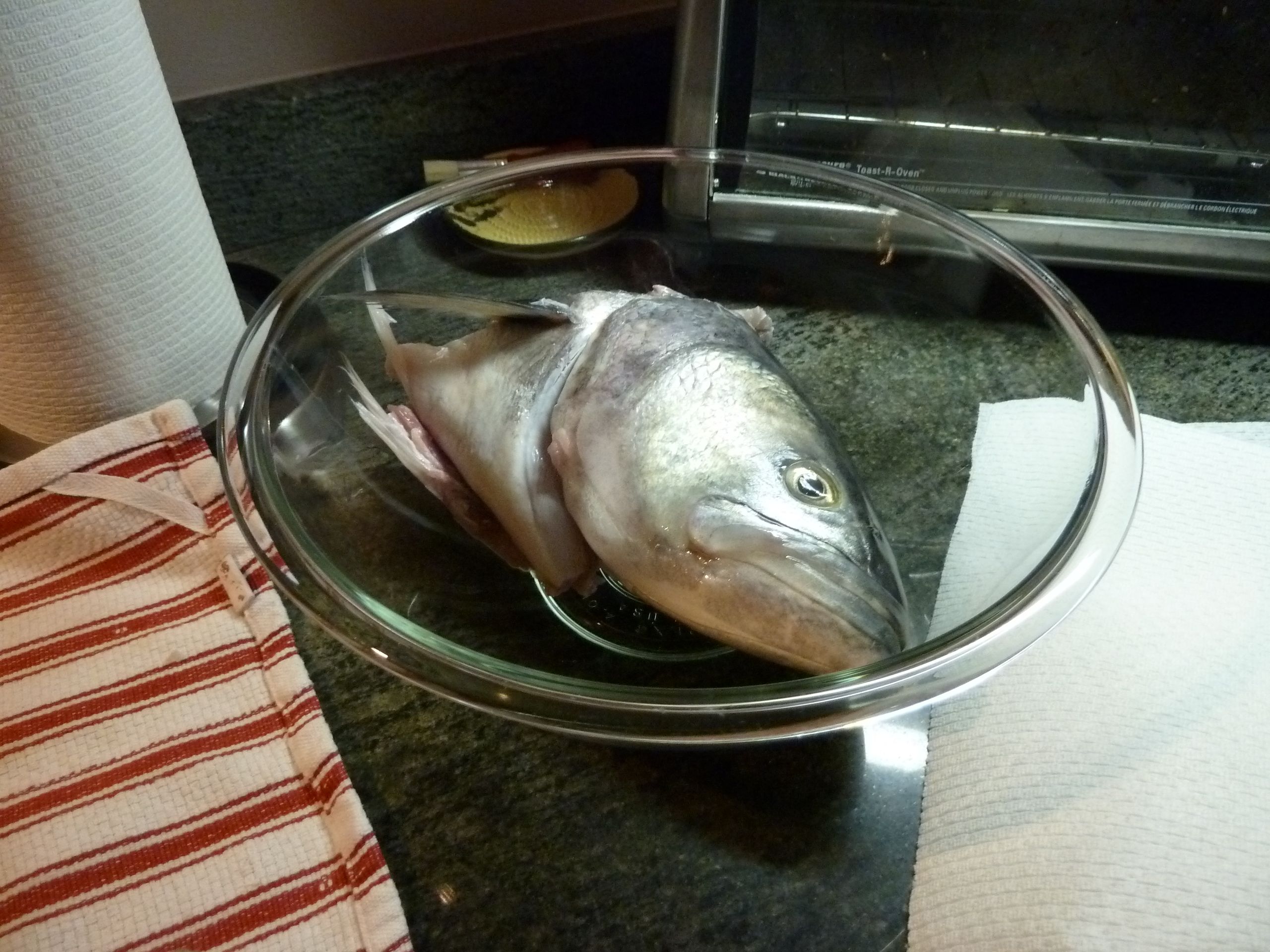
… some fish heads, tails and an intact spine and bones. Those were chucked into the freezer for a future turn in a stock pot. Also put in the freezer was one whole fillet. The other fillet was quartered, and two of those slabs were stored in the fridge. The other two were headed for the dinner table.
Finally, getting on with dinner …
For those paying attention, this meal falls into Day 2 of our Homegrown Food Challenge, and we’re doing our best to keep the ingredients either homegrown or locally sourced. The fish was locally sourced: check. The mayo? Jennifer’s a mayo whipper-upper using fresh ingredients. So yes, if it didn’t come out of a Hellman’s jar, this is locally made and sourced. And boy, does she make a yummy mayo.
Smoky Mayo
- 1 egg yolk
- 1 tsp. good-quality mustard
- 3/4 cup canola or veg oil (not a flavored or savory oil like olive)
- 2 tsp. smoked Hungarian paprika
- salt, pepper
- juice of 1/2 lemon
-In a blender or food processor, add the egg yolk and super-slowly (Jennifer’s exact words) drizzle in the oil. Super. Slowly. It’ll start to thicken and look mayo-ey. That’s a good thing. Want it thick? Less oil. Thin? More oil.
-Add in paprika and give it a whir. Taste and add in salt and pepper to your liking. Then add in the lemon juice and whir some more.

Smoky mayo

This’ll give you WAY more mayo than you’ll need for two or even four individual fillets. Have fun with the rest of it! We’re thinking grilled eggplant paninnis. Refrigerate and use within two to three days.
Broiled Bluefish with Smoky Mayo
Serves 2
- 2 6 oz. Bluefish fillets
- 2-3 Tbs. smoky mayo (recipe above)
-Place your oven’s top rack under the broiler and set your oven on broil. Let that heat up good and hot.
-Meanwhile, place the bluefish fillets in an ovenproof baking dish, skin side down. Spread 1 to 1.5 Tbs. smoky mayo on each fillet. I’d even do a little more than that. Just give the fillet a nice, thick coating of mayo.
-When the broiler is ready to go, place the fillets under the heat—7 minutes should do it. But, keep an eye on them. Broiler distance varies and your mayo could scorch. Some scorching is okay, but you don’t want grizzled char.

Broiled bluefish with smoky mayo and romanesco
The mayo holds in the fish’s moisture and adds a tasty smokiness to the fish. Really quite nice.
I know some think bluefish is … fishy. I grew up eating bluefish, so I had no worries. Jennifer quite liked the fish’s flavor, too. Plus, the fact that the fish was alive and swimming earlier that morning had a whole lot to do with the awesome flavor.
Oh, that green stuff over there on the other side of the plate—that would be roasted romanesco.
Roasted Romanesco
October 12, 2011 § 2 Comments
I love funky-looking things. Especially vegetables. Remember my experiment with growing kohlrabi?
Romanesco is a a funky-looking thing. And when I had a choice between broccoli and romanesco, I jumped on it.
It’s a bit like broccoli, taste-wise. Look-wise, though, it would be what Escher would paint/draw if he took the vegetable route with his art.

Am I right or what?
Now, the thing about romanesco is that a good portion of it is stem. If you cut off the stem portion and leave just the florets, you’ll be left with not so much. Eat the stem, people. It’s tasty.
What to do with romanesco? Well, when I see the Brassica genus, I think roasting. And that’s exactly what I did.
Roasted Romanesco
- 1 head romanesco, separated into individual stem-florets or clumps of smaller florets.
- 2 Tbs. olive oil
- salt and pepper
-Heat oven to 425F.
-If any of your romanesco sections look particularly large, feel free to cut them in half. Place romanesco sections in a big bowl. Douse with the olive oil. Sprinkle two or three large pinches of kosher salt on top (depending on the romanesco’s size) and give it a couple turns from a pepper grinder. Toss.
-Spread romanesco onto a rimmed baking sheet and pop in the oven for about 23-25 minutes or until they develop a nice brown char and a fork can just be inserted.
Finally, a new item to share space with broccoli and cauliflower in the winter months.
Homegrown Food Challenge: Day 1
October 11, 2011 § 1 Comment
Yesterday began our week-long Homegrown Food Challenge (HGFC). So, right from the beginning I have to amend the title, or rather—I should clarify and lay out the rules of this Homegrown Food Challenge we’ve undertaken:
- “Homegrown” … with such a small garden plot and the fact that it’s nearly done producing, we’re amending “homegrown food” to “local food.”
- “Local” for this challenge will mean somewhere in New England. I know, it could be more local than that. Maybe for the next challenge we’ll pull in the boundaries.
- Items that are in our allowable “pantry” include oils, vinegars and flours. And I reserve the right to add in quinoa as a “cheater” grain.
- Leftovers that were in our fridge need to be eaten, right? And trust me, we did not stock the fridge with “leftovers” so we could cheat with them.
- Our “veganish” diet – two out of three meals not containing animal products – will be put on hold for the week.
Hey, that’s not so bad, right? So far, so good.
To prep for the challenge, I hit the closest local farmers market I could find, which just happens to be at Boston Medical Center on Fridays. I came back with butternut squash, two eggplant, red peppers, dinosaur kale, two heads of leaf lettuce and romanesco – it’s like a fractal-influenced head of broccoli. All produce brought to us by the good folks at Farmer Dave’s in Dracut.

Farmers market fare from Farmer Dave's
We also stopped by Whole Foods to find some local dairy products. And you know what? We did actually find some.
So, with that, let the challenge begin!
DAY 1
Breakfast: We need coffee. Coffee doesn’t grow in this climate. What to do … Well, there are local coffee roasters. That counts. And our favorite local coffee roaster is Flat Black Coffee Company with locations in Dorchester and downtown Boston. We’ve known the owner for years and can attest he and his crew produce a great and responsible bean. Into that cup we usually pour some almond or soymilk. Not happening this week, so how about some local milk? We picked up some Maine’s Own Organic Milk.

Yogurt, apple and honey - all local!
The coffee accompanied a bowl of Stonyfield plain yogurt – I’m positive all that dairy is from New England cows and if not, someone clue me in – mixed with a local chopped apple and topped with Topsfield-produced honey. Breakfast, done.
Lunch: Okay, so … It’s Columbus Day. Jennifer’s off work, and I’m working but not all that hard … A friend calls us. Hadn’t seen her in a while. “Wanna go out for lunch?” Say no? No. We said yes. And we opted to eat at a small, local Mexican restaurant two blocks away where I know they a) make a lot of their own stuff and b) could use our dining dollars. I feel completely in-line with the challenge by supporting our local small eateries.
Dinner: Gotta clean out the leftovers from the fridge, right? Pasta with shrimp, red pepper and pesto. And just the pasta and shrimp weren’t local in that dish. Plus, we had homemade bread. And, a bottle of Harpoon IPA brewed right down the street in Southie.
Day 2 should be interesting—it’s our first Cape Ann Fresh Catch share pick-up. Fish with heads!! Awesome!
Spicy Tomato Soup
October 2, 2011 § Leave a comment
Normally, if you let produce sit around for awhile, bad things happen. Soft spots. Wilt. Mold. Eyes sprouting. Ooze. Fruit flies. Rot.
Okay, I’ll stop with the grossness.
But sometimes, if you let produce sit around, good things happen. Like what? Like ripeness, for one.
This time of year, you just never really know what’s gonna happen in the garden. And I speak specifically of the summer hangers on—the zucchini and yellow squash, the basil, the peppers, the tomatoes. Especially the tomatoes. Less sun, cooler weather means they take a way long time to ripen on the vine. And the frustrating part is a tomato could be green and happy one day, and then the next day it could be on the ground, fodder for the ants.
So, I pick them up and bring them home. Or I pick them when they’re just turning orangy. Or I pick one or two whenever I visit the garden, which is about twice a week this time of year.
What to do with green tomatoes? Orangy tomatoes? Let them sit on the counter—they’ll ripen. Kinda. Not a nice and juicy vine-ripening experience, but they’ll turn red. Ish.

The fixins.

It's Tomato Christmas.
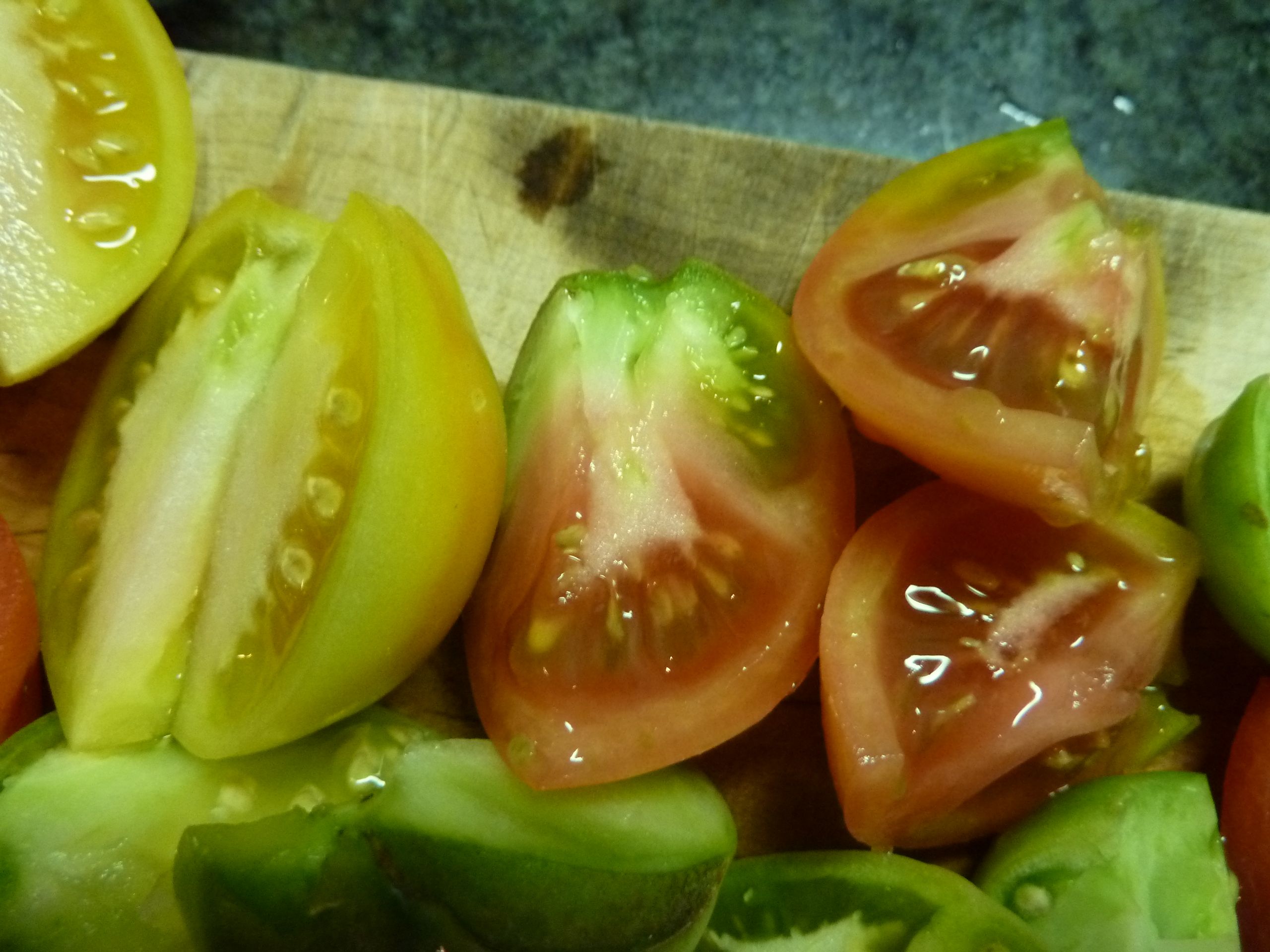
Look at that tomato in the middle—it's like the Italian flag.
With a mix of tomatoes in all stages of ripeness, I turn to a recipe from Emeril Lagasse I pulled off the Food Network website. The original calls for pancetta and three different types of hot peppers – jalapeno peppers and Anaheim and pasilla chiles. And, it calls for just green tomatoes.
Is it spicy? Oh yeah, it’s spicy. Feel free to add a dollop of sour cream to cool it down. Me? I like to add a spoonful of pesto. Tomatoes and basil – a perfect match.
Spicy Tomato Soup(this is a double batch)
-

Spicy Tomato Soup
1 Tbs olive oil
- 1 large sweet onion, sliced thinly
- 5-6 cloves garlic, peeled
- 2 bay leaves
- 5-6 hot peppers, whatever type you want to cook with, diced (I used jalapeno and Hungarian wax)
- 3.5 lbs tomatoes, cored and roughly chopped
- 6 cups chicken or vegetable stock
- Juice of 1 lemon
- Salt and pepper

-Heat oil in a pan over medium heat. Saute onion until just translucent – 4-5 minutes. Season with salt and pepper.
-Add garlic, bay leaves, garlic, and peppers and cook for 4-5 minutes. Add tomatoes and stock, then adjust seasonings with salt and pepper to taste. Bring soup to a boil, then turn down heat and simmer for 15 minutes or so, until the tomatoes are soft.
-Time to puree!! But remove the bay leaves first!! You can puree in batches in a blender. Or, we have an immersion blender that does a terrific job. Sure, you’ll get a bunch of tomato skins getting kinda caught in the blendery parts. Just remove, or put back into the soup—whatever your preference. If you’ve pureed in batches in a blender, pour the soup into a separate bowl.
-Add the lemon juice. Give it a taste. Spicy? That’s what it’s supposed to be.
Try with a bit of sour cream. Or shaved parm. Or the runny part of your stash of pesto. Be sure you have some crusty bread. You’re gonna want to sop up that goodness.
You know, this would be a great soup to make for the Homegrown Food Challenge. Luke, give this a try—I know you love spicy stuff!
The Homegrown Food Challenge
September 30, 2011 § 4 Comments

Are you in for the Home Grown Food Challenge?
I’m always up for a challenge, unless it involves deep sea diving or eating 62 hot dogs.
A few weeks ago, the folks at the Homegrown Food Challenge emailed me out of the blue with a request: Can I submit a recipe or two or three that Luke and Karen—founders of the Food Challenge—can prepare during their October-long commitment to eating locally sourced food? Sure! Absolutely! And what’s this challenge you’re talking about?
Luke and Karen tell their own story over at their blog, Sweet Local Farm. In a nutshell, they’re living the “modern-day back-to-the-land” lifestyle on three acres of farmland in the Pioneer Valley. They plant, they tend, they harvest, they cook. And what they can’t eat all at once, they put up for the winter by canning and freezing and pickling and storing in a lot of other ways.
Can I come live with you, Luke and Karen? Cuz that’s exactly what I want to do.
Last year, realizing they had buckets and buckets of a wide variety of food at this time of year, they challenged themselves eat only what they grew during the month of October. And what they didn’t grow themselves, they’d source locally.
This year, they are doing it again and encouraging others to join in. Not everybody has a 3-acre farm that can support them for the month, they know that. And they realize 31 days is a long time to commit to any challenge, let alone one that involves food.
The Homegrown Food Challenge, therefore, is nothing if not flexible. Only growing tomatoes and basil in your garden? That’s fine—commit to eating only locally sourced foods and hit up your neighborhood farmers markets. Can’t commit to a month? Then sign up for a week or a day. or hey, even one day a week. Point is, making the commitment to the Homegrown Food Challenge will get you thinking about a) where your food comes from, b) what food you’re going to eat, and c) how you’re going to get that food. You do realize that calling up Domino’s or Yum Phat and having your meal appear before you in 30 minutes or less is a modern-day miracle? And one that only a small portion of this world’s population has the luxury to partake in?
Think about your food, people!
Ahem … sorry for the rant. It was quick, though.
Back to the Challenge. Head on over to the Homegrown Food Challenge’s Facebook page and sign up whichever source and time frame works for you. Or, just mentally commit to it. Whatever you do, there’s gonna be some recipes on the page that you can turn to for inspiration. And I’m sure Luke and Karen will be posting about it over on Sweet Local Farm.
As for Dainty’s role in this … I’ll give you a heads up when Luke and Karen use one of the recipes I’ve submitted. And I’ll also direct you over there when one of their other recipes looks Daintilicious. I’m very pysched about it.
Jennifer and I have officially committed to one week of locally sourced food. And it’s not going to be this week. This takes some planning and rule making (and rule breaking)—we’ll keep you posted as to when that week occurs. And she doesn’t know it yet, but in addition to that one week, I’m also adding in one day of locally sourced food each week, which I hope to continue beyond October.
How are we preparing for the Challenge? Well, we’re coming up with guidelines, e.g. oils, vinegars, flour, lemons and limes don’t count. And we’re planning some meals. And we’re mapping out farmers markets. And we’re going out for dinner tonight.
Need some inspiration? I will be posting the three recipes I submitted to Luke this weekend. AND, I’ll post an awesomely superb spicy tomato soup recipe later today so you can hit the farmers market tomorrow morning with a shopping list in hand.
Are you in? Who’s with me?
Pressure Cooking Black Beans
September 20, 2011 § 3 Comments
You’re going to think I’m a bit crazy, but I actually really like this two-thirds vegan kick I’m on. Now, let me clarify:

Buy the dry - dried black beans are easy as pie to cook up and enjoy in 30 minutes.
1a. Two-thirds vegan means two meals out of three meals each day are non-dairy, non-poultry, non-animal products. Not even a boiled egg on my lunchtime salad – and I love a good boiled egg, too.
1b. What about snacks, you ask? What am I gonna do, eat a meat stick? Almonds, an apple, hummus and chips if I feel the need.
2. I first mentioned the two-thirds vegan thing back in … was it March? April? Lest you think I’m Superwoman, I need to inform you that I haven’t been two-thirds vegan all the time. Vacations don’t count. Weekends away don’t count. And sometimes that boiled egg would find its way onto of my salad. And, last week … I had a whole mess o’ Old Bay-seasoned wings on my business trip to Baltimore. The only wings I’ll eat, and the only town I eat them in. There are rules about being two-thirds vegan, and I make them up as I go along.
3. And sometimes, you go away for the weekend and someone makes you a three-egg omelet. With mozzarella. And lobster. Just be sure there’s a veggie burger in your near future.
BUT! It’s a new season. And I have a renewed interest in sticking to the vegan thing. At least two-thirds of the time.
BUT! I need more protein. That’s what a recent doctor visit and blood test suggested. So, here come the beans, which are an excellent source of protein and fiber awesomely tasty food. Rather than stocking up on cans upon cans of beans – they add salt and calcium chloride, which, by the way IS a salt! – we buy the dry. Oooo … I like the way that sounds, “buy the dry.” Plus, they are cheaper (I’m showing my frugal side).
Dry beans are NOT a pain in the ass to work with. It’s easy. If Dainty can do it, so can you. And you don’t have to wait around 24 hours while your beans soak, etc. etc. Invest in a pressure cooker and your beans will be done in 30 minutes, and that includes 5 minutes of prep time.
The recipe we use comes from Pressure Perfect by Lorna Sass. (Oooo … sassy.) Hey, meat lovers, there’s a roast chicken on the cover! That’ll assure you Lorna has added something for everyone inside. There are a bunch of bean recipes included – the one we use is for black beans with soft tortillas. We use just the first half of the recipe and add our own seasonings depending on what we’re using the beans for. Here, I’ll just go through the first process and produce a batch of pressure-cooked beans.
Ingredients
- 4-6 cups water (depending on how much bean broth you want)
- 1.5 cups dried black beans, pick over to remove icky ones, small pebbles, etc. and rinse
- 1 small onion
- 4 cloves, peeled and roughly chopped
- 1 TBS oil (apparently it prevents or controls foaming)
- 1/2 tsp salt
-Combine everything in a 4 qt. pressure cooker.
-Lock the lid in place. If you’re like me, you’ll do it three or four times, making absolutely sure the lid is on and won’t fly off. Seriously though, when it’s locked, it’s locked. No hardhat needed.
-Bring the pressure cooker to high pressure over high heat. READ YOUR PRESSURE COOKER INSTRUCTIONS! It will tell you how you can tell when it has reached high pressure. For our Fagor pressure cooker, high pressure is indicated when two red lines are visible.
-When it has reached high pressure, turn down the heat to a temp that will maintain that high pressure. For ours and on our gas stove, that means at a point between “lo” and “2”.
-Let the beans bubble away in there for 25 minutes. Then turn off the heat. Let them sit there as is – don’t open the lid! – and let the pressure come down naturally. READ your cooker instructions to find out how you can tell on your device.
-When the pressure has come down, open the lid AWAY from you. You don’t want to get a face full of super-heated steam, right? Always always always be careful.
-The beans should be tender. If not, lock it up, stick ’em back on the heat and cook for another couple of minutes. Repeat the heat coming down and all that.
What you have now are several cups of firm yet tender beans in broth. If you used 6 cups of water, you are halfway on the path to making a black bean soup. If you used 4 cups of water, you have a bit less broth. Letting it sit, the beans and broth will thicken slightly but not much.
We use 4 cups of water, and after the beans are pressure cooked, we typically add a touch more salt, some pepper, several shakes of red pepper and a diced small tomato. We then serve it over a bowl of rice. We’ve added other things, as well – roasted sweet potato, butternut squash, for example.

We add a touch of salt, pepper, red pepper flakes and diced tomatoes to our black beans.
If you have any suggestions for what to add in to the black beans, I’d love your suggestions. We need to keep up the variety. Please leave your comments below!
 The Dainty Dot