
Grilled Pizza
August 24, 2011 § 1 Comment
Summertime … and the grilling is easy. Cheese is melting, and the pizza is fine.
Okay, I’m no George Gershwin, but what I’m trying to say is this: Pizza on the grill is not only easy, it’s one of the quickest summertime grilled meals possible. What do I like about it most? The fact that I don’t have to deal with my smoke alarms going off. Yeah, that happens whenever we cook pizza inside. The super-heated oven ends up burning the corn meal that remains on our pizza stone. Pizza in January usually means both our front and back doors are open to prevent smoke buildup. No. Kidding.
So, when we can slap that pizza dough on a hot grill, we go there.
And you can go there, too.
I’m not going to tell you what kind of pizza to make. Your toppings are your toppings. You want pepperoni? Have pepperoni. You want smoked salmon? Go for it. Sauce? Yes, please—but don’t go overboard. A little dab will do ya (I’m showing my age with that quote).

My assorted pizza toppings, minus a bowl full of kale-ricotta mixture.
Plus, I’m not the pizza maker. Jennifer is the star when it comes to assemblage. I make the dough, I’ll make sauce. I’ll sous, but she chefs when it comes to pizza time. We’re practiced at this, but the following are our tips, not our must dos. Also, p.s., our grilling is done on a gas grill. Charcoal? A slightly different animal, so adjust as you see fit.
Grilled Pizza Tips
A hot hot grill is good. 500F is good. Clean it really well, not leftover burnt chicken skin, please.
Prep your toppings. I can’t emphasize that enough. Slice, dice, chop, stir. Get ’em ready. AND, pour a small bowl – maybe 1/3 to a 1/2 cup? – of olive oil to have on hand. Put ’em all on a big cutting board or tray to carry out to the grill.
Roll out a nice flat but not too thin dough. Round, square, oblong, whatever.
Here’s a great trick: Lightly oil a section of aluminum foil. Take that dough you just rolled out and put it down on the foil. Now, lightly swab the top of the dough with oil.

Okay, maybe I over-oiled this one. Swab off any extra oil!
Grill’s good and hot. Your toppings are ready to go. Your dough is ready to go. So, go out to the grill and … Quickly flip that dough, oiled top side down, on top searing-hot grill, and peel back the foil. There’ll be some “yikes!” and “oh, sh*t” moments, I’m not gonna lie to you. Pull the dough one way or the other, make your tweaks QUICKLY, and then close that grill cover. And fast. The sooner heat completely surrounds the dough, the quicker that dough is going to turn into a pizza crust. Right? Right.
Two-three minutes. Peek once or twice to make sure the underside is not burning. Oh, it’ll burn. Believe you me.

Oh damn, I burned the first one. These things happen.
NOTE: The first dough got kinda … well … crispy. I started another. Much, much better.
Get your mise en place in place, ready to go. Open the grill, flip that crust over.
Not using a sauce? Then give a quick brush all over the top with evoo. Using a sauce? Spread it thinly and quickly. Layer everything else on as you see fit. And be quick about it!
Close the lid for another couple of minutes. Keep an eye on the bottom, making sure it’s not burning. When the cheese (if you’re using) and the sauce look melty and hot, it’s time to take it off the heat.

Let sit for three minutes to let the sauce and toppings set. And then cut yourself a slice.
Worth it all, huh?
Roasted Vegetable Lasagna
August 14, 2011 § 1 Comment
Sometimes … sometimes I just want to eat bad things. Good-tasting things but bad for you, or your waistline. Fried chicken. Wings. A big drippy pulled-pork sandwich. A pile o’pasta.
But if it’s homemade, I hear, it’s half as much calories, conveniently. At least that’s what I tell myself. And if it has vegetables in it, well … then it’s downright a health food.
So that makes our roasted vegetable lasagna not only calorie-free but good for you, too. And the best thing about this recipe is it’s a combination of three previous posts. Brilliant!
Recipe
- Roasted vegetables of your choice
- Homemade pasta
- Roasted cherry tomato sauce
- 1 lb. ricotta cheese
- 1/2 lb. chard
- 1 tsp nutmeg
- 3 balls of fresh mozzarella, thinly sliced.
- One rectangular casserole dish, what are they, 8×13?
NOTE: If you’re not making your own pasta … and really, you don’t have to … buy the lasagna sheets that you don’t have to pre-boil. A few cents more, but really, the convenience is worth it.
-Our roasted vegetables of choice for this lasagna are yellow squash. We sliced it into 1/4-in. slices, lengthwise. Glug of evoo, salt and pepper, and roast at 425F for 6 minutes each side.When done, set aside.
-Roasted cherry tomato sauce – just as the recipe says. You may want to puree it.
-Homemade pasta … prepare just as the recipe says. Make the sheets to fit half the width of the pan.
We have the sauce, the pasta, the veggies. Oh, wait – one more vegetable.
-Chard. Stem it and then steam it for 1 minute, 2 minutes max. Let it cool. Squeeze the water out of it. And chop. Set aside.
-Put the ricotta into a medium bowl. Add the chopped chard, nutmeg and a pinch of salt and combine. That’s your cheese filling.
Now it’s time to assemble! It’s all about layers. Get the layers, get the lasagna.
-Lay down a thin layer of sauce. Then top with two lengths of pasta sheets. If you crank out the pasta as you go, you can cut the pasta to the correct length. Top the pasta with some roasted vegetables. For the squash, we fit 4-5 lengths of squash per layer.
-Next, spread some of the ricotta – as much as you’d like – over the veggie layer. Dot with slices of mozzarella. A little cheese, a lotta cheese – whatever you want.
-Add another layer – sauce, pasta, veggies, cheeses. You can make as many layers as you have ingredients for. Three or four is typical. Just keep going until you fill the dish and have absolutely no more room.
-When you are done layering, you’re going to top with a layer of pasta, then a thin coating of sauce. Then top with as much mozzarella cheese as you like. And a dusting of parmesan, too. Done!

-Cover with aluminum foil. Pop into a 375F oven for 25 minutes. Remove foil and cook for another 15ish, or until the sauce and cheese are bubbling.
-Let it sit for 10 minutes.
Try not to make a pig of yourself at the dinner table. Really, you’re better than that.
Roasted Cherry Tomato Sauce
August 14, 2011 § 5 Comments
I’m telling you, some gardening years are better than others. A string of spectacular harvest sseasons from my small urban plot have made this summer a “meh” – that’s on a scale from “it sucks” to “this is freakin’ amazing.”
My cherry tomatoes—I’m not thrilled with them. They’re growing okay. I just don’t like the fruit. Too big. Too thick-skinned. And the flavor fell flat. Cherries are supposed to poppable, add a brightness to a salad. These? Meh.
When life gives you lemons, right?
So, these cherry tomatoes went straight into sauce. Roasting brings out the sweetness they lack when just sitting on your salad.
Step 1: Put about 2-3 lbs. cherry tomatoes in a cast iron skillet. Add a couple of tablespoons evoo, sprinkle with kosher salt and give it a couple of turns of fresh ground pepper.

Cherry tomatoes seasoned and waiting to be popped into a 425F oven.
Pop it into a 425F oven for about 40 min. or until the tomato skins start bursting and the liquid starts bubbling. Let it bubble along for a total time of about 1 hour.
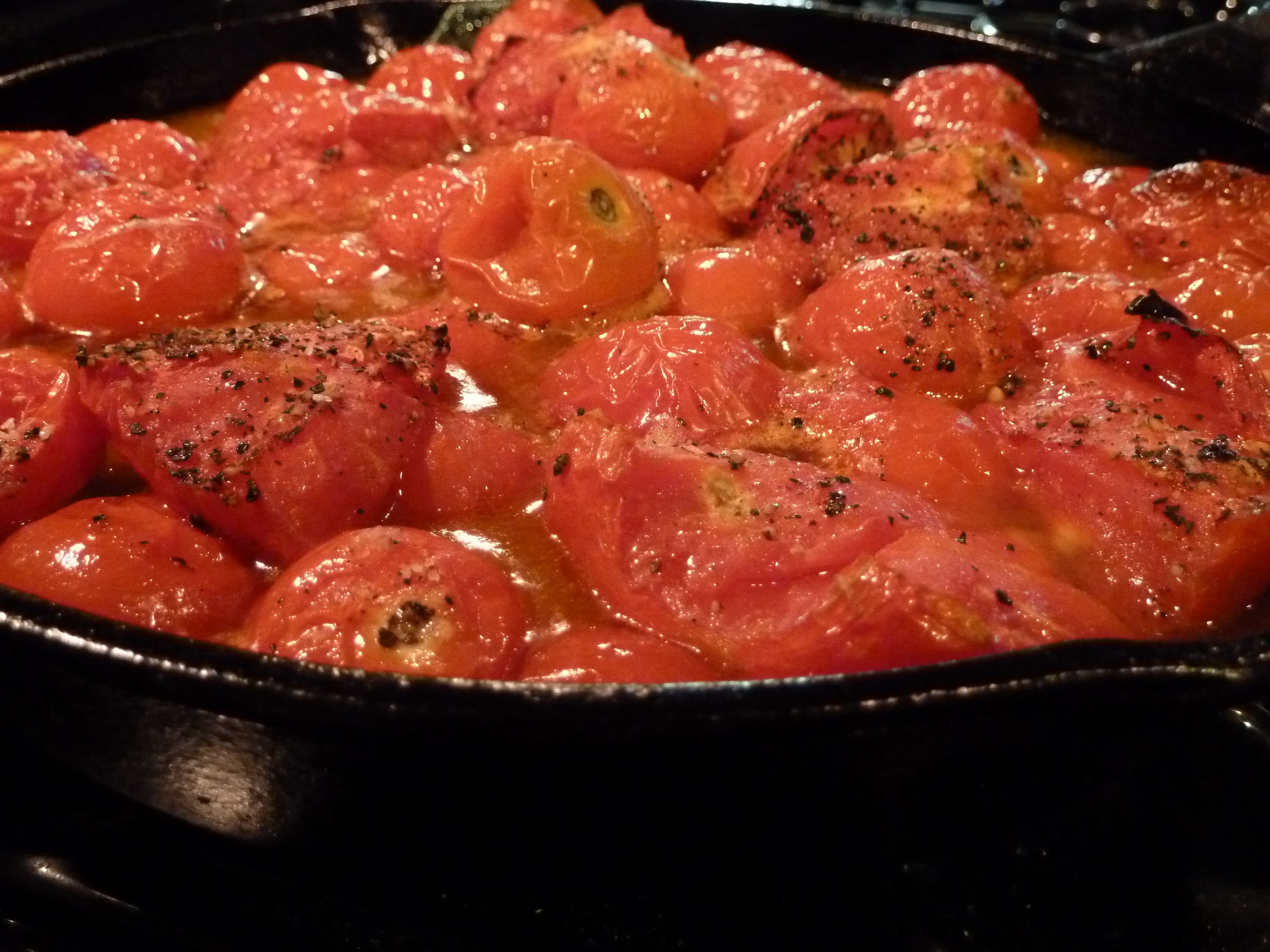
Cherry tomatoes after an hour of roasting
Step 2: Your gonna get lots of juice from the tomatoes, and you want to let it cook off. And you also want the flavor of the tomatoes come through more and get the sauce a bit thicker. So, take the skillet out of the oven and put it on the stove top over a low flame. Add 2-3 cloves of crushed garlic. Add some herbage; whatever you like. Fresh thyme or basil. Will it top a pizza? Add some chopped fresh oregano. 2Tbs is about right. Taste it for seasoning and add salt/pepper if you need to. And cook loooow and sloooooow. How long? Until enough liquid has cooked out to get the sauce to the thickness you like. In my case, 2 hours.
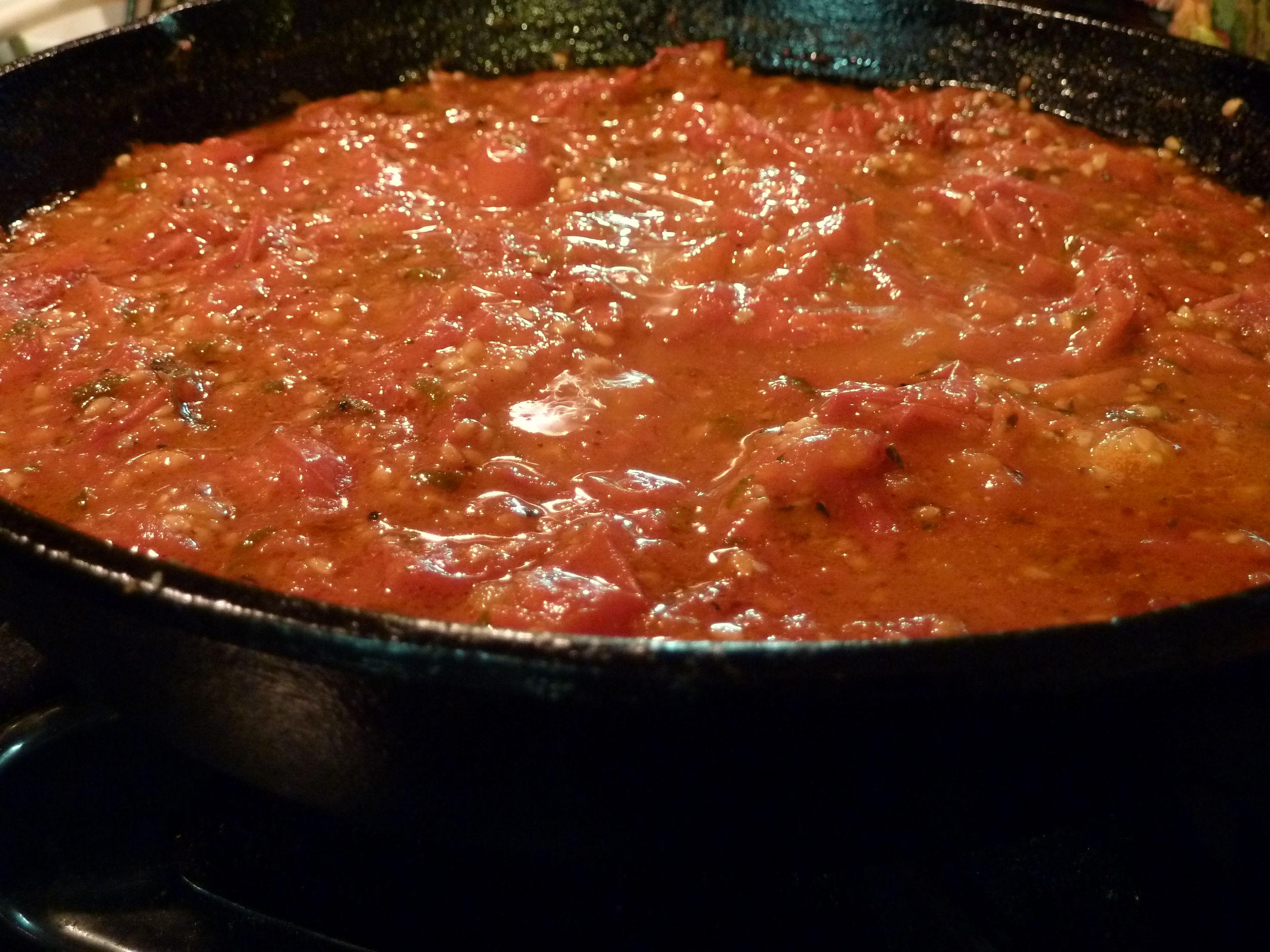
After two hours simmering on the stove top.
How easy was that? You might find it still a bit too chunky to spread on a pizza or spoon onto layers of lasagna. Whir it up in a blender or use an immersion blender if you like.
And how sweet is this, uh? You may never go back to plum tomatoes for sauce again.
Pasta Dough: It’s Easier Than You Think
August 10, 2011 § 6 Comments
Mmmm … fresh pasta.

Fresh linguini - the flour lightly dusts the pasta, keeping it from sticking together.
Have you ever had it? I mean fresh pasta. The kind someone has just made right there in the room. Not the stuff you buy in the refrigerated section of your local grocer. Okay, so that’s not dry pasta—but it’s not fresh fresh either.
What? Are you saying, “I don’t have time for that … “? Or, “Oh, that’s soooo complicated …”? It’s not. If you liked to make mud pies as a kid (and who didn’t?), then you can make fresh pasta.
Of course, I say this not having made fresh pasta myself. Jennifer is the pasta maker in our household. And she makes it look easy. She says it’s because it is easy. She first made it in a cooking class last year, and the technique below is from that class. The recipe comes from The Food Network’s Anne Burrell.
Try it. The only way you can screw it up is by making a horrible sauce.
Homemade Pasta Dough (from Anne Burrell)
- 1 pound all-purpose flour (get yourself a kitchen scale!)
- 4 whole eggs plus 1 yolk
- 1/4 cup evoo
- kosher salt – about 1 Tbs
- 1-2 Tbs water or more
-Set yourself up on a clean and dry work surface with plenty of room. Pile the dry ingredients (flour and salt) right on the work surface, and create a hole or well in the flour, making a doughnut-shaped ring about 8 inches wide.
-Crack all of the eggs and the individual yolk (I always do this in a separate bowl to catch the occasional shell) and add these to the well along with the wet ingredients—olive oil and water.
-Use a fork to beat the wet ingredients together. Then, you’re going to pull in the flour bit by bit into the egg mixture. I say bit by bit because you don’t want to pull too much of the flour into the center and break the ring’s side walls. Then your egg leaks out and it’s a big mess. As soon as the egg mixture has enough flour in it is no longer runny, you can put aside the fork and get your hands in there. Your hands are the best tools to combine everything completely.
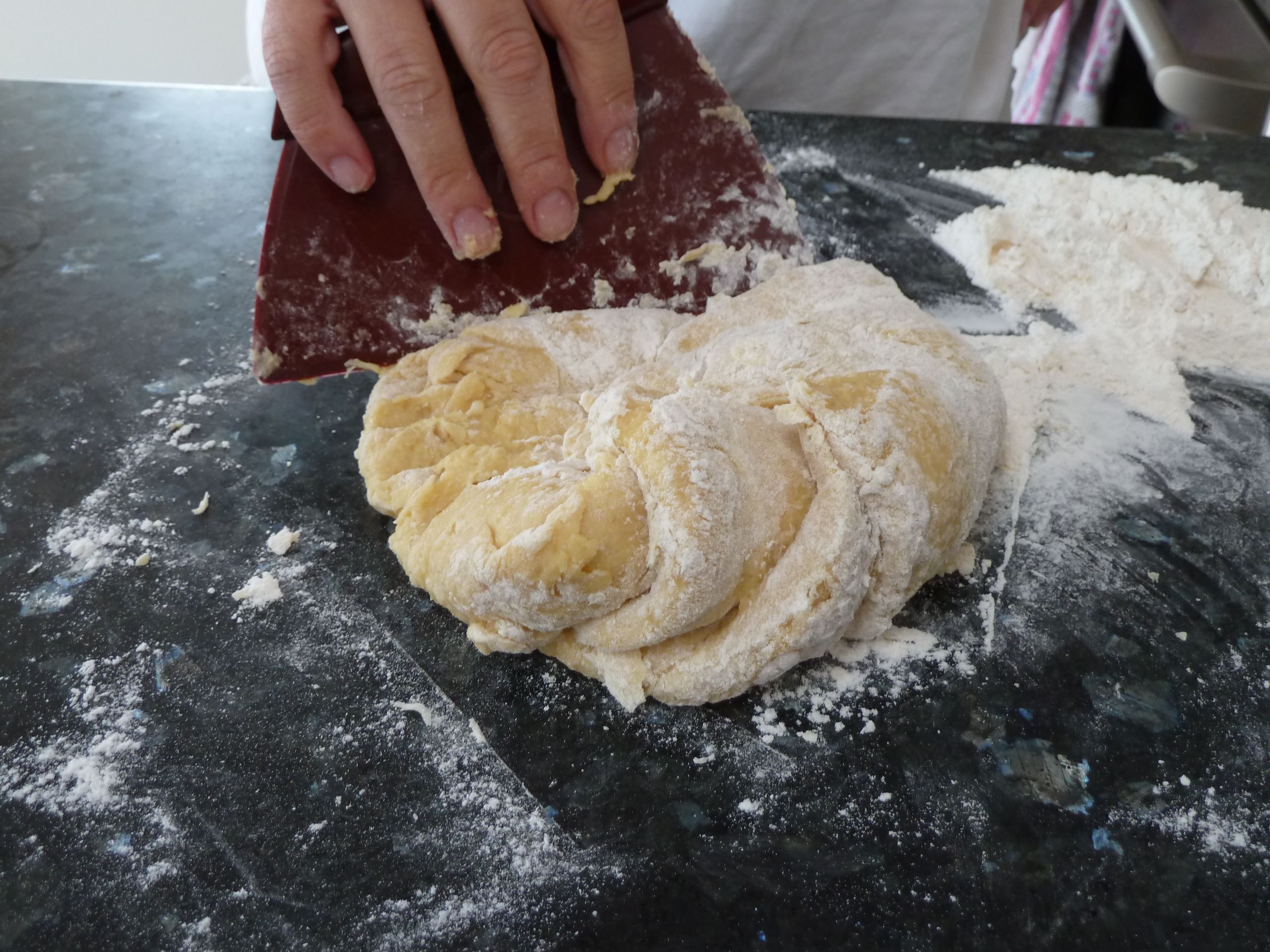
Incorporating the flour into the egg mixture
-When the mixture is completely combined, it’s time to start kneading the dough. Use your muscles! Get the heels of your palms in there push the dough away from you, stretching it but not tearing it. Push, fold, turn. Push, fold, turn. Put your weight into it, girl! Your goal is to create a dough that feels smooth and looks smooth. Warning: Eat an energy bar beforehand because you’re going to be kneading for 15-20 minutes. No kidding. But doing this by hand is the best way.

Knead it, girl!
-When you start thinking that perhaps you’re done, take a knife and slice the dough in half. Look at the inside of the dough—does it have small bubbles in it? Yes? Then keep kneading. You want the dough to be smooth throughout.
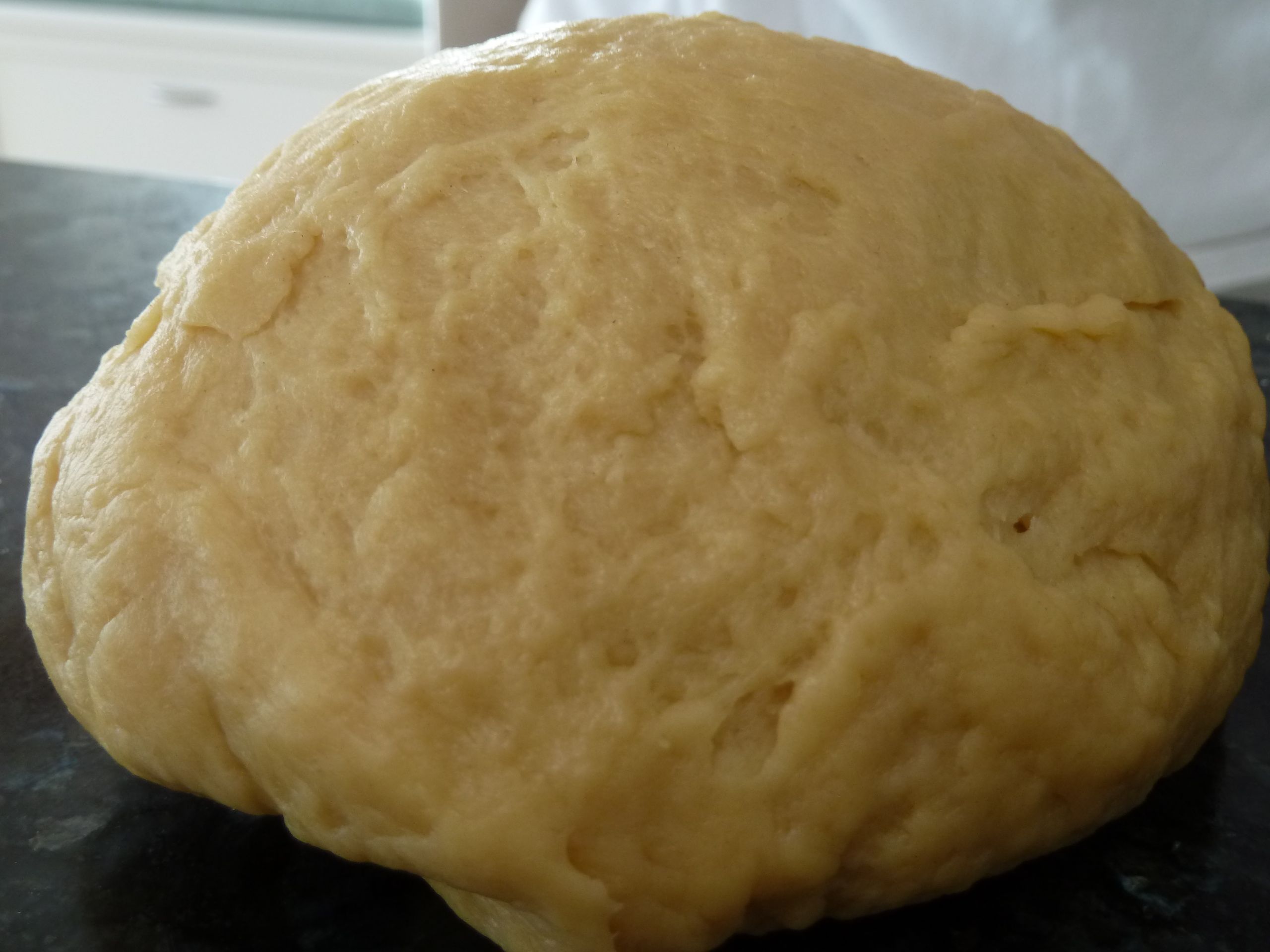
-Wrap the dough in plastic wrap and let it rest for 1 hour. Put it in the fridge until you’re ready to use, or use it right away.
What next? Get rolling! Usually this is done with a pasta roller. There are ones you can attach to your counter and crank by hand. We have one that fits on our Kitchen-Aid and turns automatically—so much easier. Either way, what you want to do is cut that ball of dough into quarters or eighths, pat it into a bit of a square shape of even thickness, add a touch of flour to make it less sticky, and run it through the pasta roller starting on the thickest setting—usually the number 7. Roll it through twice, then take it down one thickness, and so on, patting it with flour now and then. We usually go down pretty thin, usually to a number 2. As it gets thinner, it gets looonger. We usually cut it in half to make it more manageable, especially if you are cranking the roller by hand.
Going through the roller you end up with a flat sheet. Perfect for making lasagna or raviolis. Or, take that sheet and run it through the spaghetti or linguini cutter (an add-on that usually comes with the roller). Separate the noodles, lay them on a platter, sprinkle with dusting of flour, and toss to prevent sticking. Do one flat sheet at a time this way, each time dusting with flour.
And to cook, all you have to do is drop that pasta in boiling water for 2 minutes, max.
Now, that’s great pasta.
Beets: From Seeds to Roasted
August 2, 2011 § 1 Comment
I love me some beets. Love love love.
I know beet love is not a universal thing. I don’t belittle that. There are reasons to not like them. Sometimes there’s a metallic dirt after-taste. They can stain your hands—and cutting boards and dish towels—like you just murdered someone and stored them in the freezer. Then there’s that whole … nah, I’m not gonna go there.
My first beet love was a dish an old roommate would make in summer. Fresh, julienned beets with minced garlic, evoo and balsamic. Had a real nice crunch. Tasty, but only if you’re not dating someone.
Jennifer has an awesome beet soup – that’s my second beet love. It has the kitchen sink in it, too. I don’t want to hold out on you, but when the next beet harvest comes along, it’ll go up on Dainty. That okay?
My daily beet love goes out to the roasted variety. Simple. Delicious. And really quite beautiful.
New to Dainty!
Yeah for new! I’m including growing instructions. Yup, that’s what I said. This urban farmer is going to show that you—yes, you, city kid!— can take some seeds, grow them, and put them on your tasty table.
Growing Beets
What you’ll need: Beet seeds. A patch of soil/dirt, or a big, wide, deep container. Some way to water them.
Step 1: Beets can take cool weather. And hot weather, too. Another reason to love them. Get out in the garden early in spring—Aprilish for New England peeps—to sow your seeds. OR, start some seeds in early- to mid-August (ahem, NOW!).
Step 2: Beets’ big bulbousness develops underground, in case you didn’t know. It helps if your soil (I never called it dirt, but you know what I mean) isn’t rock hard. Is your soil like cement? Then go to the DIY store and buy a bag of “garden soil,” spread it on top of your “dirt,” and dig it in with a shovel or hoe. Sounds like work … it is! Don’t worry, it doesn’t take long.
Step 3: Beet seeds. Never beet “seedlings” because root vegetables (like beets and carrots) don’t like to be moved once they begin to grow. So, get yourself some. There’s all different types. Choose whichever tickles your tastebuds.
Step 4: Sow the seeds according to the seed packet instructions. Here’s a tip: Plant them in several rows maybe 6 in. apart and in a chess board-type pattern. You can squeeze more in the space that way.
Step 5: Water the seeds in … gently. And keep the soil moist as they germinate.
Step 6: Now, you’re going to wait weeks and weeks … watering and even fertilizing with an all-purpose fertilizer (go to the store and ask for it – you’ll get something good). Your seedlings may be too close together. And when that happens, the beets under the ground kind of grow into each other. It’s ok to sacrifice some of the smaller seedlings. If one seedling is too close to another, just pull it up and discard.
Just a warning: If you spot something on your beet leaves that look like random squiggly lines, you’ve got a pest called Leafminer. These little guys tunnel between the top and bottom of the leaf surface. Crazy! They are the bane of my spring garden—because they also love spinach and chard. If you spot a leaf with these markings, remove it … from the entire garden! Put it in the trash. Do not compost. You want these suckers dead and gone far away. You’ll eat those beet tops later … or the chard or the spinach. You don’t want these guys getting to it first, do you? If you are so inclined, look along the squiggly line and you just might be able to spot the white-ish larva. It’s really gross. Okay, on second thought, don’t look.
Step 7: As your beets get bigger—yay, how awesome is that?!—they may push themselves a bit above ground. Just lightly cover with some surrounding soil to keep the beet covered. Don’t want it to get sunburned, right?
Step 8: Harvest! Pull those beets up whenever you want. You can get a good idea of the size by taking your finger and going around the top of the beet under the soil. After a few months you’ll have small beets that will be good for pickling. Three months, and you’ll get a decent beet—the size you’ll see at a market. Don’t go for massive. No one needs massive beets.

Beets! and chard, too.
Step 9: Time to roast!
Roasted Beets
- beets, 3-4
- olive oil
- course salt, pepper
-Set oven to 425F. Cut off a 1 ft. length of aluminum foil, place in a cast iron pan.
-Wash beets. Cut off tops just above beet. Reserve beet tops for … well, you can saute them for pasta or as a side dish …
-Arrange beets on the foil. Glug olive oil on top of each beet – don’t need a whole lot. Sprinkle with salt and a turn of pepper. Fold foil around the beets so they are snug in the packet. You’ll want the moisture to stay inside.

Beets oiled and seasoned
-Slide into the oven. Cook 45-60 minutes, depending on the size of the beets. When are they done? When you can just insert a paring knife deep into its heart.
-When the knife slides in, remove the pan. Let cool until the beets can be handled. Actually, just wait until they are room temp. The skins of beet will be soooo much easier to remove when they are completely cool. And then just rub off the skins! For a cool visual, you can keep the short tops on the beet and rub the rest of the skin away if you want.

Beets, cooling.
What to do next? Store in sealed container in the fridge for 3-4 days. Cube or slice and eat with salads. Goat cheese is in love with beets, too, so be sure to pair them whenever you can.

Naked beets, ready to be sliced or cubed. How beautiful!
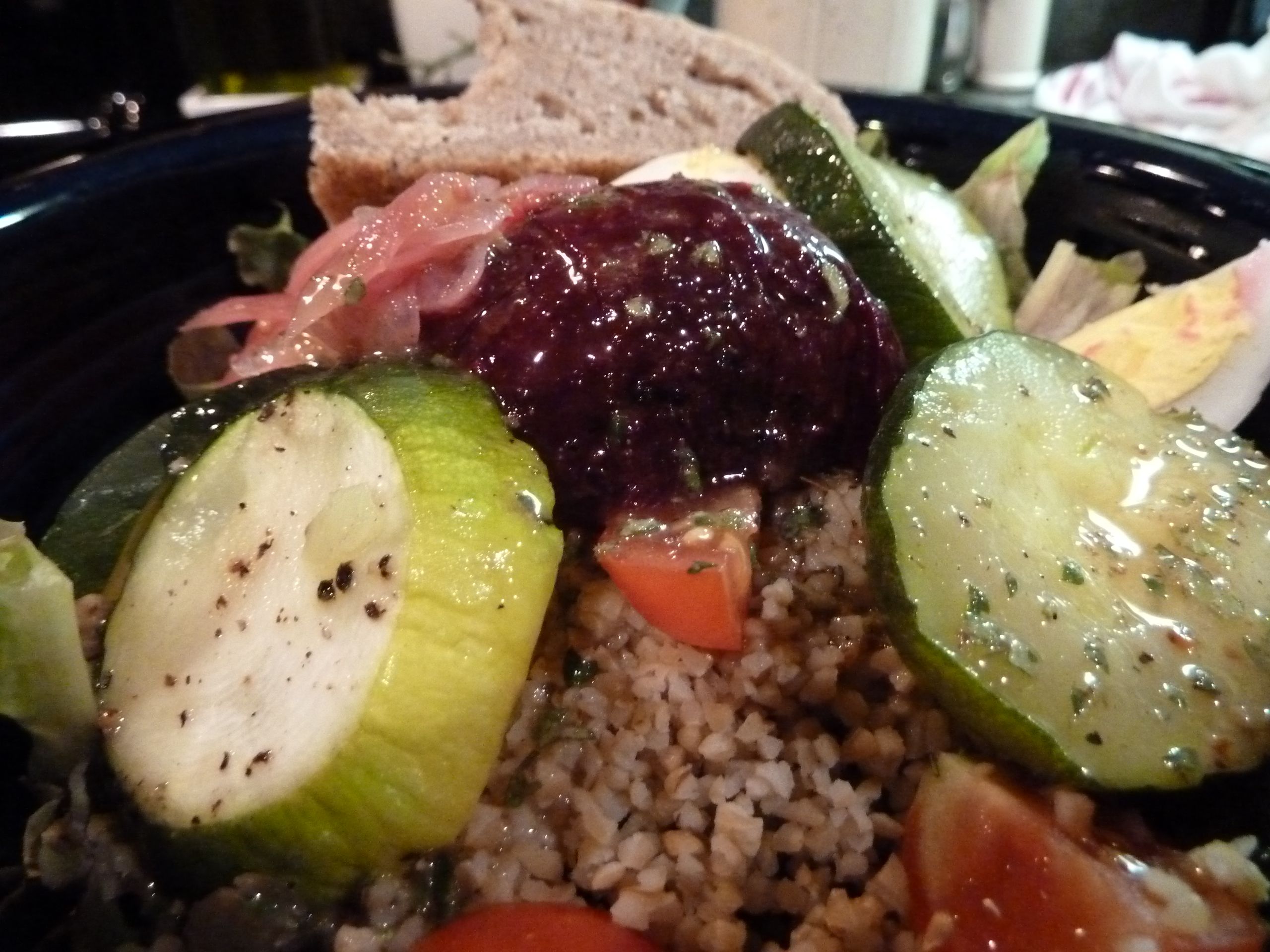
Roasted beets are fabulous on a salad.
Biga-Based Pizza Dough
June 1, 2011 § 5 Comments
Pizza is one of our fallback meals in the Dainty domicile. And it’s not delivery; not even DiGiorno. It’s made with good ol’ homemade, hand-thrown dough. With a special addition. Let’s call it Dainty Dough.
There are two things that make the Dainty Dough a bit different. First, it’s made with biga, one of many types of dough starters. It’s a yeast-based starter, not a natural sourdough starter—meaning it contains commercial yeast and not yeast found naturally in the environment (have I lost you yet? Hang on for a minute.). The biga ferments—i.e. sits on your counter bubbling away—for 8 to 24 hours or so, all the while developing a richer, chewier flavor. Pizza crust with flavor, not just used as a platform for toppings, imagine that.
The second thing I do is add a dollop or two of my Sourdough Starter, aka Milo the Baby Dough, during the dough-making process. A few months back you may recall I was experimenting with natural yeast and tried creating a real sourdough. Well, after a month or so, Milo is alive and well. I feel like I created a golem, it’s so incredibly cool. It’s totally not necessary to add this sourdough starter, but I’ll explain in a minute why I do it.
Dainty Dough: Step 1
Biga Recipe (from my Basic Baking class at the Cambridge School of Culinary Arts)
- 1/4 oz. yeast
- 1/4 cup warm water (warm=dip in a finger and it should feel the same temp as your body)
- pinch of sugar
- 1 1/2 cups warm water
- 3 3/4 cups flour (I suggest all-purpose flour here. If you want wheat dough you can add wheat flour later)
-Add yeast and 1/4 cup warm water with sugar in a bowl and stir together. Let it sit for 10 minutes. Add remaining water and the flour and mix thoroughly. You’ll end up with a creamy mixture. Cover and either let sit on the counter 8 hours or place in the fridge for 24 hours. It will become creamy and bubbly. The biga will remain
-At this point you can proceed with the next step and make the pizza dough. Or, I suggest weighing out your biga into 4 oz. pieces, reserving one piece for your current pizza and placing the remaining into individual freezer baggies and popping them in the freezer. Label and date your baggies! Otherwise a year from now you’ll excavate your freezer and wonder what the heck that thing is. From this one batch of biga you will get up to 8 4 oz. pieces. And each 4 oz. biga gives you four pizza stone-sized pizzas. Do the math—that’s a lot of pizza!
Dainty Dough: Step 2
Pizza Dough Recipe
- 4 oz. biga
- 1/4 tsp. salt (kosher preferred)
- 2 Tbs. olive oil
- A dollop or two of Milo the Baby Dough sourdough starter (optional)
- 4 1/2 cup flour (for wheat dough use 2 1/2 cups all-purpose and 2 cups whole wheat)
- 1 1/2 cup water
-Add biga, salt, oil, sourdough starter and flour to the bowl of a stand mixer fitted with a dough hook. Turn on slow speed, let it mix together for up to a minute then add water slowly. Because I’ve added a bit of the sourdough starter, there is more moisture in the dough and depending on your weather conditions, you may not need all of that water. Yes, baking depends on weather conditions, believe it or not.
-If you’ve added all the water and the dough seems wet and watery, add a tablespoon of all-purpose flour and let it mix in. Keep adding flour one tablespoon at a time until the dough is no longer wet but not bone dry! You’ll likely need no more than four or five tablespoons of flour.
-Keep mixing on medium speed for about five minutes. The dough has a tendency to ride up the dough hook. Stop the mixer when the dough makes it above the hook’s collar and push the dough back down into the bowl. Keep mixing until the dough feels smooth and it’s started to relax a bit; i.e., it shouldn’t feel like a hard tight wad of flour.
-Oil a medium bowl. Roll the dough around in the oil so it’s slightly oily all over. Cover with plastic wrap and let it sit for an hour. The dough won’t have risen all that much—it’s not rising like bread, we just want it to become elastic.
-Cut the dough into four equally sized pieces—they’ll likely have a triangular shape. Want an oddly shaped pizza? Then place these dough pieces as they are on a baking sheet or on the counter and cover with oiled plastic wrap. Want a perfectly round pizza? Then do this: Holding the dough piece in your hands, pull all the dough from around the piece into a central point. Go around the outside a couple times pulling it all into the center. Now, do your best to pinch that central point closed, then place the dough with that point facing downward. What you will have is a little ball with a perfectly round top, no seams showing anywhere except on the bottom. Cover these with oiled plastic wrap and let sit for about 20 minutes.
So, about adding that dollop or two of sourdough starter to the dough … here’s why I did it. I did, in fact, excavate my freezer recently and found two baggies of 13 month-old biga. Doing a little research I found that the recommended time for biga in the freezer is a max of four months. Oops. I added the sourdough starter as a way to give the dough a kick of fresh yeast. I think it worked. Plus, I noticed the crust did have telltale sourdough bread-like air bubbles. Tasty!
Hmm … turns out I have absolutely no photos of any of this. Bummer. Guess I’ll have to make some biga and dough later today.
By the way, biga can be used for more than just pizza dough. So instead of making 4 oz. balls of biga for the freezer, you can use what you have left for bread baking.
Wait, what? Am I leaving you without actually making a pizza? You bet. That’s for another day, when Jennifer can chime in on her favorite toppings. I make the dough, but she’s the pizza master.
The Ever-Versatile Roasted Vegetables
May 11, 2011 § 7 Comments
I don’t share Dainty with my real-world colleagues as a rule. Not sure most would approve of Dainty’s exploits. But my super-awesome colleague Chris T.—the designer of the Dainty Dot logo up at the top of the page—is definitely Dainty worthy.
So when Chris T. told me yesterday that I use a lot of—too many?—ingredients, I considered it. Do I really? Salt, pepper, oils and vinegars not withstanding, I’m mentally going over my recipes and counting up. The Steel-Cut Oatmeal I’m currently eating definitely doesn’t have that many ingredients—oats, raisins, slivered almonds, maple syrup. Okay, yeah, that’s a lot for a simple breakfast. Plus, it takes 20-plus minutes to prepare. But at least you can shower while it’s cooking—that’s something.
Chris T., to show that Dainty can prepare a flavorful dish with simple ingredients and instructions, I humbly present this for your consideration: Roasted Vegetables.
It doesn’t matter what it is—beets, leeks, broccoli, and old tennis shoe—you add EVOO, salt and pepper, put it on a baking sheet or cast-iron pan in a 42F oven and you’re going to end up with something tasty. You can skip the oil maybe, but why? If anything, it helps prevent the veggie from sticking to pan. The salt and pepper add flavor, yes, but the salt also helps to draw out the vegetable’s own juices. The high heat caramelizes those juices, so you end up with a tasty savory sweetness. Want to get your children in the habit of eating veggies? Don’t serve them bland boiled bleck—lightly roast some carrots or cauliflower and let them have at it. I don’t have children and I’ve never tested this theory so it might be bunk, but you never know. Give it a try.
Roasting vegetables is my go-to method when it seems there is absolutely nothing left to cook with in the house. There’s always something—a sweet potato, an onion or leek, a pepper, something—laying around that, with a little high heat, salt, pepper and EVOO, can be incorporated into a meal. If anything, they can be tossed with penne for a simple pasta supper.
Do you need instructions? Really? Okay, here they are.
Roasted Vegetables
-Firm vegetables work best. Sweet potatoes, potatoes, cauliflower, broccoli, winter squashes, onions, leeks work really well. Summer squashes such as yellow and zucchini, are good, too. Tomatoes … I typically use cherry tomatoes and put them in a medium-sized cast iron. They’ll burst, beware. But the flavor is phenomenal. Be forewarned—the acid will mess up your cast iron’s patina a bit. Clean immediately.
-Set your oven to 425F. I never rely on the temp gauge—your 425 may be hotter than my 425. So keep an eye on the veggies the first time you roast them to get a good idea of how your oven works.
-Veggie prep: The secret is to cut the veggies into uniform pieces for even cooking. All the sweet potatoes should be about the same size. Easily enough to do. When chopping the onion, leave them in relatively big chunks. No dicing. Broccoli and cauliflower can be kinda tricky to get into even sizes. But if some get more crispy than others, hey, that’s ok—it’s all tasty.
-Put your veg in a medium to big bowl, depending on how much you have. Add olive oil—I tip the bottle down and go once around the bowl for a small amount of veg, two to three times for more veg. Add one to two large pinches of kosher salt and several turns of a pepper mill. Toss to coat. Your hands are fine, or a wooden spoon or tongs work too. I prefer hands. Spread out evenly into a single layer in a cast-iron pan or rimmed baking sheet. Single layer! You want each veg to get in contact with the hot metal. Put in the oven and close ‘er up.
Note: What’s a large pinch? It’s a pinch that uses your thumb and your index, middle and ring fingers. It’s one finger away from a small grab. Go ahead, try it.
-Roasting time: Well, now, that all depends on what you’re roasting. Broccoli—2o minutes. Cauliflower—20-25 minutes. Beets, same thing. Sweet potatoes—up to 40 minutes. Butternut squash—35-40 minutes. Onions, leeks—15 maybe? Same with summer squashes. Asparagus, maybe 10 minutes. The softer the vegetable, the less time it takes. For softies, I check them at 12 minutes and then gauge from there. The harder the veg—like sweet potatoes—the longer it takes. For broccoli and cauliflower, I check them at 10 and give them a shaky toss. If you’re roasting a two or more different veggies—like broccoli and onions—on the same pan, I separate them so it’s easier to remove one if it’s done ahead of the other.
-When’s it done? When they turn a nice golden color, especially around the edges. Broccoli’s florets will begin to get a bit dark. That’s ok. Are the stem parts firm yet edible? You don’t want them to be floppy, but you want to be able to chew them without an awful crunch as if they are raw. Squashes—you should be able to stick a toothpick or fork into it easily but it shouldn’t be mush. Get the idea?
This weekend we made a simple pasta meal with roasted broccoli and onions and sun-dried tomatoes. We took a small handful

Roasted broccoli and onions with sun-dried tomatoes over pasta
of the tomatoes and put them in a bowl of maybe 1.5 cups of boiling water. Let them sit there while the broccoli and onions roasted and the pasta water boiled. Just before the roasting was done, we took out the tomatoes and gave them a rough chop, then threw them in with the drained pasta, a 1/2 cup of reserved pasta water and the roasted veggies. We served with a bit of Parmesan cheese. Delicious. Want some meat with that, you meat-eaters? We’ve had similar dishes where we’ve added a link or two of Al Fresco chicken apple sausage cut into bite-sized pieces.
Pasta, quinoa, bulgar, rice … whatever you have, as long as you have a veggie or two around and know how to roast it, you’ve got yourself a meal. And one with not that many ingredients.
Dainty’s Concocted Curry
April 28, 2011 § Leave a comment
Several weeks ago I attempted my first-ever Indian-spiced meal. Cauliflower masala. Turned out pretty well—read about it HERE. That was then followed by a chana bateta from the Brooklyn Eats blogger, not blogged about here but really tasty. That one includes potatoes in a homemade tomato-based curry. From those two recipes I figured if you have some mustard seeds, cumin, coriander and a touch of heat—and a whole bunch of other stuff—you can whip up a curry.
Last night’s meal is what I’m calling Dainty’s Concocted Curry. I had 2/3 cup of coconut milk I needed to finish off, and I didn’t have all the ingredients for either of the above recipes, so I kinda/sorta combined the two. Believe me, it can be tweaked here and there, especially in the heat department. But I’m pretty proud that I even attempted getting jiggy with these East Asian flavors.
Dainty’s Concocted Curry

Dainty's Concocted Curry over roasted broccoli, marinated baked tofu and brown rice
2 shallots, thinly sliced
3-ish garlic cloves, minced
0.5-1.0 TBS grated ginger
1-2 TBS oil (I always use olive but you can use canola)
1 tsp mustard seed
1.5-2 tsp cumin
2 tsp coriander
0.5-0.75 tsp cayenne (Would have added a touch more if we had it.)
1 tsp tumeric
couple pinches fenugreek
1 28 oz. can whole tomatoes
2 big dollops of tomato paste
2/3 cup coconut milk
salt and pepper
-Heat oil in a fairly deep fry pan, medium heat. Add shallots and garlic. Move ’em about in the pan now and then and you’re looking for them to be a bit translucent or, better yet, wilted. At this point I just grate the ginger right on top of that, guesstimating a tablespoon’s worth.
-While this is happening, put the mustard seeds in a small skillet with a slight amount of oil and heat on med-high. Cover! These seeds will start popping when they are ready – not long, about 3 minutes.
-When shallots/onions/ginger are done, add mustard seeds and all the spices to the mix. Stir about – it’ll be kinda pasty. You just want to get some heat on them to begin releasing their aromas. Doesn’t take long – a minute or two.
-Now, this can of whole tomatoes—one recipe called for one diced tomato, the other for a 14 oz can diced tomatoes. Other than a handful of cherry tomatoes, all I had was this 28 oz can of whole tomatoes. Open the can, reach on in there and grab one or two tomatoes, hold it over the pan and squeeze—carefully, otherwise it’ll squish tomato juice all over you. Do this for the entire can, then add the juice. And also add the tomato paste‚—that’ll help thicken it. Add coconut milk and stir. Give it a taste and see if you need to add salt or anything extra. Since I added way more tomatoes than I needed, I gave the mix a few extra shakes of all the spices except the cayenne (no more left) and the mustard seeds. Bring to just about boiling, then turn down to simmer and thicken. We had this on low while our brown rice was cooking for 45 minutes. Stir now and then and check up on it.
We’re pretty much done at this point. We did a take-out sorta thing with this when it came to assembling the meal. I roasted some broccoli and also baked some marinated sliced tofu. We put a big spoonful of brown rice in a salad-sized bowl, added some of the broccoli and a few tofu slabs, and then spooned the curry on top. Not too bad, I have to say.
You? You can add some cubed potatoes (as in one of the original recipes) and let those cook away while the curry is simmering. Or, maybe add some mushrooms. Maybe some stir-fried chicken. Steamed veggies. It’s a curry, and you can use it to add a little East Asian flair to your Wednesday evenings without leaving the house.
Double Mushroom Barley Soup
April 26, 2011 § 3 Comments
Will spring ever get here? Until it does, one of the ways to deal with cold and damp weather is with hot soup. Hot, hearty soup. This is one of our favorites in the hot and hearty category. It’s “double” mushroom because it uses both fresh and dried mushrooms. Adding the dried gives the soup its earthy heartiness.
This is another recipe Jennifer acquired from a soup class several years ago. Note on the bottom says it’s from the Great Vegetarian Cooking Under Pressure book. Ah, yes, “under pressure.” This is made in a pressure cooker! Have no fear, people—pressure cookers won’t explode on your stove top. And if you don’t have a pressure cooker, just cover and simmer for … well, I’m not sure. Just keep checking to see if the barley is toothy.
As before, the recipe below is with our adjustments

Double mushroom barley soup
Double Mushroom Barley Soup
- 2-3 tsp olive oil
- 2-3 medium cloves garlic, finely minced
- 2 cups chopped onions or 2 thinly sliced leeks (I use onions here)
- 6 cups boiling stock (see note in recipe)
- 1/2 cup pearl barley
- 1/2 lb sliced fresh mushrooms, white buttons are fine
- 1/2 oz. sliced dried mushrooms
- 2 large carrots, sliced
- 2 celery ribs, diced
- 2 large bay leaves
- 1.5 tbs dill weed
- salt and pepper to taste
-Put dried mushrooms in a medium bowl. Add about 2 cups boiling water. Cover with plastic wrap and let steep for 15 minutes.
-Now, for the “6 cups boiling stock” – set a pot of about 4 cups stock (veggie is good, chicken is okay if you don’t have veggie) to boil. You’re going to add the mushroom liquid to it when those are done steeping.
-While the mushrooms are steeping is a good time chop your veg.
-When mushrooms have steeped, drain the liquid into a measuring cup. You should have a bit less than 2 cups. Just add water to fill up to 2 cups. Add to the pot of stock. Reserve mushrooms.
-Heat oil in the bottom of the pressure cooker (or soup pot if not using a pressure cooker) to medium-high. Add garlic and onions. Cook for 1 minute, stirring so they don’t stick. Add the stock and then invite everyone else into the pool!
-Lock the top onto the pressure cooker. Bring it up to high pressure, then lower heat to maintain that pressure. Let it cook away for 18 minutes. Then, remove pressure cooker from the heat and place it under cool running water to bring the pressure down quickly. Remove the lid, being sure to face it away from you. You don’t wanna get hit with a cloud of steam!
-IF you’re not using a pressure cooker, bring the soup to boil, cover the pot but leave a little crack, and then turn it down a bit to simmer. Let it bubble along for … let’s say 35 minutes and then check every 5 minutes or so until you feel the barley is cooked.
-Discard the bay leaves. Add a bit more salt and pepper. In my opinion it needs more salt than you’d think.
-With barley in there, it’s going to thicken up, especially after being in the fridge for a day or two. Just be aware. If you want, add some stock or water to thin it out a bit. I kinda like the soups that turn into stews the next days.
It’s one of those soups that is dinner-worthy if you pair it with a salad or suitable for lunch with some toast. In fact, it’ll be my vegan lunch in about 3 hours.
Eggplant Asparagus Napoleons
April 21, 2011 § 4 Comments
Why these are called Napoleons, I’m not sure. Maybe because they are short squat layered stacks. I’m almost positive it wasn’t because the guy had a tasty complexity of flavors. In my book, these take the victory.
Here’s the idea: Layers of eggplant, ricotta and asparagus. Simple. Delightful. And they do have a mysteriously complex flavor, thanks to grilling.
Giada DeLaurentis, aka food porn queen, made these in a recent show. The recipe is easy enough to recreate. Just a warning, these require some grilling. We have one of those indoor grills that you plug in AND a 16-in. All-Clad grill pan. We used both at the same time for these.
Eggplant Asparagus Napoleons

Eggplant asparagus napoleon
(gives you 4 short stacks)
- 1 medium eggplant, sliced into 1/2-in. slices, at least 12
- asparagus – about 12 stalks
- 3-4 tbs freshly chopped thyme
- evoo
- salt/pepper to taste
- ricotta cheese, about 2 cups
- 1/2 lemon
-Set oven to 200F-250F
-Put about two cups of ricotta in a medium bowl. Add about half of the chopped thyme and squeeze in the juice of half a lemon. Stir to incorporate. Set aside.
-Put eggplant slices in a big bowl. Dowse with olive oil, sprinkle with two big pinches of kosher salt, a couple of twists of pepper, and the remaining chopped thyme. Get your hands in there (or use tongs) and make sure it is all evenly coated. The eggplant will suck up the oil – that’s okay, don’t overdo it.
-Set indoor grill or grill pan or maybe even your outdoor grill to medium and let it heat up. Place 12 eggplant slices on the grill – reserve the bowl they were in. If it looks like some of the slices missed a bit of oil, take some olive oil and a brush and brush them up a bit. Let them grill up on that side for a few minutes.
-Meanwhile, chop the woody parts off your asparagus. Place in that bowl, add a touch of olive oil, salt and pepper. You can grill these up in a separately as I did, or you can wait until your eggplant is done.
-Speaking of eggplant, check to see how the undersides are coming along. When they get golden grill marks on the bottom, flip ’em over. Maybe some of the ones you just turned over need another wash of oil. Your decision. Give them another couple of minutes to grill up – just take them off before they get limp and burned.
-Grill up the asparagus on medium. It won’t take as long as the eggplant. Move them to get all sides as best you can. 4-5 minutes max. You don’t want them wimpy; pick one up and hold it sideways – it shouldn’t sag. Place them on cutting board when done and chop them in half.
-Here’s the assembly part: On a baking sheet place four slices of eggplant. Spoon on a dollop of the ricotta – not too much, just enough to cover the slice but don’t spread it thinly either like butter on toast. Now add three asparagus sections on top of the ricotta. Add another layer of eggplant. More ricotta. Another three sections of asparagus. Now top it off with eggplant. You should have yourself a nice short stack.
-Pop the baking sheet in the warm oven for about 10 minutes or so – enough time to bring everything up to temperature.
Use one napoleon as a side dish or use two as a meal and serve with some sort of protein. I made a side of quinoa with roasted cherry tomatoes and shallots.
 The Dainty Dot