
Double Mushroom Barley Soup
April 26, 2011 § 3 Comments
Will spring ever get here? Until it does, one of the ways to deal with cold and damp weather is with hot soup. Hot, hearty soup. This is one of our favorites in the hot and hearty category. It’s “double” mushroom because it uses both fresh and dried mushrooms. Adding the dried gives the soup its earthy heartiness.
This is another recipe Jennifer acquired from a soup class several years ago. Note on the bottom says it’s from the Great Vegetarian Cooking Under Pressure book. Ah, yes, “under pressure.” This is made in a pressure cooker! Have no fear, people—pressure cookers won’t explode on your stove top. And if you don’t have a pressure cooker, just cover and simmer for … well, I’m not sure. Just keep checking to see if the barley is toothy.
As before, the recipe below is with our adjustments

Double mushroom barley soup
Double Mushroom Barley Soup
- 2-3 tsp olive oil
- 2-3 medium cloves garlic, finely minced
- 2 cups chopped onions or 2 thinly sliced leeks (I use onions here)
- 6 cups boiling stock (see note in recipe)
- 1/2 cup pearl barley
- 1/2 lb sliced fresh mushrooms, white buttons are fine
- 1/2 oz. sliced dried mushrooms
- 2 large carrots, sliced
- 2 celery ribs, diced
- 2 large bay leaves
- 1.5 tbs dill weed
- salt and pepper to taste
-Put dried mushrooms in a medium bowl. Add about 2 cups boiling water. Cover with plastic wrap and let steep for 15 minutes.
-Now, for the “6 cups boiling stock” – set a pot of about 4 cups stock (veggie is good, chicken is okay if you don’t have veggie) to boil. You’re going to add the mushroom liquid to it when those are done steeping.
-While the mushrooms are steeping is a good time chop your veg.
-When mushrooms have steeped, drain the liquid into a measuring cup. You should have a bit less than 2 cups. Just add water to fill up to 2 cups. Add to the pot of stock. Reserve mushrooms.
-Heat oil in the bottom of the pressure cooker (or soup pot if not using a pressure cooker) to medium-high. Add garlic and onions. Cook for 1 minute, stirring so they don’t stick. Add the stock and then invite everyone else into the pool!
-Lock the top onto the pressure cooker. Bring it up to high pressure, then lower heat to maintain that pressure. Let it cook away for 18 minutes. Then, remove pressure cooker from the heat and place it under cool running water to bring the pressure down quickly. Remove the lid, being sure to face it away from you. You don’t wanna get hit with a cloud of steam!
-IF you’re not using a pressure cooker, bring the soup to boil, cover the pot but leave a little crack, and then turn it down a bit to simmer. Let it bubble along for … let’s say 35 minutes and then check every 5 minutes or so until you feel the barley is cooked.
-Discard the bay leaves. Add a bit more salt and pepper. In my opinion it needs more salt than you’d think.
-With barley in there, it’s going to thicken up, especially after being in the fridge for a day or two. Just be aware. If you want, add some stock or water to thin it out a bit. I kinda like the soups that turn into stews the next days.
It’s one of those soups that is dinner-worthy if you pair it with a salad or suitable for lunch with some toast. In fact, it’ll be my vegan lunch in about 3 hours.
Seriously Good Protein Bars—Homemade!
April 23, 2011 § 1 Comment
I was making my Half-Whole Wheat Bread this morning, and since I had the Kitchen-Aid mixer out I thought, why not make some protein bars? We’re exercising a bit more and have cut down on our meat eating, so it’s a good idea to have additional sources of protein for those oh-my-god-I-wanna-eat-a-horse moments.
Yeah, I like those packaged protein bars – especially those Odwalla bars (mmmm….LOVE the carrot cake ones!). But a) they get kinda expensive and b) they aren’t as healthy as you think. full of sugar and all that.
So, when I saw Alton Brown make protein bars on Good Eats, I was all over it. Here’s the recipe with my minor alterations:
Alton Brown’s Protein Bars
4 oz soy protein powder – about a cup
2.25 oz oat bran – about 1/2 cup
2.75 oz whole wheat flour – about 1/2 cup
0.75 oz wheat germ – about 1/4 cup
1/2 tsp kosher salt
dried fruit – his recipe calls for 1/2 cup each of raisins, cherries, blueberries, apricots. I just use 2 cups of any dried fruit.
1 package silken tofu
1/2 cup unfiltered apple juice (do your best to find something along these lines)
4 oz brown sugar, about 1/2 cup packed
2 large whole eggs
2/3 cup natural peanut butter
-Line bottom of 13 b 9 inch glass baking dish with parchment paper. Or, just spray with Pam-like substance.
-Heat to 350F. I turn mine up to 375F.
-In large mixing bowl, combine protein powder, oat bran, wheat flour, wheat germ and salt. Set aside.
-In the bowl of a Kitchen-Aid mixer, whisk the tofu with the whisk attachment. Add apple juice, brown sugar, eggs and peanut butter, each one separately. Make sure everything’s incorporated. Change to the paddle attachment and add in the flour.
-Take bowl off mixer. Add dried fruit and mix in with a wooden spoon. Pour into glass dish. Spread around evenly.
-Bake about 35 minutes, until internal temp is 205F. Remove and let cool. Cut into squares. Store in airtight container. Best to keep in fridge because these can get a bit moldy otherwise.
-Chop up your dried fruit so it’s all about the size of raisins. Set aside.
Eggplant Asparagus Napoleons
April 21, 2011 § 4 Comments
Why these are called Napoleons, I’m not sure. Maybe because they are short squat layered stacks. I’m almost positive it wasn’t because the guy had a tasty complexity of flavors. In my book, these take the victory.
Here’s the idea: Layers of eggplant, ricotta and asparagus. Simple. Delightful. And they do have a mysteriously complex flavor, thanks to grilling.
Giada DeLaurentis, aka food porn queen, made these in a recent show. The recipe is easy enough to recreate. Just a warning, these require some grilling. We have one of those indoor grills that you plug in AND a 16-in. All-Clad grill pan. We used both at the same time for these.
Eggplant Asparagus Napoleons

Eggplant asparagus napoleon
(gives you 4 short stacks)
- 1 medium eggplant, sliced into 1/2-in. slices, at least 12
- asparagus – about 12 stalks
- 3-4 tbs freshly chopped thyme
- evoo
- salt/pepper to taste
- ricotta cheese, about 2 cups
- 1/2 lemon
-Set oven to 200F-250F
-Put about two cups of ricotta in a medium bowl. Add about half of the chopped thyme and squeeze in the juice of half a lemon. Stir to incorporate. Set aside.
-Put eggplant slices in a big bowl. Dowse with olive oil, sprinkle with two big pinches of kosher salt, a couple of twists of pepper, and the remaining chopped thyme. Get your hands in there (or use tongs) and make sure it is all evenly coated. The eggplant will suck up the oil – that’s okay, don’t overdo it.
-Set indoor grill or grill pan or maybe even your outdoor grill to medium and let it heat up. Place 12 eggplant slices on the grill – reserve the bowl they were in. If it looks like some of the slices missed a bit of oil, take some olive oil and a brush and brush them up a bit. Let them grill up on that side for a few minutes.
-Meanwhile, chop the woody parts off your asparagus. Place in that bowl, add a touch of olive oil, salt and pepper. You can grill these up in a separately as I did, or you can wait until your eggplant is done.
-Speaking of eggplant, check to see how the undersides are coming along. When they get golden grill marks on the bottom, flip ’em over. Maybe some of the ones you just turned over need another wash of oil. Your decision. Give them another couple of minutes to grill up – just take them off before they get limp and burned.
-Grill up the asparagus on medium. It won’t take as long as the eggplant. Move them to get all sides as best you can. 4-5 minutes max. You don’t want them wimpy; pick one up and hold it sideways – it shouldn’t sag. Place them on cutting board when done and chop them in half.
-Here’s the assembly part: On a baking sheet place four slices of eggplant. Spoon on a dollop of the ricotta – not too much, just enough to cover the slice but don’t spread it thinly either like butter on toast. Now add three asparagus sections on top of the ricotta. Add another layer of eggplant. More ricotta. Another three sections of asparagus. Now top it off with eggplant. You should have yourself a nice short stack.
-Pop the baking sheet in the warm oven for about 10 minutes or so – enough time to bring everything up to temperature.
Use one napoleon as a side dish or use two as a meal and serve with some sort of protein. I made a side of quinoa with roasted cherry tomatoes and shallots.
Potato Kale Soup
April 11, 2011 § 3 Comments
Dainty’s been back from California a week, but still hasn’t gotten in the groove. Catching up on work, volunteer meetings, dinners out, etc, have given me zero fodder for posting. And you’d think with a weekend just behind me, I’d have plenty to write about. I think maybe I made a batch of steel-cut oatmeal for breakfast—that’s about it. And a loaf of bread, but it was a workhorse kinda loaf—nothing spectacular.
I spent the weekend working on a homey project—painting the window well in the bedroom. Sure, I saved several hundreds of dollars doing it myself, but I sacrificed several million brain cells in the process (just say no to paint fumes). It’s a project that’s been on my list for about a year and I’m glad I got it done. And while I was scraping and painting, Jennifer was making a big batch of vegan soup to weekday lunches. And this is a good one.
Potato Kale Soup
- 1 tbs evoo
- 2 cups onions, chopped
- 2 leeks, washed and sliced thinly (chuck the dark green parts)
- 6 cups water
- 4 medium potatoes, cubed
- 2 tbs parsley, minced
- 3 carrots – whole
- 3 ribs celery – whole
- 2 bay leaves
- 1 tsp salt
- 1/4 tsp pepper
- 1/2 lb. kale, washed, torn and ribs removed
-Heat oil in large soup pot over medium heat. Saute onions and leeks until soft—abou 10-15 minutes.
-Add potatoes, parsley, whole carrots and leeks, bay leaves, salt and pepper. Boil, cover and simmer over medium low for 45 minutes.
-While that is simmering, cook kale in 2 cups boiling water in a skillet. Cover tightly and cook for 4-5 minutes until tender. Drain and set aside.
-After 45 minutes, remove carrot, celery and bay leaves from soup. Reserve the celery and carrots but chuck the bay leaves. Puree half the soup in a blender. OR, an immersion blender is awesome for this—just whirr up (who says that? Jamie Oliver?) half of it right in the pot. Stir in cooked kale. Chop up the carrots and celery and return to the pot. Heat the soup through again. Salt and pepper it if you need to.
Tada! A vegan alternative for lunch. Sounds like this could use some bread. I think I’ll do that right now.
Lentil-Bulgur Salad ala Moosewood
March 22, 2011 § 4 Comments
Bulgar? Bulgur? Bulghur? However you spell it, society at large has been hiding this absolutely spectacular whole-grain from me. If you are to believe movies such as The Adjustment Bureau, the men behind the curtains controlling my life have seen to it that bulgur shall never be placed in front of me. Ever. Never had it. Never saw it. Was never even tempted.
That is, until one Sunday morning a few months ago. I was tidying up the house with Food Network on in the background and Ba-Da-Boom Nigella Lawson made a bulgur dish to accompany a Moroccan meal. And if Nigella likes it, well … I gotta give this stuff a try.
Forget for a moment it’s a whole grain and nutritious and etc. It tastes good! It’s got a great consistency! And it plays well with others. In today’s recipe—and yesterday’s, too, actually—bulgur plays really well with lentils. So well, it’s like they are playing doctor, if you know what I mean.
This recipe is from the Moosewood Cookbook. I’ve eaten at the Moosewood, by the way, back in the mid 90s. And it’s true what they say—terrific food, the service coulda been better (they didn’t place my order. At. All. And that was just one of many examples). But, seriously good food. And if you can chop, you can make this stuff.
I made this for the first time Sunday. And my first reaction after tasting was, “ARE YOU KIDDING ME?? I just made this from that stuff??” I’m not kidding you, this stuff is taste on a plate.
A coupla notes: 1) Omit the feta and it’ll be vegan. 2) Serve at room temp – it has better flavor. 3) Stuff it in pita … yum. 4) I didn’t add the olives. I don’t think I had any and I forgot in general. 5) It’s a perfect protein. Oh yeah.
Lentil-Bulgur Salad
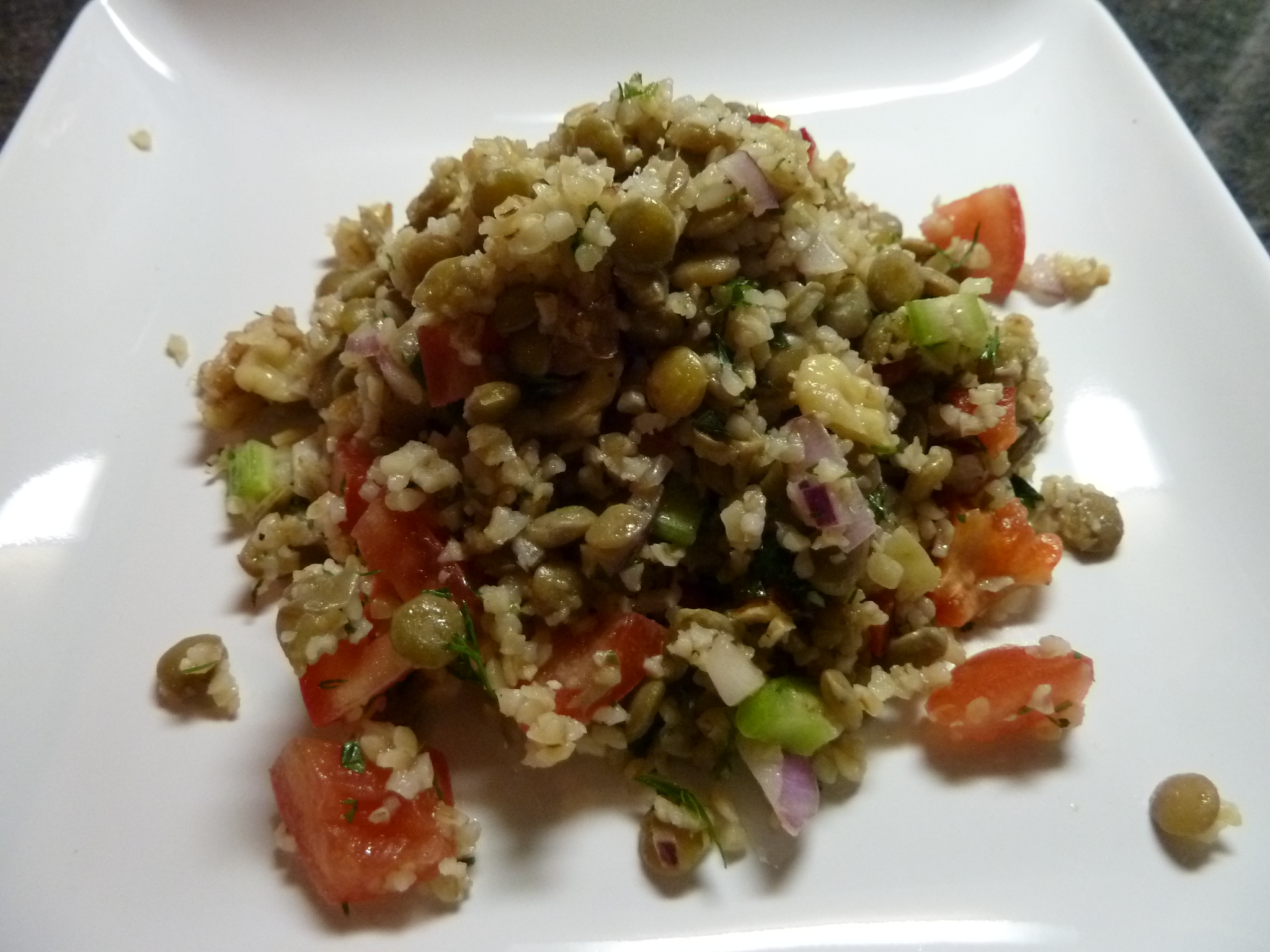
Lentil-Bulgur Salad
- 1 cup dry lentils (use green!)
- 2 cups water
Put lentils in small saucepan. Add water (and a pinch of salt). Bring to just boiling. Turn heat to low and simmer, partially covered, for 20-25 minutes until tender but not mushy. Drain well and place in a large bowl.
- 1 cup dry bulgur wheat
- 1 cup boiling water
Place bulgur in a small bowl. Boil a cup of water (microwave is fine) then add it to the bulgur. Give it a swirl. Cover the bowl with a plate. Let it sit for at least 15 minutes. That’s it.
Now comes choppin’ time. Add all of this to the lentils:
- 1/4 cup olive oil
- 1/4 cup lemon juice (I used juice of one lemon)
- 2 medium cloves garlic, crushed
- 1 tsp salt
- 1/2 tsp oregano
- 2 tbsp freshly minced (or 2 tsp dried) mint (do not skip this!)
- 2-3 tbsp freshly minced (or 2-3 tsp dried) dill
- fresh black pepper to taste
- 1/4 cup freshly minced parsley (I broke off a hunk of my frozen parsley)
- 1/3 cup minced red onion
- 1 small bell pepper
- 1/2 stalk celery, minced
- 1/2 cup crumbled feta
- 1/2 cup nicoise olives (oops, forgot those)
Stir those around and add the bulgur, too. Now add:
- 1 medium tomato, diced
- 1/2 cup chopped toasted walnuts
Fold that around. Give it a taste.
Right? I TOLD you. That’s flavor that’ll make your Greek grandmother weep.
Turkish Red Lentil Soup
March 21, 2011 § 6 Comments
So, about that two-thirds vegan diet … Oh, no worries, we’re still on it and still successful. Yay us! There is one small side effect, however, that I need to address. I get a vacant-minded, mad-hungry feeling around lunch time, and no matter how much I eat, I’m still kinda not all there. I’m thinking I may need more protein around then.
I’m no nutritionist, but I do know that a not-so-magical combination of certain beans and grains form a perfect (or close to it) protein. Do red beans and rice stave off the protein cravings enough so you don’t go chasing the nearest cow? I’m pretty sure they do.
In search of a protein-packed lunch option, two recipes found their way to me. The first just happened to be one of many Turkish recipes found in last Wednesday’s Boston Globe. Middle Easterners boy, do they know how to make huge flavors in vegan meals. Below is the recipe with a few changes as noted.

Turkish Red Lentil Soup
Turkish Red Lentil Soup (Ezogelin in Turkish)
- 2 tbs butter (I used a couple swigs olive oil)
- 1 small onion, chopped
- 1 tbs tomato paste (what to do with the rest of the can? freeze it)
- 1/2 cup bulgar wheat
- 2/3 cup red lentils
- 7 cups chicken stock (we used veggie stock)
- 3 tbs dried mint (couldn’t find any! so we used minced fresh, about 3tbs)
- 1 tsp dried thyme
- 1/4 tsp crushed red pepper
- salt & pepper to taste
-In a soup pot over medium heat, heat up butter or oil. Cook up onion until softened, about 5 min. Stir in tomato paste until blended in – 30-60 sec.
-Add bulgur, lentils and stock. Boil then simmer on low heat, pot covered. Let it simmer for about 30 min until lentils and bulgur are tender.
-Add mint, thyme, red pepper, salt and black pepper and simmer a few more minutes to meld the flavors.
Use RED lentils, not green. Red lentils tend to break down further than green, creating more of a mush or, when in a soup, it’s more of a thickener. You can use green but, well … I wouldn’t, not for this soup.
We actually had this last night for dinner, served with hunks of fresh bread (I’m still baking!) and a side of lentil-bulgur salad—another high-protein dish. I’ll give you that recipe tomorrow. That is a seriously tasty salad.
The Really Slow Food Movement
March 18, 2011 § 1 Comment
Slow food – either in the home or in a restaurant – is something I believe in. It’s flavorful, aromatic, enjoyable and really hits all the senses. I get that – and I absolutely love it.
I am, however, a big big believer in the really sloooow food movement. In fact, I’m working on a spinach salad right now. Should be ready in about 40 days, if we get some good weather.
You guessed it – I’m growing the spinach myself.
Spinach is one of those cool-season crops that you can start as early as March. It’s a tough character and can take chilly weather. Think of it as a Patriots linesman at Gillette in January with short sleeves and lovin’ it. Yes, it’s mild outside today – what plant doesn’t love 65F? – but temps will drop, believe me. And spinach will be able to handle the temp fluctuations.
I have a garden plot in the Washington-Rutland Community Garden – aka the Gazebo Garden – right across the street from Flour Bakery in the South End. Our plot is one of about 40 in the fenced-in lot, former site of I believe three rowhouses from back in the day. At roughly 15 ft x 30 ft, it’s one of the largest plots in the garden. And, after more than three decades as a community garden, I’m still finding bits of broken glass and the occasional spark plug while digging around.

My garden plot is within the two railroad ties on the left and right, and ends right beyond that white bag.
I know I said spinach can handle coldish weather, but it certainly does respond when given a bit of warmth. I’m helping my spinach seeds along by creating some warmth with a coldframe. This is the concept: It’s an enclosed space topped with a clear material like glass or plastic. When I was a kid my parents made a coldframe by creating a rectangle with hay bales and then putting old glass windows on top. Sunlight comes in, heats up the space, and the plants grow while the air outside is still chilly.
Hay bales? Old window frames? I’m not down on the farm anymore – I needed to find another solution.
Last year I made a 2ft x 3ft x 2ft wooden box, filled it with organic soil and grew my carrots in it. Why I did that is a story for another time. But, there it was, sitting there in my garden, unused and topless. And I had one of those light-bulb-going-on-over-my-head moments: Put a piece of plexiglass on top and make a coldframe!

My awesome coldframe!
So, the plexiglass top has been in place since Sunday, covering newly sown rows of carrots and spinach. I checked on it today and the soil was nice and warm – something that seeds trying to germinate would really appreciate. I propped the lid open just a tad, too. More for the photo than to cool down the interior. And, because the top was on during Wednesday’s rain, I had to water it, too.

So, here it is propped open. In a perfect world, the plexiglass would be attached to the frame and there would be a device that would allow the top to be opened in varying increments. Actually, in a perfect world the top would open automatically in response to a solar and temperature sensor. But, this’ll do.
About those spinach seeds: I sowed just one row last Sunday. This weekend I’ll sow another, and so on until the end of April. That way I’m not stampeded by a crop of spinach all at once. I may let the first two batches mature in the box but eventually the box will fill up. At that time I’ll just transplant the seedlings out into the ground. If this year’s crop is anything like last year’s, I may have some to share with you.
Mini Mint Oreos ala Flour Bakery
March 17, 2011 § Leave a comment
From now on—for the rest of my life—whenever I say the word “oreo,” I am exclusively referring to the oreo as envisioned and interpreted into chocolate cookie and filling by Joanne Chang of Flour Bakery. Have one bite of the Flour Oreo and you will agree. That other … cookie … it’s a dime-a-dozen cookie. Flour’s oreo is a treat.
If there is one negative I have to nail onto Flour’s oreo, it’s that the chunk of dark chocolately heaven is too big. Is it possible? Slightly. That’s why I had the idea to make them smaller.
Last December I promised I would bring homemade oreos to a holiday party. The recipe – which is a slice-cookies-from-a-dough-log type of cookie – makes about 18 cookies. Definitely not enough for a holiday party. “Minis!” I thought. And why not add some peppermint flavoring for that added holiday pizzazz.
They were the hit of the party.
Well, Erin Go Bragh, it’s now St. Patrick’s Day. For St. Patty’s Day, you’ve got to do something green. Well, let’s add green food coloring to the oreo filling. And if the filling is going to be green, the eater of the cookie is expecting mint. Right?
Green Mint Oreos for St. Patrick’s Day. And minis, too.

Mini Mint Oreo Cookies ala Flour Bakery
Adjustments to Oreo cookie recipe ala Flour cookbook:
Dough log: After leaving dough to firm up for 1 hour, divide dough into 4 equal batches. Roll it into a 1-in. log on parchment paper, as opposed to the instructed 2.5-in log.
Mint: Add 1/2 tsp. peppermint extract. That’s enough! Seriously. All you need.
Green: Add 3-5 drops green food coloring. You can’t tell from the photo, but it’s a nice medium green.
The one thing that I would adjust next time … because the mixer really needs to beat in the food coloring, it makes the filling a bit softer than I’d like. I may decrease the addition of milk from 1 tbs to 1/2 tbs next time.
Bread Cracking in the Oven—Solved!
March 14, 2011 § Leave a comment
Last summer I discovered the joys of bread baking. I guess you’d call it my hobby now. And I say hobby because … well, unlike putting a Pop Tart in the toaster and waiting for the ding, there are levels of complexity at every step. There’s practice and skill and problem-solving and continual learning from mistakes. Described that way, it seems more like a sport. And, considering I currently have three different sourdough ferments tucked snuggly in the warm and draft-free microwave, perhaps I’m also a collector.
Yesterday, I had one of those “Aha!” learning experiences. I made a batch of Country Sourdough from the Amy’s Bread cookbook. It was my first time making this recipe and considering my firm levain wasn’t so firm and I substituted in my sourdough starter, I wasn’t so sure the recipe would work properly.
I made the dough, let it autolyze, formed it into a ball, let it rise, punched it down, let it rise again, separated into two doughs, formed boules and let them rise again – seam side down – in floured baskets. The dough looked and felt great. So far, so good.
Now, in Amy’s instructions, typically once you get to this point in the recipe it’s almost as if they copied and pasted the remainder of the instructions for each and every recipe. At least for the handful of recipes I’ve tackled so far. BUT, this time she had a slightly different twist in the instructions. She said to tip the boule out of the basket onto the prepared parchment paper so the seam was now on top. Hmmm … I had not encountered that in previous recipes. All others were seam side down. Why would you put the seam up?
I had two boules – I thought, “Let’s try one seam side up, one seam side down, and see what happens. I scored both loaves on top, put them in the oven, and let them go.
Here’s what came out of the oven. Can you guess which one was which?

Seam side up on the left, seam side down on the right.
The one on the right was the seam-side down. Even though I scored the top, the steam escaping the loaf escaped through the seam on the bottom, causing it to tear.
For the boule on the left, the scores through the seam on top let the steam escape. Not having a weak spot—a seam on the bottom—prevented the bottom from bursting.
I tried to seal that seam as tightly as possible, but apparently not enough. This doesn’t happen with all of the breads I’ve made, but I have had this happen before. And now I know why. Problem solved.
Cauliflower Masala
March 2, 2011 § Leave a comment
It’s not that I don’t like Middle Eastern/East Asian spices. I love them. I just don’t know how to use them.
For me, adding a shake of tumeric or fenugreek isn’t like reaching for the thyme or oregano. There’s a feeling for proportion with these spices with which I am not yet familiar.
Cooking is about trying new things. So, I tried something new last night. Cauliflower Masala.
A few months ago when I was testing out names for blogs I thought would be appropriate for me, I typed in www.growcookeat.com into my little url space and – what do you know – someone already had that blog. A chef/urban gardener/consultant, Julia Shanks had already taken the perfect name. Turns out she’s in the Boston area, too. Julia, if you read this, we should meet up and talk about getting a jump on the gardening season.
Cruising around her site, I found a recipe I just had to put in my “to cook later” files. I love cauliflower (my mother was be aghast to hear that), and it’s about time I try my hand with Middle Eastern spices. The recipe seemed ultra-accessible, so why not?
Again, I made a few changes to the recipe due to only having a 1/2 head of cauliflower – hers calls for a whole head, no potato, one tomato and a whole onion. I kept the spice proportion the same.
Ingredients

Cauliflower Masala
- 1/2 head cauliflower, separated
2 potatoes, on the smaller side, cut into 3/4-in. chunks
1+ 1 tbs. olive oil
1/2 onion, chopped or diced
minced fresh ginger, about the size of your thumb to your first knuckle
1clove garlic, finely chopped
½ tsp. brown mustard seed
½ tsp. cumin
pinch fenugreek
½ tsp. turmeric
2 tomatoes, chopped – try to keep the juices if you can
1 fresh green chili, sliced
Salt to taste
-Toss cauliflower and potato with the olive oil and add a pinch of salt/twist of fresh pepper. Put on a baking sheet and roast in a 425F oven for 20 minutes.
-Meanwhile, saute onion, garlic and ginger in another 1 tbs. olive oil on med-low heat. Let it cook down until the onions are transparent – 5 minutes or so.
-While that is happening, rough chop the tomatoes. Instead of slicing, I minced the chili because I’m a wuss. But, I did mix the tomatoes and chili with a pinch of kosher salt and let them sit together until needed, letting the flavors meld together.
-When onions, garlic and ginger are nicely sauteed, add the spices, stir, and let them sit on low for a minute. Add the tomatoes and chili. Cover and let sit until cauliflower is done – no more than a couple of minutes.
-Time the cauliflower to come out just as the tomatoes go into the onions. Add the roasted veggies and mix the flavors together. Season with salt.
Oh my lord, it worked. The flavors were amazing. So simple and so QUICK. I’d serve it on top or alongside of cous cous or rice, but last night we had it on its own.
A note about proportions – I used half a cauliflower because that’s what we had and added in an extra tomato and the potatoes to make up for some of the bulk. Even with a whole head I would add in two tomatoes. The potatoes were good in it, too. The recipe is definitely a keeper. Thanks, Julia.
P.S. Yes, my food photography sucks. It’s just my camera phone. But I’m in the process of researching cameras. Any suggestions?
 The Dainty Dot