
Zucchini and Corn Salad
August 1, 2011 § Leave a comment
You can’t cook. I mean, you just can’t cook.
It’s 105F in the shade. It’s hot. The thought of lighting that pilot light and having a controlled fire on your stove top makes you break out in hives.
Or …
Or you’re in my friend Katherine’s position and don’t currently have a working kitchen due to home remodeling. Home “modeling,” I should say; her condo is so brand-spanking new, there are no appliances yet. But wait. She has an electric wok and maybe a microwave. Thank god, that’s something. She does dishes in her shower, I hear.
So, Katherine, this recipe is for you and all those other folks who can only make a meal the pre-discovery of fire way. Yes, it calls for you to eat corn and zucchini in their raw states. But it’s surprisingly good, and refreshingly cool.
Zucchini and Corn Salad (adapted from a Martha Stewart Living recipe)
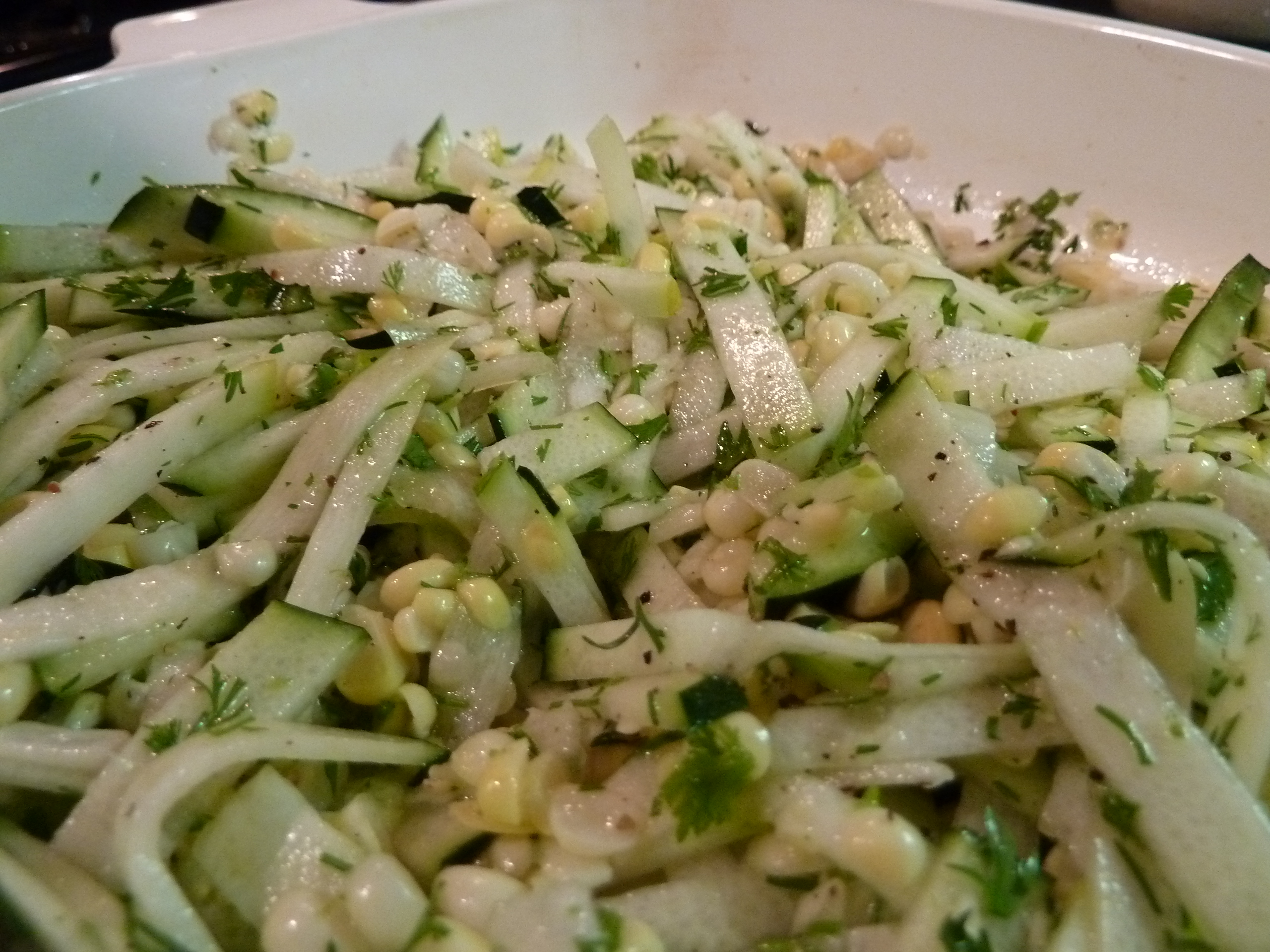
Zucchini and Corn Salad
- 3 ears corn, shucked
- 2 medium zucchini, thinly sliced or matchsticked
- 2 tablespoons fresh lime juice
- 2 tablespoons extra-virgin olive oil
- 2 tablespoons coarsely chopped fresh cilantro
- Coarse salt and ground pepper
-Remove kernels from corn cob. Martha had a great suggestion: Cut off the cob ends, and stand cob up in a shallow dish. Take a sharp knife and, starting from about the middle of the cob, slice off the kernels in a downward motion, working your way around the cob. Don’t slice off too much of the cob – you want just the nice milky kernel. Flip the cob over and do the other half.
-Recipe calls for two medium zucchini. Not sure about you but my zucchini in the garden this time of year only come in the “extra large” size. I’d say you’re looking for 2-3 cups of zucchini, sliced thinly. Or, make matchsticks: I slice 1/4-in. thick rounds of zucchini and then run them down the large, single-slice side of my stand-up grater. Okay, it’s not the small, square-sided wooden matchsticks; more like the slim matches in those paper booklets. But matchsticks, nonetheless. Add the zucchini to the corn in that small shallow bowl.
-Add lime juice, evoo, cilantro and salt and pepper to taste. Letting it sit for about an hour before serving lets the flavors develop. Pop it in the fridge if you’d like for a nice crunchiness.
Salad from a City Garden
July 29, 2011 § Leave a comment
Remember yesterday?
Remember that haul of produce I brought home from my city community garden plot? All of it—the lettuce, the chard, the beets, the tomatoes and whatever else I gathered—is washed/bagged/roasted/drying/sitting in a hydrator.
Are you interested in how I saved the lettuce/chard/etc? There’s a way to do it. I can tell you about that later if you want …
But for now, let me tell you about my lunch. 
-Lettuce from the garden.
-A half of a beet from the garden, roasted.
-Cherry tomatoes from the garden.
-A half of a zucchini from the garden, roasted.
–Greek Salad Dressing, made with oregano from the garden.
-Boiled eggs, from our backyard hens (Oh, please. Who do I think I am? Jayme Jenkins?).
–Pickled red onions, pickled myself!
-Green lentils and bulgur – okay, I didn’t grow them but at least I boiled them myself.
-A slice of bread I made using my wild yeast sourdough starter.
I’m full. I need a nap.
Spicy Eggplant Relish ala Moosewod
July 22, 2011 § 1 Comment
One of the things we do when we spend time in Provincetown is head over to the Saturday farmers market. This time of year the stalls offer some great fresh produce we haven’t seen locally since last summer. This time we picked up two smallish eggplants. Versatile! Yummy! Pretty! Eggplants are all of the above … And also a bit short-lived on the countertop, especially in weather like this.
What to do with them? We could grill. We could stuff. We could make lasagna. We could bread. And we did none of those. Instead, when they began getting “long in the tooth,” we turned to an old standby – spicy eggplant relish.
I pulled this recipe from my Moosewood cookbook a few years ago for a get-together and used it as a dip. It got a great response. We used the leftovers in numerous ways, such as a spread for sandwiches, and also as an eat-by-the-forkful snack. Can’t remember exactly which Moosewood cookbook it came from, possibly the original. Luckily its a popular recipe and we were able to find it online – hey, we’re on vacation, we don’t travel with old cookbooks.
Recipe
2-3 Tbs olive oil
1 medium onion
1 small red pepper, large dice
2 small-medium eggplant, small cubes, don’t bother peeling
Salt, pepper and cayenne to taste
-heat oil over medium-low. Add onions and sautée until softish, 4-5 min.
-add cubed eggplant and red pepper. The eggplant will soak up a lot of the oil. Stir really well to coat all of it. Let it cook low and slow. Add a generous pinch or two of kosher salt and several turns of fresh pepper.
-Let it cook down awhile – 5 min or so. Add in as much cayenne as is appropriate for you. Cook partially covered for another 4-5 min.
-is the eggplant soft? Take it off the heat. Season with salt/pepper if needed.
We ran into one small problem during this – there was no cayenne in the house. How is that possible? We made due with some chili powder and red pepper flakes. The chili powder gave it a smoky flavor, making it a bit more savory. It was a good addition, actually. I added a bit too much red pepper flakes. Adding a small sliver of cheese when serving on a cracker will take care of that. Looking forward to having this in a tofu wrap for lunch. Perfect beach food.

Kitchen Cobb Salad
June 25, 2011 § Leave a comment
When staying at our friend’s winter getaway in Vermont, the “fridge-tata” is the breakfast of choice. But it’s summer now, and our summer getaway is our friend’s bay-side home in Provincetown. No fridgetatas here. Lunches call for something lighter, something a little more summery. But just as easy.
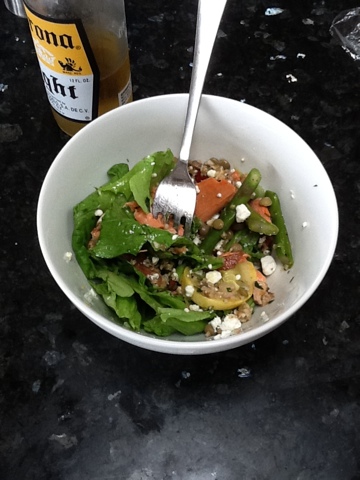
Open the fridge. pull out the freshly harvested lettuce from the garden. Assess the leftovers. Make yourself a Kitchen Cobb Salad.
Now, a Kitchen Cobb is not an actual Cobb salad. It could be, I guess, if you just happen to have strips of turkey and bacon and egg and such. The Kitchen Cobb is much less structured, much less formal. Really, it’s anything you find in your fridge that you wouldn’t mind having atop some greens. Leftover roasted asparagus? Sure. Grilled salmon? Why not. A dollop of cottage cheese? Throw it on there. When it comes to a Kitchen Cobb, anything goes.
Today’s Kitchen Cobb benefitted from last night’s meal cooked for eight – steak, salmon, and lentil-bulgur salad, with the leftover pear and red onion green salad as a base. No steak on our salads, of course. We also threw in some roasted asparagus and goat cheese, and topped with lemon-oregano vinaigrette.
Jennifer gets credit for the name. She’s good like that.
Biga-Based Pizza Dough
June 1, 2011 § 5 Comments
Pizza is one of our fallback meals in the Dainty domicile. And it’s not delivery; not even DiGiorno. It’s made with good ol’ homemade, hand-thrown dough. With a special addition. Let’s call it Dainty Dough.
There are two things that make the Dainty Dough a bit different. First, it’s made with biga, one of many types of dough starters. It’s a yeast-based starter, not a natural sourdough starter—meaning it contains commercial yeast and not yeast found naturally in the environment (have I lost you yet? Hang on for a minute.). The biga ferments—i.e. sits on your counter bubbling away—for 8 to 24 hours or so, all the while developing a richer, chewier flavor. Pizza crust with flavor, not just used as a platform for toppings, imagine that.
The second thing I do is add a dollop or two of my Sourdough Starter, aka Milo the Baby Dough, during the dough-making process. A few months back you may recall I was experimenting with natural yeast and tried creating a real sourdough. Well, after a month or so, Milo is alive and well. I feel like I created a golem, it’s so incredibly cool. It’s totally not necessary to add this sourdough starter, but I’ll explain in a minute why I do it.
Dainty Dough: Step 1
Biga Recipe (from my Basic Baking class at the Cambridge School of Culinary Arts)
- 1/4 oz. yeast
- 1/4 cup warm water (warm=dip in a finger and it should feel the same temp as your body)
- pinch of sugar
- 1 1/2 cups warm water
- 3 3/4 cups flour (I suggest all-purpose flour here. If you want wheat dough you can add wheat flour later)
-Add yeast and 1/4 cup warm water with sugar in a bowl and stir together. Let it sit for 10 minutes. Add remaining water and the flour and mix thoroughly. You’ll end up with a creamy mixture. Cover and either let sit on the counter 8 hours or place in the fridge for 24 hours. It will become creamy and bubbly. The biga will remain
-At this point you can proceed with the next step and make the pizza dough. Or, I suggest weighing out your biga into 4 oz. pieces, reserving one piece for your current pizza and placing the remaining into individual freezer baggies and popping them in the freezer. Label and date your baggies! Otherwise a year from now you’ll excavate your freezer and wonder what the heck that thing is. From this one batch of biga you will get up to 8 4 oz. pieces. And each 4 oz. biga gives you four pizza stone-sized pizzas. Do the math—that’s a lot of pizza!
Dainty Dough: Step 2
Pizza Dough Recipe
- 4 oz. biga
- 1/4 tsp. salt (kosher preferred)
- 2 Tbs. olive oil
- A dollop or two of Milo the Baby Dough sourdough starter (optional)
- 4 1/2 cup flour (for wheat dough use 2 1/2 cups all-purpose and 2 cups whole wheat)
- 1 1/2 cup water
-Add biga, salt, oil, sourdough starter and flour to the bowl of a stand mixer fitted with a dough hook. Turn on slow speed, let it mix together for up to a minute then add water slowly. Because I’ve added a bit of the sourdough starter, there is more moisture in the dough and depending on your weather conditions, you may not need all of that water. Yes, baking depends on weather conditions, believe it or not.
-If you’ve added all the water and the dough seems wet and watery, add a tablespoon of all-purpose flour and let it mix in. Keep adding flour one tablespoon at a time until the dough is no longer wet but not bone dry! You’ll likely need no more than four or five tablespoons of flour.
-Keep mixing on medium speed for about five minutes. The dough has a tendency to ride up the dough hook. Stop the mixer when the dough makes it above the hook’s collar and push the dough back down into the bowl. Keep mixing until the dough feels smooth and it’s started to relax a bit; i.e., it shouldn’t feel like a hard tight wad of flour.
-Oil a medium bowl. Roll the dough around in the oil so it’s slightly oily all over. Cover with plastic wrap and let it sit for an hour. The dough won’t have risen all that much—it’s not rising like bread, we just want it to become elastic.
-Cut the dough into four equally sized pieces—they’ll likely have a triangular shape. Want an oddly shaped pizza? Then place these dough pieces as they are on a baking sheet or on the counter and cover with oiled plastic wrap. Want a perfectly round pizza? Then do this: Holding the dough piece in your hands, pull all the dough from around the piece into a central point. Go around the outside a couple times pulling it all into the center. Now, do your best to pinch that central point closed, then place the dough with that point facing downward. What you will have is a little ball with a perfectly round top, no seams showing anywhere except on the bottom. Cover these with oiled plastic wrap and let sit for about 20 minutes.
So, about adding that dollop or two of sourdough starter to the dough … here’s why I did it. I did, in fact, excavate my freezer recently and found two baggies of 13 month-old biga. Doing a little research I found that the recommended time for biga in the freezer is a max of four months. Oops. I added the sourdough starter as a way to give the dough a kick of fresh yeast. I think it worked. Plus, I noticed the crust did have telltale sourdough bread-like air bubbles. Tasty!
Hmm … turns out I have absolutely no photos of any of this. Bummer. Guess I’ll have to make some biga and dough later today.
By the way, biga can be used for more than just pizza dough. So instead of making 4 oz. balls of biga for the freezer, you can use what you have left for bread baking.
Wait, what? Am I leaving you without actually making a pizza? You bet. That’s for another day, when Jennifer can chime in on her favorite toppings. I make the dough, but she’s the pizza master.
De Kas Restaurant: A Hot Table in Amsterdam
May 24, 2011 § 3 Comments
More than a week after lunching at De Kas Restaurant in Amsterdam, I’m still dreaming of the meal. It’s one of the hottest tables in Amsterdam, and no wonder, given its fresh, bright flavors, dedication to locally grown foods and airy environment. And I mean airy environment: The restaurant is under glass in a state-of-the-art greenhouse.

Restaurant De Kas
De Kas is certainly in unique surroundings. The history of the property goes something like this: Back in the 1920s, the parcel of land was home to Amsterdam’s municipal nurseries. All of the plants and flowers used for Amsterdam’s municipal plantings were grown on these grounds and in greenhouses. Over the decades, the nurseries were shut down and the buildings and greenhouses became dilapidated—such a shame! About 10 years ago the greenhouses were scheduled for demolition, but a Michelin-rated chef, Gert Jan Hageman, came up with the idea of converting one of the greenhouses into a restaurant and growing area. The dining room was designed by renowned designer Piet Boon and is lovely. The kitchen is open, and there’s even a chef’s table, where guests can enjoy their meal just steps from the hot grill (honestly, not something on the top of my list to do). And the bar area, while open and visible, is tucked away and is just shady enough for any self-respecting bar fly.

The Piet Boon-designed dining room, with the just-shady-enough bar in the background.
As I mentioned, they believe in fresh, local food. And it can’t get more local than the greenhouse adjacent to the kitchen and the gardens that surround the restaurant. The team also has a farm that produced a great deal of their produce. What they don’t grow and raise themselves is sourced from nearby farms and the North Sea.

The veggie gardens outside De Kas.

The growing area inside De Kas's greenhouse, adjacent to the kitchen.
Enough about that, let’s move on to the food. The three-course menu is fixed; i.e. you are served what they are preparing that day (they do ask if the chef should take into account for any dietary restrictions). And they do offer a wine pairing, which I eagerly agreed to. Can’t recall the first wine, but the second was an unoaked chardonnay from Spain. Tasty!
The meal was fabulous, that’s a given. And beautiful – not something every restaurant gets right. Instead of attempting to describe the meal, I’ll just leave you to enjoy the photos.

First of two first-course salads: Roasted beets and steamed rhubarb over baby beet (?) greens with a pea puree and nasturium flowers.
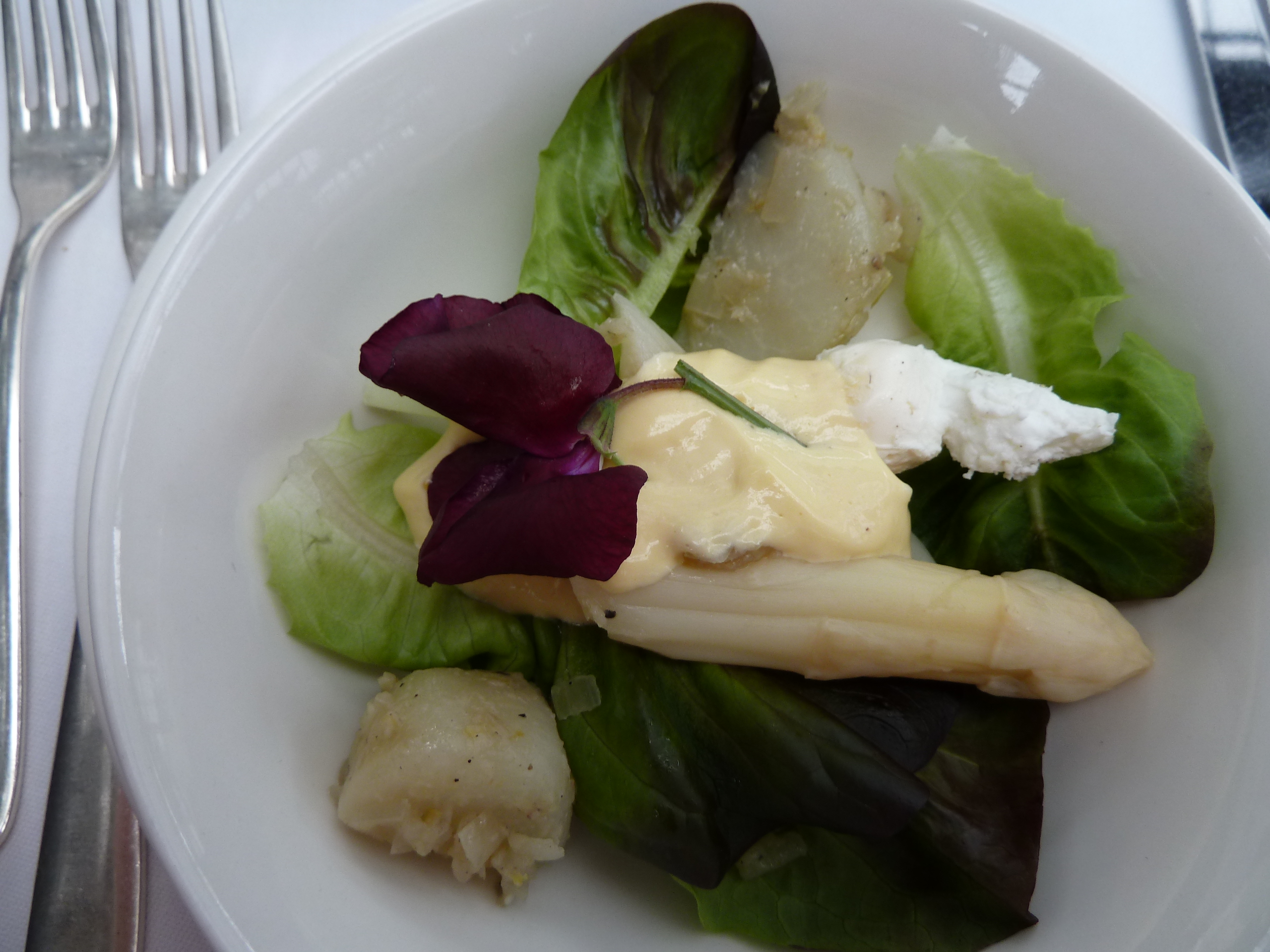
Second of two first-course salads: White asparagus, turnip and a boiled quail's egg over young lettuce greens with a sauce of some kind (sorry, whatever it was, it was delicious) and sweetpea blossoms.

Second course: Lobster with a bechamel sauce topped with a light frisee salad.

Third course: Pollack over roasted eggplant and cauliflower with a North Sea-shrimp and caper brown butter sauce. (Oh man, was this good.)

First dessert: Pistachio meringue with salt-touched white chocolate ice cream and pansy petals.

Second dessert: Platter of three cheeses with fruit and nut brown bread and a dot of apple-pear stroop (syrup) to the right and a candied cherry (?). Translation of cheese on right is "cheese that sticks to your knife."
While the municipal nurseries are long gone, the remainder of the property has retained its “municipalness”—it’s now a public park enjoyed by people and wildlife alike.

Children's play area below, and a stork nest with baby on top of the smoke stack.
Double Mushroom Barley Soup
April 26, 2011 § 3 Comments
Will spring ever get here? Until it does, one of the ways to deal with cold and damp weather is with hot soup. Hot, hearty soup. This is one of our favorites in the hot and hearty category. It’s “double” mushroom because it uses both fresh and dried mushrooms. Adding the dried gives the soup its earthy heartiness.
This is another recipe Jennifer acquired from a soup class several years ago. Note on the bottom says it’s from the Great Vegetarian Cooking Under Pressure book. Ah, yes, “under pressure.” This is made in a pressure cooker! Have no fear, people—pressure cookers won’t explode on your stove top. And if you don’t have a pressure cooker, just cover and simmer for … well, I’m not sure. Just keep checking to see if the barley is toothy.
As before, the recipe below is with our adjustments

Double mushroom barley soup
Double Mushroom Barley Soup
- 2-3 tsp olive oil
- 2-3 medium cloves garlic, finely minced
- 2 cups chopped onions or 2 thinly sliced leeks (I use onions here)
- 6 cups boiling stock (see note in recipe)
- 1/2 cup pearl barley
- 1/2 lb sliced fresh mushrooms, white buttons are fine
- 1/2 oz. sliced dried mushrooms
- 2 large carrots, sliced
- 2 celery ribs, diced
- 2 large bay leaves
- 1.5 tbs dill weed
- salt and pepper to taste
-Put dried mushrooms in a medium bowl. Add about 2 cups boiling water. Cover with plastic wrap and let steep for 15 minutes.
-Now, for the “6 cups boiling stock” – set a pot of about 4 cups stock (veggie is good, chicken is okay if you don’t have veggie) to boil. You’re going to add the mushroom liquid to it when those are done steeping.
-While the mushrooms are steeping is a good time chop your veg.
-When mushrooms have steeped, drain the liquid into a measuring cup. You should have a bit less than 2 cups. Just add water to fill up to 2 cups. Add to the pot of stock. Reserve mushrooms.
-Heat oil in the bottom of the pressure cooker (or soup pot if not using a pressure cooker) to medium-high. Add garlic and onions. Cook for 1 minute, stirring so they don’t stick. Add the stock and then invite everyone else into the pool!
-Lock the top onto the pressure cooker. Bring it up to high pressure, then lower heat to maintain that pressure. Let it cook away for 18 minutes. Then, remove pressure cooker from the heat and place it under cool running water to bring the pressure down quickly. Remove the lid, being sure to face it away from you. You don’t wanna get hit with a cloud of steam!
-IF you’re not using a pressure cooker, bring the soup to boil, cover the pot but leave a little crack, and then turn it down a bit to simmer. Let it bubble along for … let’s say 35 minutes and then check every 5 minutes or so until you feel the barley is cooked.
-Discard the bay leaves. Add a bit more salt and pepper. In my opinion it needs more salt than you’d think.
-With barley in there, it’s going to thicken up, especially after being in the fridge for a day or two. Just be aware. If you want, add some stock or water to thin it out a bit. I kinda like the soups that turn into stews the next days.
It’s one of those soups that is dinner-worthy if you pair it with a salad or suitable for lunch with some toast. In fact, it’ll be my vegan lunch in about 3 hours.
Potato Kale Soup
April 11, 2011 § 3 Comments
Dainty’s been back from California a week, but still hasn’t gotten in the groove. Catching up on work, volunteer meetings, dinners out, etc, have given me zero fodder for posting. And you’d think with a weekend just behind me, I’d have plenty to write about. I think maybe I made a batch of steel-cut oatmeal for breakfast—that’s about it. And a loaf of bread, but it was a workhorse kinda loaf—nothing spectacular.
I spent the weekend working on a homey project—painting the window well in the bedroom. Sure, I saved several hundreds of dollars doing it myself, but I sacrificed several million brain cells in the process (just say no to paint fumes). It’s a project that’s been on my list for about a year and I’m glad I got it done. And while I was scraping and painting, Jennifer was making a big batch of vegan soup to weekday lunches. And this is a good one.
Potato Kale Soup
- 1 tbs evoo
- 2 cups onions, chopped
- 2 leeks, washed and sliced thinly (chuck the dark green parts)
- 6 cups water
- 4 medium potatoes, cubed
- 2 tbs parsley, minced
- 3 carrots – whole
- 3 ribs celery – whole
- 2 bay leaves
- 1 tsp salt
- 1/4 tsp pepper
- 1/2 lb. kale, washed, torn and ribs removed
-Heat oil in large soup pot over medium heat. Saute onions and leeks until soft—abou 10-15 minutes.
-Add potatoes, parsley, whole carrots and leeks, bay leaves, salt and pepper. Boil, cover and simmer over medium low for 45 minutes.
-While that is simmering, cook kale in 2 cups boiling water in a skillet. Cover tightly and cook for 4-5 minutes until tender. Drain and set aside.
-After 45 minutes, remove carrot, celery and bay leaves from soup. Reserve the celery and carrots but chuck the bay leaves. Puree half the soup in a blender. OR, an immersion blender is awesome for this—just whirr up (who says that? Jamie Oliver?) half of it right in the pot. Stir in cooked kale. Chop up the carrots and celery and return to the pot. Heat the soup through again. Salt and pepper it if you need to.
Tada! A vegan alternative for lunch. Sounds like this could use some bread. I think I’ll do that right now.
Clover Food Lab
March 24, 2011 § 3 Comments
Guys, I’d love for today’s post to be more of a discussion. I don’t know much about Clover and I’d love for you to chime in.
I met friends at the Clover Food Lab in Harvard Square for lunch yesterday. Like I said, I don’t know much about it—except these two things:
- This particular brick-and-mortar location developed from a wheels-and-engine business. Am I right about that? Clover was originally a food truck, I take it, and there are a herd of them now in the Cambridge/Boston area.
- They serve all (or mainly?) vegetarian food.
Food trucks are on fire right now. And to see that a nomadic business can settle in and put down roots seems pretty cool. I mean, that’s how “civilization” started. (Hey, I used air quotes, and I’m not saying that today’s nomadic societies aren’t civilized.) I would have loved to try the Clover food truck experience first.
My friend Deb, on the other hand, had tried the food truck first. Raved about it. Loved the food. And when she saw that I’m eating “veganish” she suggested we meet up with friend Sonya to try out the steady digs.
What did we think? Here are my quick impressions as a first-timer, and an observation from Deb as a food truck customer:
The electronic “sandwich boards” as you walk in: Interesting technology there. It’s a vertical flat screen. Rather than erasing and re-writing a sign, they erase and rewrite something on their computer in the back (?) and reload or whatever. What’s the point? Not sure, except when you don’t need two “menus,” you can switch one of the screens to whatever it is you want. When we walked in both boards were menus. When we walked out, one was a menu, one was Clover’s website/blog.

Clover's Chickpea Fritter with a side of Brothy Barley & Spinach Soup. (See the indentation where my falafel ball once sat?)
I ordered the Chickpea Fritter – aka, falafel – in a pita. It came highly recommended by Deb. It was awesome. The slaw was tasty, as was whatever Mediterranean-esque sauce that was in it. The falafel was nicely done, still moist inside. There were a lot of things inside my pita I couldn’t quite pinpoint, but that was okay because I loved it all. Especially the pickle slices. BUT, folks, DO NOT put a falafel ball right on top of the stuffed pita. Mine did an “On Top of Old Smokey” thing and rolled onto the floor. Sad face.
Deb ordered the Egg & Eggplant pita. She loved that, too. Looked good. Can you get that without the egg? Next time.
We all ordered the Brothy Barley and Spinach Soup. Do you know what the word “brothy” brings to mind? Broth. A clear, flavorful liquid. No broth in this soup. If you want to be alliterative, try Burly Barley. Because it was a burly soup—any soup in which a spoon can stand straight up in (without assistance) is burly. As for taste … I’m a barley lover, and I did enjoy it. Add a touch of salt. My companions weren’t very fond of it. Oh, and where was that spinach? (Add more.)
Rosemary fries for the three of us. Yum. Dude, they were awesome.
I love that “city water” was on the menu and listed as $0.
Deb was a bit disappointed that the restaurant menu was the same as the food truck. I think she was expecting a few other choices.
If you’re going to serve pitas that are hefty and stuffed, maybe provide “holding docks” at each table—things like the U-shaped diner napkin holders. So, when you’re settling down into your seat, taking off your coat, etc., this thing can hold your pita without the food falling out (and rolling onto the floor). Just a thought.
The space needs a living wall either in the front windows above, or on that back wall. I know there’s those supports on the back wall and it looks like there’s grape ivy being training on them. Long, slow process. Clover may be looking into this—but, I do know a little something about living walls and know people in the biz. It doesn’t have to be complicated. AND, how cool would it be if they grew their own herbs and salad greens right there on location? It’s possible. Plus, as you may not know, plants “clean” the air, provide oxygen, and also help regulate temperature. Like I said, I know a little somethin’ somethin’ ’bout the topic.
Dainty Rates: 3 out of 5 Dots.
Lentil-Bulgur Salad ala Moosewood
March 22, 2011 § 4 Comments
Bulgar? Bulgur? Bulghur? However you spell it, society at large has been hiding this absolutely spectacular whole-grain from me. If you are to believe movies such as The Adjustment Bureau, the men behind the curtains controlling my life have seen to it that bulgur shall never be placed in front of me. Ever. Never had it. Never saw it. Was never even tempted.
That is, until one Sunday morning a few months ago. I was tidying up the house with Food Network on in the background and Ba-Da-Boom Nigella Lawson made a bulgur dish to accompany a Moroccan meal. And if Nigella likes it, well … I gotta give this stuff a try.
Forget for a moment it’s a whole grain and nutritious and etc. It tastes good! It’s got a great consistency! And it plays well with others. In today’s recipe—and yesterday’s, too, actually—bulgur plays really well with lentils. So well, it’s like they are playing doctor, if you know what I mean.
This recipe is from the Moosewood Cookbook. I’ve eaten at the Moosewood, by the way, back in the mid 90s. And it’s true what they say—terrific food, the service coulda been better (they didn’t place my order. At. All. And that was just one of many examples). But, seriously good food. And if you can chop, you can make this stuff.
I made this for the first time Sunday. And my first reaction after tasting was, “ARE YOU KIDDING ME?? I just made this from that stuff??” I’m not kidding you, this stuff is taste on a plate.
A coupla notes: 1) Omit the feta and it’ll be vegan. 2) Serve at room temp – it has better flavor. 3) Stuff it in pita … yum. 4) I didn’t add the olives. I don’t think I had any and I forgot in general. 5) It’s a perfect protein. Oh yeah.
Lentil-Bulgur Salad
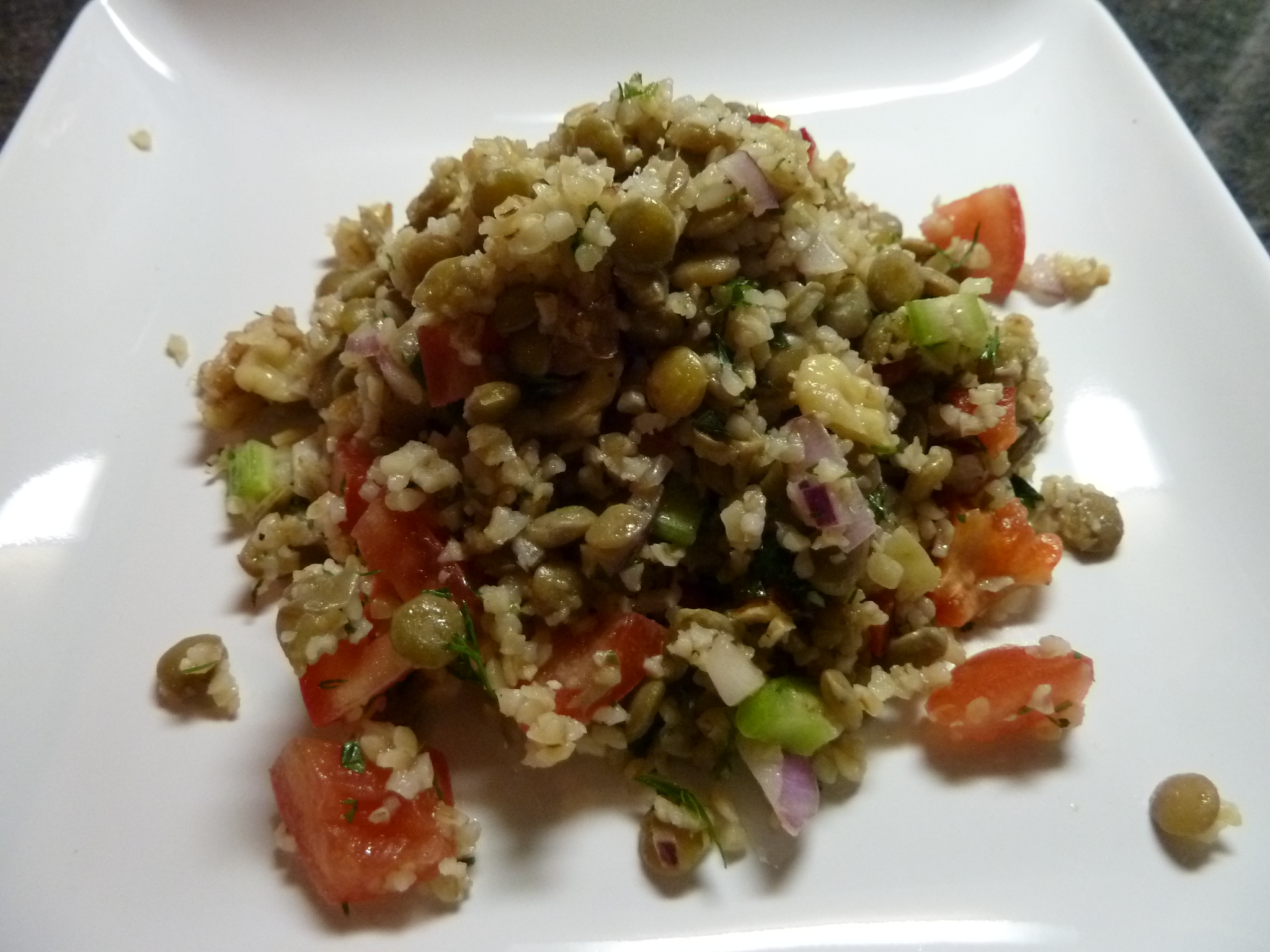
Lentil-Bulgur Salad
- 1 cup dry lentils (use green!)
- 2 cups water
Put lentils in small saucepan. Add water (and a pinch of salt). Bring to just boiling. Turn heat to low and simmer, partially covered, for 20-25 minutes until tender but not mushy. Drain well and place in a large bowl.
- 1 cup dry bulgur wheat
- 1 cup boiling water
Place bulgur in a small bowl. Boil a cup of water (microwave is fine) then add it to the bulgur. Give it a swirl. Cover the bowl with a plate. Let it sit for at least 15 minutes. That’s it.
Now comes choppin’ time. Add all of this to the lentils:
- 1/4 cup olive oil
- 1/4 cup lemon juice (I used juice of one lemon)
- 2 medium cloves garlic, crushed
- 1 tsp salt
- 1/2 tsp oregano
- 2 tbsp freshly minced (or 2 tsp dried) mint (do not skip this!)
- 2-3 tbsp freshly minced (or 2-3 tsp dried) dill
- fresh black pepper to taste
- 1/4 cup freshly minced parsley (I broke off a hunk of my frozen parsley)
- 1/3 cup minced red onion
- 1 small bell pepper
- 1/2 stalk celery, minced
- 1/2 cup crumbled feta
- 1/2 cup nicoise olives (oops, forgot those)
Stir those around and add the bulgur, too. Now add:
- 1 medium tomato, diced
- 1/2 cup chopped toasted walnuts
Fold that around. Give it a taste.
Right? I TOLD you. That’s flavor that’ll make your Greek grandmother weep.
 The Dainty Dot