
Zucchini Tomato Mozzarella Sliders
July 27, 2012 § 4 Comments
Zucchini. It doesn’t stop.
Turn around for a minute and the long green veggie is 3 inches longer on the vine. Not kidding. Hold off on picking it for a day and … well … it becomes a billy club. Growing up, we’d throw the very large zukes into the pig pen. Healthy, zucchini-loving pigs, that’s what we had.
Lately, thoughts during my 25-minute walk back home from yoga have turned to how to use that day’s zucchini. Pizza. Pasta. Salad. I’ve done them all and wanted something different. Last night, my craving for a burger—really, the craving for something meaty between two bready buns—decided dinner for me. Why should sliders be reserved for meat eaters? Zucchini can play that game, too.
Ingredients
1 5-6 in. zucchini
2 tbs olive oil
1+tbs balsamic vinegar
1 spring oregano
kosher salt and freshly ground pepper
6 small French rolls, cut into top and bottom halves
2 cloves garlic, peeled
1-2 tbs olive oil
1 deliciously red heirloom tomato
mozzarella
1. Slice zucchini into rounds slightly thicker than 1/2 in. Discard (or eat!) the smaller rounds. Shoot for using 12 rounds.
2. Combine oil, vinegar, oregano, a big pinch of kosher salt and several turns of the pepper grinder in a medium bowl. Dip your finger in there and adjust seasoning if you’d like (more vinegar? more oil? It’s your food—make it taste the way you like!). Add zucchini slices and toss. Put aside.
3. Smash those garlic cloves with the back of your chef’s knife (on a cutting board, of course) and schmear it together until the garlic becomes kinda pasty. You can add a sprinkle of salt or not. Add this to a small bowl of 1-2 tbs olive oil. Brush this oil onto the bun halves.
4. Set a grill pan onto medium-high heat. When it’s hot, place buns, cut side down, onto the pan and flatten slightly. 10-15 seconds will do. Put grilled buns into a bowl and cover with a tea towel for now. Turn off grill pan.
5. Meanwhile … we’re still waiting for the zucchini to marinate a bit. Take this time to make a small side salad and whip up a quick vinaigrette.
6. Okay, done with the salad? Time to move on. Get that grill pan back up to medium high. Place your zucchini rounds onto the grill pan. Using a brush, dab some of the liquid remaining in the bowl onto each slice. Let them sit for 4-5 min, or until they get some nice-looking grill marks on the bottom.
7. While those are grilling, slice the tomato into 6 slices and add to whatever liquid remains in the bottom of that bowl.
8. Mozzarella. Time to slice it. Slice it about 1/4 in. thick or less, and into whatever size will sit nicely on top of a zucchini round.
9. Back to those zucchinis. They should be ready to flip onto the other side. Do that. Then place a bit of mozzarella on top of each. Let them grill for a minute.
10. Get your buns ready, working with one top and bottom at a time. This part is optional: Make some room in that grill pan and place the buns cut side down into the goodness the zucchini has been cooking in. Only takes a second, and remove quickly. If not doing that: Place one zucchini slice onto the bun bottom, and overlap a second on top of that. Add a slice of tomato. Top it off with other half of the bun. Repeat with the remaining zukes and buns.
Super. Good. I ate one and a half. Coulda had two. Or three.
Enjoy. I’m off to make zucchini bread now.
Do you have a favorite zucchini recipe? Share it in the comments section.
Cilantro Pesto
July 9, 2012 § 1 Comment
Pesto makes me happy. It just does. Just like the pop of a champagne bottle means something celebratory is about to happen, the knowledge that pesto is in a dish means something tasty is about to be experienced.
Basil is just the tip of the pesto iceberg. It’s the easy and expected version. But when the garden presents one with an abundance of other herbs, it’s a prime opportunity to explore other pesto flavors. That’s how this batch of cilantro pesto came about. A 3-ft. row of cilantro plants was beginning to bolt (i.e. grow quickly and produce flowers), and rather than let it go to seed, I opted to harvest it all. And what’s the best way to use large amounts of herbs? Pesto.
Like anything with cilantro, this pesto goes pretty darn well with Mexican food. It’s also tasty spread inside a grilled cheese and as a base for a pizza. And the best thing about this version is … it’s accidentally vegan.
Ingredients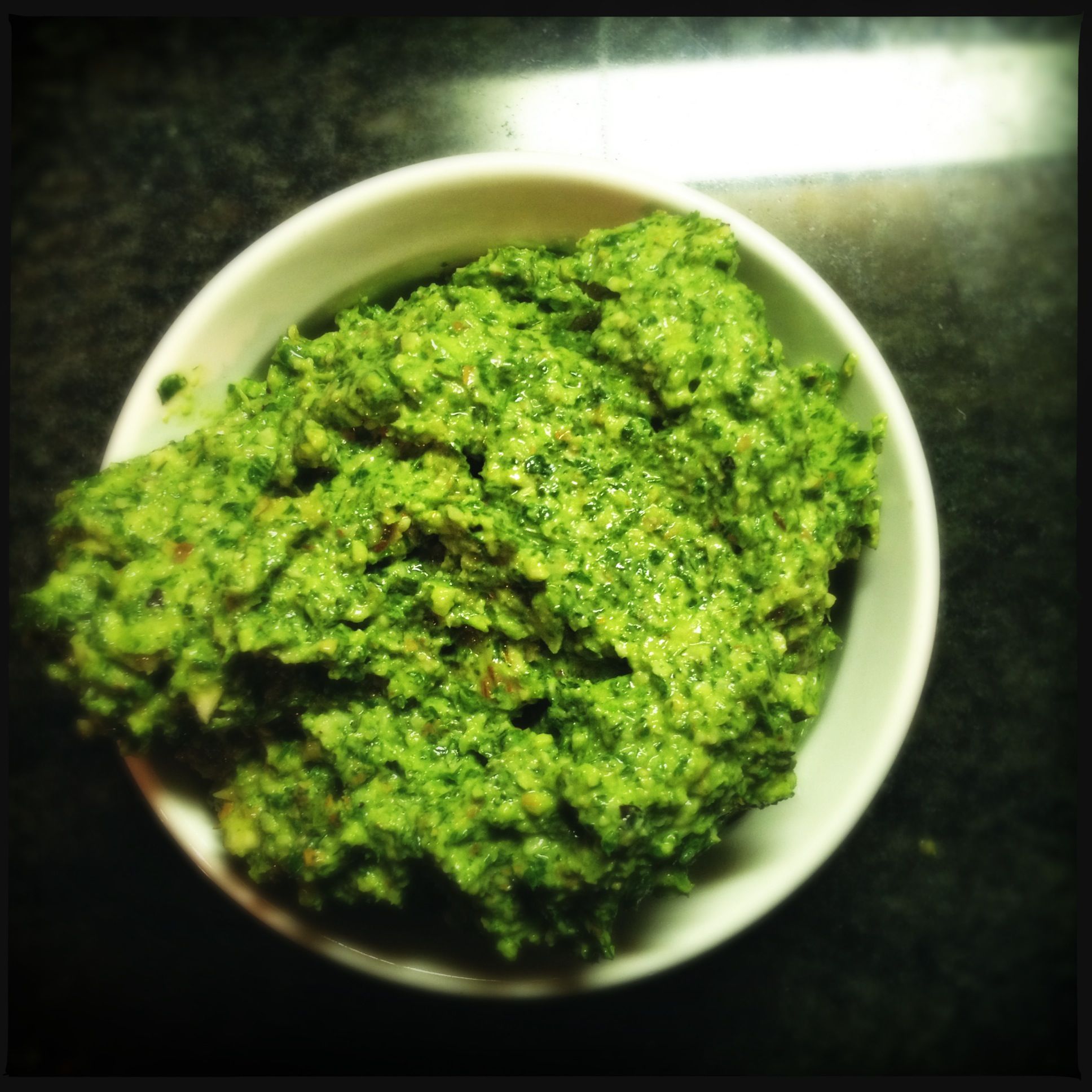
- 1 cup loosely packed cilantro leaves (and I also threw in the flowers)
- 1 cup loosely packed parsley leaves
- 1/3 cup whole almonds
- 1 small fresh chili (jalapeno is good)
- 2 garlic cloves coarsely chopped
- 2 tbs fresh lime juice (I used a whole lime)
- 1/4 cup vegetable oil
- salt and pepper to taste
-Place all ingredients except lime juice and oil in a food processor and pulse several times to chop finely.
-With the foodpro on, add the juice and oil in a steady stream. If you like your pesto saucy, add a bit more oil.
All my pesto recipes come from the The Moosewood Kitchen Garden cook-garden book. The dill pesto recipe is also a keeper. I’ll share, but first my dill needs to grow a bit more.
Tofu Marinade
July 5, 2012 § Leave a comment
Tofu. Exciting stuff.
Exciting stuff that you most likely stay away from. Am I right? “Meh, whatever. I’ll have the chicken,” is what you’re saying.
The best tofu I’ve ever eaten was takeout from this hole-in-the-wall Chinese place in Ithaca, New York, about 18 years ago. It was a bit spicy with a shockingly crisp texture. No idea what they did to it but I can still remember how tasty it was.
While trolling the Web in search of what to do with tofu, I came across a fabulous marinade. And by fabulous I mean I had all the ingredients on hand and it was super-simple to make. The recipe has been on a Post-It Note on the fridge for about 8 months now, and before I lose it down that mysterious gap between the icebox and the counter, I thought I’d post it to Dainty for safekeeping.
Okay, so … you marinate this tofu baby. Then what? The cooked marinated tofu slabs go well with an Asian-style slaw. Put both in a wrap or on top of brown rice. A little added soy sauce is a good addition for the latter, as well.

marinating tofu
Ingredients*
1 tbs balsamic vinegar
1 tbs sesame oil
1 tsp agave nectar
1 tbs minced ginger (a heaping tsp of ground ginger works, too, and gives it a tiny bit sweeter flavor)
1 tbs minced garlic
1/2 tsp cumin
1/2 tsp coriander
1/4-1/2 tsp cayenne
*This recipe easily doubles BUT think twice before doubling the cayenne. A double recipe will more than adequately cover a standard block of tofu cut into 1/4-inch slices.
-Combine all ingredients in a tall-sided container and whir up with a hand-held immersion blender. Or, put in a regular blender. Blending isn’t totally necessary, but I feel it gives the marinade more body than just a simple whisking. It then holds onto the tofu better.
-Brush overtop 1/4-in. tofu slices, and the sides, too, if you wish. You may have extra marinade – keep that around to pour on top of your wrap or tofu rice bowl.
-Let sit in the refrigerator for an hour or two. Then place slices bottom-side down in a medium-hot pan. Flip after 3 minutes. Flip again after three minutes—this helps get the marinade onto the side that wasn’t brushed.
We used the marinated tofu in a brown rice bowl along with a raw corn-cabbage slaw and some leftover sauteed mushrooms that we reheated in the same pan used to cook the tofu. A sprinkle of nama shoyu or regular soy sauce gave the dish a nice pop.
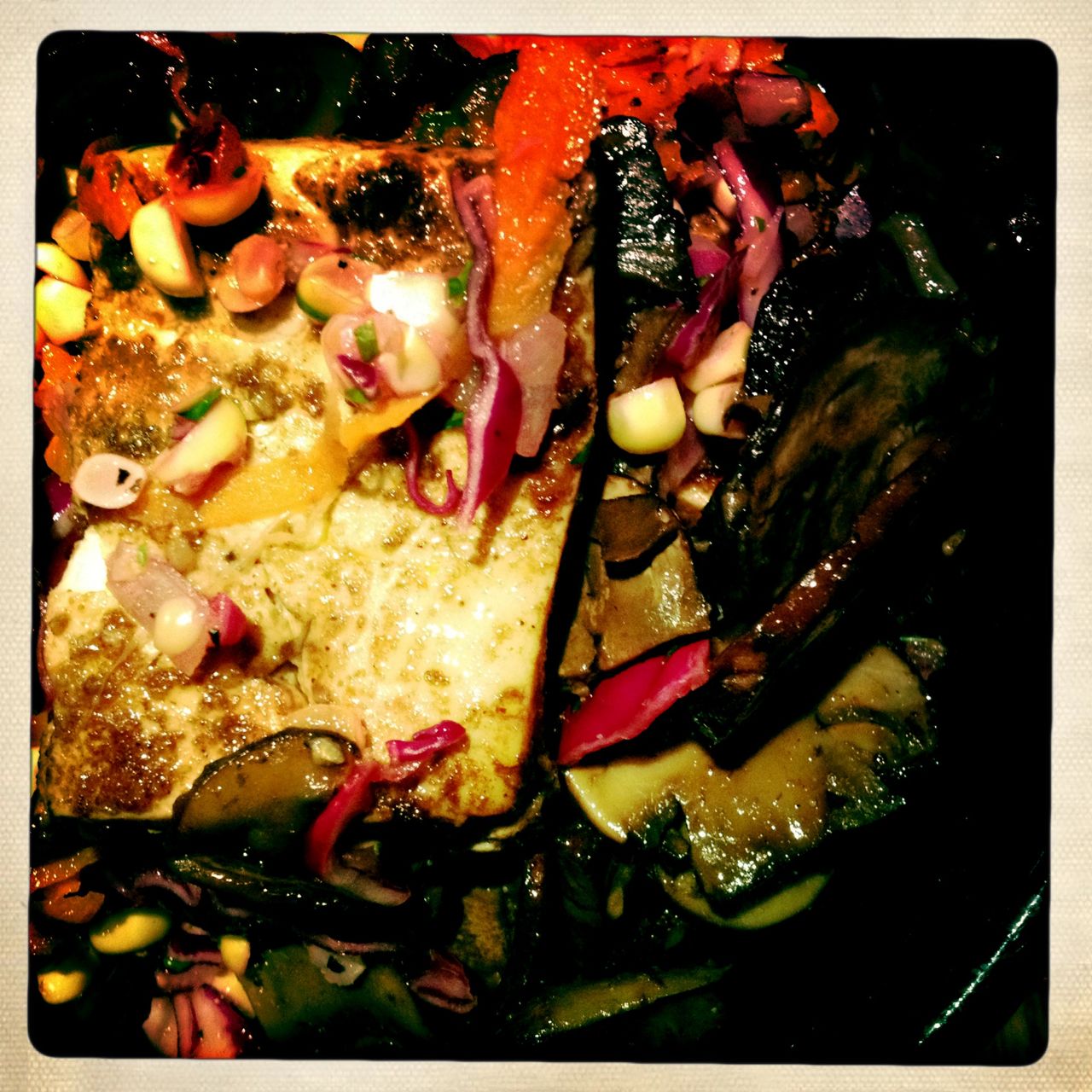
marinated tofu overtop brown rice, mushrooms and corn slaw
What’s your favorite tofu marinade? Please share below – it’s good to have more than one in your recipe book!
Sweet potato, goat cheese and rosemary-sage pizza
May 7, 2012 § 1 Comment
The following is a paraphrased and nearly completely inaccurate account of a recent text conversation.
Text from Nan: J’s sick, can’t use tix to tonight’s show at Club Passim. Can you use them?
Text from Dainty: Uh … wha? Tonite? Sure! Who’s playing, where’s it?
Nan: Meg Hutchison. She’s great. H Sq.
Dainty: We’re in! Coming after Baptiste yoga, could eat a cow. Do they have food?
Nan: Veggie Planet serves their food. Order Henry’s Dinner. On a pizza. Trust me.
Jennifer and I do indeed trust Nan—she’s a lawyer, after all, and we love her. We go to Club Passim, ravenous, and after a cursory glance at the menu, immediately ordered the Henry’s Dinner, pizza version. Something about sweet potato, goat cheese, asiago, rosemary and sage—oh, don’t forget the caramelized onions—all atop a whole wheat pizza.
First thought: Um … yeah. It’s really good. Things that should come together as a side dish at Turkey Time turns out to be a great topping for a pizza.
Second thought: I could totally make that.
And I did Here’s my version.
Ingredients:
- 2 pizza doughs from the Biga-Based Pizza Dough recipe (which makes a total of four)
- 1 large sweet potato
- 1 sweet onion
- olive oil
- balsamic vinegar
- fresh rosemary and sage, ground in a spice mill together, about 2 tbs each
- a log of goat cheese
- asiago cheese (we used parmesan)
- salt and pepper go without saying …
-We had a gigantic sweet potato, so we spiked it with a few holes and popped it into a 425F oven for nearly an hour. After 45 min you want to keep poking a fork in it to see if it’s done all the way through. When done, let it cool enough to handle. The skin will just peel right off with your hands. Slice it into 1/4-1/2 inch think rounds.

Baked sweet potato
-While the potato is cooking, slice up that sweet onion. Add about 2 tbs olive oil to your trusty large skillet, set on medium high, and toss the onion in there. Add maybe 2 tbs balsamic vinegar. Sprinkle generously with kosher salt. Toss often. After a bit you’ll want to turn the heat down low and let it saute low and slow. Half hour, maybe. Give the onions a taste halfway through – you might want to add more balsamic to your liking. When they’re done, let them cool, too.
-Heat the oven to 480F. Got a pizza stone? You need one, seriously.
-When you’re ready, flour your counter and roll out that pizza dough – thin but not super super thin. Sprinkle a pizza peel with fine corn meal and lay that dough on there.
-Next, brush the dough surface with some olive oil. Now you can arrange your ingredients however you want. I put the caramelized onions on the bottom. Next I layer with sweet potato – I broke my potato slices into chunks and spread them out a bit. Same with the goat cheese – I just broke chunks off the log and applied liberally. Next, a generous dusting of the rosemary-sage mixture, followed by Parmesan cheese. Salt and pepper on top.
-Slide the pizza onto the stone. 6-7 minutes is all you need. You should have enough ingredients for two pizzas, so while the first one is cooking, get the second one all set to go.
-Wait 3 minutes before cutting into it. You gotta let that thing set up.

sweet potato, caramelized onion, goat cheese and rosemary-sage pizza
Jennifer just took the leftovers for lunch and popped it into the break room toaster oven. A colleague asked, “Hey, is that the Henry’s Dinner pizza from Veggie Planet?” Looks like I got it right.

Why and when this vegetarian believes it’s ethical to eat meat
April 8, 2012 § 5 Comments
This is a little something I sent to the New York Times Magazine’s Ethicist column in response to their query about why it’s ethical to eat meat. Yes, I am currently a vegetarian. No, I don’t believe it’s unethical to eat meat. It’s all about the how and where and … well, read on to get a real idea of where I stand on this. And please keep in mind, I’m not advocating one way or the other and for no one else but me. Comments? Leave ’em below!
I was 4, and I accompanied my oldest brother to a duck farm. He was delivering a load of hay to be used as bedding for the local two-legged citizenry, and I was just along for the ride. The bales were unloaded and we drove toward the gate. We slowed as we rounded the corner and spotted a bright-yellow baby duckling against the brick-red barn. The trouble was the roll of chicken fencing the little guy was stuck behind. We stopped, liberated the fluffball, and brought him home. I named him Grover.
We kept Grover in a pen by the sandbox. Each day as I stepped off the bus from kindergarten I would bound toward the pen, shove fistfuls of lawn toward him, study the quick thrusts of his neck. As a rule, ducks aren’t the cuddliest of pets, but for a kid, they’re alright.
It’ll come as no surprise to you that one day, Grover wasn’t in his pen to greet me. And it will also come as no surprise that later the same week an odd-looking, all-dark-meat chicken appeared on the dinner table. It was another brother—one who is still not my favorite—who broke the news. I remember the tears; no sound, just tears rolling down my cheeks. Mom got up, opened the freezer, and took out a package of hot dogs.
Growing up on a farm, this is what happens. Animals are named. Pets are killed. Portions of pork and beef and lamb are carved from their bodies, wrapped in crisp, white butcher paper, then “Bucky” or “Victor” and the date are penned on the package. Their flavors are contemplated as their diets are recalled and discussed. “Did we feed Bucky too many potato peelings?”
Grover was my indoctrination into this culture. A farm girl has to learn.
Forty years later I am a vegetarian. The psychological root of this is not due to my childhood pet being served to me on dinner plate. In fact, I do not eat meat because I don’t know who is on my plate. Who has touched that ham? Where did she live, what did she eat? This is not a creature with whom I am familiar, and because of that, I cannot take the animal into me. I can’t.
Four years ago I stopped eating pork. Years before I had given up beef and other red meat, and I have since stopped eating poultry (except for the Thanksgiving turkey, I admit). But pork, that was a big thing. And I gave it up with this caveat: I will not eat pork until I can raise the pig myself. (I have since tacked on the other meats.) I will once again know the what and where and when of the who that is on my plate.
The why or why not of the ethics of eating meat is irrelevant. We cannot feed our population unless meat is provided. On a societal level, meat must be a part of this American culture. And this holds true for numerous cultures and their circumstances.
The statement “eating meat is ethical” is one that can only be made by an individual, and with qualifications. For this vegetarian, eating meat is ethical if I know who it is and approve of how it was treated.
When I was 16, one of our female Muskovies died a horrible death: She drowned in a mud puddle while a male…ahem…did his business with her. My parents chose not to serve her for dinner. They clearly knew which side of ethical this duck died on.
copyright Ellen C. Wells, 2012
Brothy Asian-Inspired Soup
March 19, 2012 § 4 Comments
Hearty soups … yes, I love them. And the ones I make are nearing the definition of stew. But every once in a while I will be in the mood for something light, breathy and brothy.
This Asian-Inspired Soup is a riff on something Mark Bittman published in March 2011. He gave three simple (very simple) recipe suggestions in each of four categories: creamy, brothy, earthy and hearty. The second and third recipes are slight twists on the first in each category. By the end of making the twelfth, he says, you’ll never need to follow another soup recipe.
With a package of firm tofu and some leftover chickpea broth (remember that from Pressure Cooker Basics?), I twisted Mark Bittman’s own Asian twist on brothy soups.
Ingredients 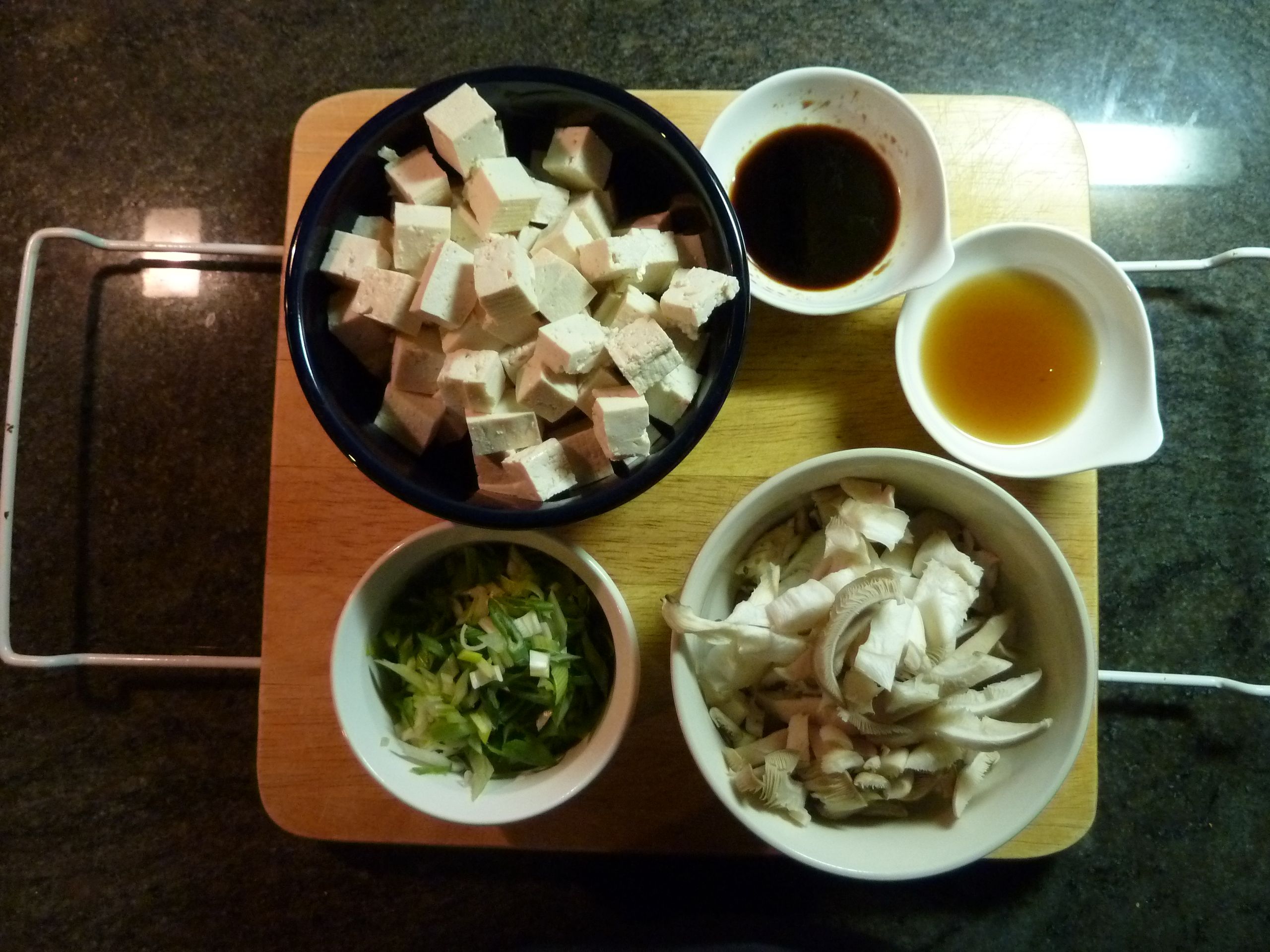
- 8 cups water, in this case chickpea broth and water
- 1/4 cup chopped scallions (about 3-4)
- 1 package firm tofu, drained and cubed
- 4 oz oyster mushrooms, roughly chopped
- 1 tbs soy sauce
- 1 tbs sesame oil
-To a large pot add the water or broth, scallions, tofu, mushrooms, soy and sesame.
-Heat over a medium-high flame to just boiling, them bring to a quiet simmer, partly covered. Let simmer for … 15 minutes? 20 minutes? It’s up to you and how tender you like your oyster mushrooms. Check it at 15, then check the mushrooms every few minutes.

Oyster mushrooms - aren't they just beautiful?
-Ladle into bowls. Garnish with a few chopped scallions. You might enjoy a crispy baguette to dunk.

Brothy Asian-inspired soup
Seriously, I tried to make this soup sound difficult/complex/sophisticated/finicky. But that’s just impossible. This soup is just way simple. And delicious.
Any Asian-inspired and simple soup suggestions or ingredient ideas? Leave a comment and let me know.
Hearty Soup: Potato & Kale
March 8, 2012 § 1 Comment
We’re nearing the end of Hearty Soup season. And I feel like it got short-shrifted this year. Bone-warming broths, stews and soups weren’t really needed so very much this winter. And it’s too bad—hearty soups are my favorite to make.
We were able to squeeze in a batch of Potato & Kale Soup earlier this week. Thank goodness, because a winter soup season shouldn’t go by without this cooking on the stovetop at least once.
Jennifer and I tag-teamed this recipe. I chopped and prepped late in the afternoon, then she came home and cooked, giving it her special touch while I lunged and downward-dogged and shavasana’d. The potatoes and kale really satisfied a hungry yogini.
Full disclosure here: Full credit goes to Jennifer, who got this recipe from a soups class she took back in the late ’90s. We’ve adjusted a bit here and there. But not spectacularly so.
Potato & Kale Soup

Potato-Kale Soup with a drop of sherry vinegar
- 1+ tbs evoo
- 2 cups chopped onion
- 2 leeks, white and light green parts only, sliced thin (we omitted, used extra onion)
- 6 cups water (we used 4-6 cups leftover chickpea broth – remember that from the chickpea stew and hummus?) PLUS 2 additional cups water/broth
- 4 medium potatoes, cut into medium-sized cubes (~4 cups)
- 2 tbs minced fresh parsley
- 3 carrots, trimmed but whole
- 3 celery stalks, trimmed but whole
- 2 bay leaves
- salt & pepper
- 1/2 lb kale (we used an entire bunch of kale as bundled by the local neighborhood grocery)
- sherry vinegar
-Heat oil in large Dutch oven over medium heat. Add onions (and leeks if you have them) and sautee until soft and translucent.
-Add potatoes, parsley, whole carrots, whole celery, bay leaves and 6 cups water or broth, and season with salt and pepper (several good pinches of salt/twists of the pepper grinder). Cover. Simmer on low to medium low for about 45 minutes.
-While the soup is simmering, wash the kale and remove the thick ribs. Tear the kale into a size that won’t annoy you – i.e. not too big. You’re going to steam/cook the kale in about a cup or two of water/broth in a high-sided skillet with a lid. Boil that water, add the kale, cover, and let it cook for not that long – 4-5 minutes. You want it tender but not melty-mushy. Drain out the water and set the kale aside.
-When the soup base has simmered 45 minutes, remove and RESERVE the carrots. And remove and DISCARD the celery. Puree by using a light touch with an immersion blender—you want part of it pureed but you still want some chunks of potato in there. OR, just puree half of the soup in a food processor and return it to the soup pot.
-Stir in kale. Chop the reserved carrots, add them back in there, too. Heat until nice and hot. Give it a taste – add salt and pepper as necessary.
-Here’s the last bit that is Jennifer’s touch and it’s completely optional: Add a tad – let’s say a 1 tbs – of sherry vinegar. Not so optional, uh? That’s good stuff, that soup is.
A nice “creamy” soup—and absolutely no cream! And now that I think about it, it’s vegan. Bonus.
What’s your favorite hearty soup recipe? Drop in a comment and let us know.
Moroccan Chickpea Stew
March 1, 2012 § 9 Comments
If you don’t like cumin, step away. You’ve made up your mind about the spice, and no amount of my praising it will change the way your taste buds feel. So, I’ll see you another day, okay?
But you cumin fans, lean in a bit closer—I have something to tell you. This stew … it’s awesome. Awesome as in delicious. Really. Super. Delicious. And it’s all due to the cumin.
It being from Bon Appetit may explain why it’s so delectable. Theirs is a meaty version. I’m sure the addition of chicken thighs is nothing but fabulous. I didn’t have them on hand—plus I’m doing a no-meat kinda thing currently. Still, this rocks with out the cluck factor.
Ingredients
- 4 tbs olive oil, divided

Chickpea Stew ala Bon Appetit
- 2 skinless, boneless chicken thighs—optional
- 1 medium sweet onion, sliced
- Kosher salt
- 3 large garlic cloves, minced
- 2 tbs ground cumin—yes, that much
- 2 tbs tomato paste
- 3/4 tsp crushed red pepper flakes
- 2 bay leaves
- 2 15-ounce cans chickpeas, rinsed, drained OR 1 lb. dry chickpeas cooked to firm
- 1/2 cup chopped drained roasted red peppers from a jar (I just roasted a whole large red pepper myself)
- 2 tbs (or more) fresh lemon juice
- country-style bread
- 3 tbs coarsely chopped flat-leaf parsley

-IF you’re going the chicken route, heat 2 tbs of the oil in a Dutch oven over medium-high heat. Season chicken with salt; add to pot and cook, turning once, until browned, 8–10 minutes. Transfer to a plate.
-IF you’re not using chicken, heat 2 tbs of oil to medium low, add onion and garlic, and saute for 5-6 minutes or until onions become translucent. Add cumin, tomato paste and red pepper flakes; stir until a smooth paste forms, about 1 minute.
-IF using chicken, add it back into the pot along with bay leaves and 4 cups water and dislodge any of the brown chicken bits that might be on the bottom of the pot.
-Just a quick note: I used dry chickpeas and cooked them in a pressure cooker with 9 cups water, kosher salt, a celery stalk, a carrot, 2 bay leaves and 3 whole garlic cloves for 28 minutes. When I drained the chickpeas, I reserved the liquid and used that in place of 4 cups water. Mmmmm … more flavor.
-Bring everything in the pot to a boil; reduce heat to medium-low and simmer, uncovered, with occasional stirring. IF using chicken, let it simmer until chicken is tender (20 minutes). Sans chicken, 10 minutes is enough to get the flavors to meld.
-Transfer chicken to a plate (if it’s in there). Add chickpeas to pot and bring to a simmer and cook for 5 minutes. Shred your chicken off the bone and add it in there. Otherwise, skip it. Add in the red peppers and stir in remaining 2 tbs of oil (but only if you want – you don’t need to).
-Don’t skip this part: Give it a taste. Good, right? Yummy power-packed cumin flavor. Okay, now add in 2 tbs of lemon juice (or about half a lemon). Let it simmer for a minute. Now give it another taste? Better, huh? Yup, that lemon is a major major plus here. Adjust seasonings with salt and maybe more lemon if you think it needs it.
-Serving: Bon Appetit says to cube crusty bread, put it in an individual bowl, and ladle the stew on top. DO NOT even attempt. All you get is soggy bread. Bleck. But DO enjoy a nice slice alongside, dipping it to your liking. Oh, and sprinkle some parsley on top, too.
Good, good stewy stuff. There’s no room for cumin haters here.
Vegetarian Chili with a touch of chocolate
February 6, 2012 § 2 Comments
Chocolate. I knew I’d hook you with that ingredient. And yes, there really is chocolate in this version. Two types of chocolate, actually. But first …
Vegetarian … yeah, vegetarian. We’re pretty much completely meat-free now. Seafood being the exception. And chicken stock, although we have been doing a good job of keeping ourselves supplied with homemade vegetable and seafood stocks. The reason for ditching the fowl – the last remaining terrestrial flesh I ate – was simple. I just don’t trust where it comes from and what’s in it. Sure, I could purchase meat from Whole Foods or a retailer that sources only organic and local foods. News alert: That stuff is expensive.
Local fish and seafood is, too. I get that. But somehow I feel the seafood is a better value for the protein we get. And we use it all—from tip to tail (or claw). And we enjoy being members of our local Community-Supported Fisheries. I guess that’s a big part of it, too—it makes us feel good to support the local folks who definitely could use our dollars.
Okay, back on track. We’re talkin’ veggie chili here. I wish I could take credit for this but I can’t. This is one of Jennifer’s signature dishes (one of many). I have made it now and then, but she does it justice. And Jennifer, if you see anything wrong with the recipe, please correct me in the comments section.

Vegetarian chili with a touch of chocolate - we added green beans in place of the corn (we were out!).

Vegetarian chili, two minutes later.
Ingredients
- 1 tbs oil (olive will do)
- 1 large onion, chopped
- 2 clove garlic, chopped
- 2 peppers, whatever color you prefer but red is nice
- 2 jalapeno peppers, minced (seeds removed if you don’t like it so spicy)
- 1 bag of frozen soy crumbles
- 1 28-oz. can of whole chopped tomatoes (or whole tomatoes that you squish with your hands)
- 1 15-oz. can of red kidney beans
- 1 15-oz. can of black beans
- 1 cup (or small can) of whole kernel corn
- 1 tbs chili powder
- 1 tbs cocoa powder
- 1 tbs lime juice
- 1 tbs cumin
- 2 tsp dried oregano
- 1 small block (2 oz?) of Baker’s semi-sweet chocolate
- 2 tbs chopped cilantro
- salt and pepper to taste
1. In a large pot or Dutch oven, heat oil to medium and add chopped onion and garlic. Saute until translucent.
2. Add both types of peppers and cook until tender – about 5 minutes. Add the bag of frozen soy crumbles just so it thaws out a bit before adding other ingredients. It’ll take just a couple of minutes.
3. Add the tomatoes, beans, corn, chili powder, cocoa powder, lime juice, cumin and oregano—and a general sprinkle of salt— stir thoroughly, and let it come to a boil. Turn heat down a bit and let it simmer for about 30 minutes. During that time it will thicken a bit.
4. Add in the 2-oz. block of chocolate and stir it around, helping it to melt and incorporate into the chili. Add the cilantro, season to taste with salt and pepper.
Serve with a dollop of sour cream, Greek yogurt, guacamole, grated cheese or straight up. Give it a taste. Good, right? And you know that flavor that’s right on the edge of being familiar? It’s the chocolate. Serve it to guests and when they ask what that ingredient is, don’t tell them. It’ll be our secret.
Some notes:
1. Feel free to soak and use dried beans of any kind. I would use 1 cup of two different types of dried beans—we’ve used pinto, cranberry, garbanzo.
2. Want to speed up the cooking? Use a pressure cooker. It’ll shave off 10-15 minutes from the simmering time.
Homegrown Food Challenge—Days 6 & 7
October 21, 2011 § Leave a comment
No, we did not whither away and die from lack of food after Day 5 of our Homegrown Food Challenge. We survived quite nicely, thank you very much. I’ve just not been … well … in the blogging mood, I guess. If you’re a blogger, you’re pickin’ up what I’m puttin’ down. Hey, it happens. I’m back on track now, though, no worries.
Breakfast:
Day 6—it was all the way back last Saturday. I had promised we’d kick it up a bit with something for breakfast that was more interesting than yogurt. And we did—omelets! Not an omelet, per se, but more of a flat egg. That’s what my mom called them when I was growing up. It’s just two eggs, slightly beaten and NOTHING added to the eggs, as you would were you making omelets. Just a straight ol’ egg. We added in some local goat cheese and diced homegrown tomato right at the last second, folded and called it breakfast. A slice or two of toasted homemade bread made it a filling meal.

Lunch:
After, Jennifer took off for the weekend to attend to some business, leaving me to fend for myself. Lunch was … honestly, I can’t remember. Must have been the last of the grilled eggplant paninni … yum … By the way, that post was way popular. Way. Popular.
Dinner:
Dinner was when I got creative on Day 6. Earlier in the week I had cooked up some homegrown Vermont cranberry beans. Used the pressure cooker, actually, and the process yielded some terrific bean broth. Add some homegrown leeks, homegrown carrots, and a neighbor’s small bunch of homegrown celery, and it’s the beginning of soup! I added to that the leftover Vermont cranberry beans, some leftover homegrown/homemade tomato sauce, a fading homegrown zucchini and a couple of locally grown potatoes—along with salt, pepper, homegrown oregano and sage. Soup and bread for dinner—the end of a great gardening day.

Day 7
Our weeklong Homegrown Food Challenge ended not with a big banquet ala Julie and Julia, but on a much more common, everyday note. Plans for going out with a bang—lasagna of homemade pasta, homegrown broccoli, eggplant and kale—faded with the afternoon. Instead we hunkered down, ate our soup and toasted our accomplishment with the last of the local beer.
Next year … I truly wonder what that will bring.
 The Dainty Dot