
Food Trucks: Lefty’s, Bon Me & Roxy’s
August 22, 2011 § Leave a comment
Our neighborhood has this gem of a Sunday market—the Sowa Open Market. With our summer travel schedule – both work and pleasure – it’s a not a place we get to a whole heck of a lot. And that’s a darn shame. We definitely are able to get there during the “shoulder seasons” – spring and fall. And if you like to explore all the artsy-craftsy stuff going on in Boston and New England, this really has been the place to go for the last eight years. 
More recently – maybe in the last couple? – they’ve also had a pretty nice array of food trucks. I put a question mark down there because, like I said, we don’t get there a whole heckuva lot. With the food truck craze that’s traveling in the left lane nowadays, it’s probably one of the major draws of the Market.
And considering that one of their usual food trucks is participating in the second season of Food Network’s The Great Food Truck Race, we decided to take one of our atypical in-town weekends are check out Roxy’s Grilled Cheese, among the other dozen or so trucks parked within the Sowa Open Market.
Of course, I scheduled only an hour (including walking time) between my various work-related activities to check out the food trucks. Seriously, not a smart move.
We decided to divide and conquer. We didn’t get far.
I stood in the Roxy’s line while Jennifer stood in the Bon Me line. Guess which line was longer? Jennifer decision to hit the Vietnamese street food truck was smart. My standing in the ‘order waiting to be picked up’ line at Roxy’s was not.
Jennifer was already chomping on her tofu and shitake mushroom banh mi (aka a sandwich on a baguette) before I decided to abandon my chance to nibble on a TV star. She shared, of course. Excellent flavor in the marinated tofu and mushrooms, a nice pickled topping. Great filling. Bread? Not the best, but I’m a bread snob. I’d definitely line up there again.
I was determined to have my own food truck experience, so I lined up for Lefty’s Silver Cart for a specialty sandwich. What drew me to that one? Pressed for time, it was close by, the line wasn’t long, and I judged a book by its cover—I really liked the old-timey font they used. Menu items were intriguing, too. It took me a good couple of minutes to realize they had a vegetarian menu, that’s how fun their combos were. I was torn between the Granny-B-Good – a grilled cheese with Vermont cheddar and Granny Smith apple – and the Figment, which was baguette with truffle-dressed mixed greens, goat cheese and fig jam. LOVE fig jam, so ordered the latter. Can’t go wrong with fig and goat cheese, and putting it on bread makes it a very healthy thing, I’m sure. Very happy with my order. Plus, Lefty’s baguette rocked. Now, if Bon Me had that baguette, they’d kick it up a notch. The difference? Baking technique, definitely. More steam produced a better crust for whoever is making Lefty’s bread.
Dainty Rates: 4 Dots.
If you’re around Boston Sundays through October, take a walk down to Sowa. Save room for lunch.
Salad from a City Garden
July 29, 2011 § Leave a comment
Remember yesterday?
Remember that haul of produce I brought home from my city community garden plot? All of it—the lettuce, the chard, the beets, the tomatoes and whatever else I gathered—is washed/bagged/roasted/drying/sitting in a hydrator.
Are you interested in how I saved the lettuce/chard/etc? There’s a way to do it. I can tell you about that later if you want …
But for now, let me tell you about my lunch. 
-Lettuce from the garden.
-A half of a beet from the garden, roasted.
-Cherry tomatoes from the garden.
-A half of a zucchini from the garden, roasted.
–Greek Salad Dressing, made with oregano from the garden.
-Boiled eggs, from our backyard hens (Oh, please. Who do I think I am? Jayme Jenkins?).
–Pickled red onions, pickled myself!
-Green lentils and bulgur – okay, I didn’t grow them but at least I boiled them myself.
-A slice of bread I made using my wild yeast sourdough starter.
I’m full. I need a nap.
Biga-Based Pizza Dough
June 1, 2011 § 5 Comments
Pizza is one of our fallback meals in the Dainty domicile. And it’s not delivery; not even DiGiorno. It’s made with good ol’ homemade, hand-thrown dough. With a special addition. Let’s call it Dainty Dough.
There are two things that make the Dainty Dough a bit different. First, it’s made with biga, one of many types of dough starters. It’s a yeast-based starter, not a natural sourdough starter—meaning it contains commercial yeast and not yeast found naturally in the environment (have I lost you yet? Hang on for a minute.). The biga ferments—i.e. sits on your counter bubbling away—for 8 to 24 hours or so, all the while developing a richer, chewier flavor. Pizza crust with flavor, not just used as a platform for toppings, imagine that.
The second thing I do is add a dollop or two of my Sourdough Starter, aka Milo the Baby Dough, during the dough-making process. A few months back you may recall I was experimenting with natural yeast and tried creating a real sourdough. Well, after a month or so, Milo is alive and well. I feel like I created a golem, it’s so incredibly cool. It’s totally not necessary to add this sourdough starter, but I’ll explain in a minute why I do it.
Dainty Dough: Step 1
Biga Recipe (from my Basic Baking class at the Cambridge School of Culinary Arts)
- 1/4 oz. yeast
- 1/4 cup warm water (warm=dip in a finger and it should feel the same temp as your body)
- pinch of sugar
- 1 1/2 cups warm water
- 3 3/4 cups flour (I suggest all-purpose flour here. If you want wheat dough you can add wheat flour later)
-Add yeast and 1/4 cup warm water with sugar in a bowl and stir together. Let it sit for 10 minutes. Add remaining water and the flour and mix thoroughly. You’ll end up with a creamy mixture. Cover and either let sit on the counter 8 hours or place in the fridge for 24 hours. It will become creamy and bubbly. The biga will remain
-At this point you can proceed with the next step and make the pizza dough. Or, I suggest weighing out your biga into 4 oz. pieces, reserving one piece for your current pizza and placing the remaining into individual freezer baggies and popping them in the freezer. Label and date your baggies! Otherwise a year from now you’ll excavate your freezer and wonder what the heck that thing is. From this one batch of biga you will get up to 8 4 oz. pieces. And each 4 oz. biga gives you four pizza stone-sized pizzas. Do the math—that’s a lot of pizza!
Dainty Dough: Step 2
Pizza Dough Recipe
- 4 oz. biga
- 1/4 tsp. salt (kosher preferred)
- 2 Tbs. olive oil
- A dollop or two of Milo the Baby Dough sourdough starter (optional)
- 4 1/2 cup flour (for wheat dough use 2 1/2 cups all-purpose and 2 cups whole wheat)
- 1 1/2 cup water
-Add biga, salt, oil, sourdough starter and flour to the bowl of a stand mixer fitted with a dough hook. Turn on slow speed, let it mix together for up to a minute then add water slowly. Because I’ve added a bit of the sourdough starter, there is more moisture in the dough and depending on your weather conditions, you may not need all of that water. Yes, baking depends on weather conditions, believe it or not.
-If you’ve added all the water and the dough seems wet and watery, add a tablespoon of all-purpose flour and let it mix in. Keep adding flour one tablespoon at a time until the dough is no longer wet but not bone dry! You’ll likely need no more than four or five tablespoons of flour.
-Keep mixing on medium speed for about five minutes. The dough has a tendency to ride up the dough hook. Stop the mixer when the dough makes it above the hook’s collar and push the dough back down into the bowl. Keep mixing until the dough feels smooth and it’s started to relax a bit; i.e., it shouldn’t feel like a hard tight wad of flour.
-Oil a medium bowl. Roll the dough around in the oil so it’s slightly oily all over. Cover with plastic wrap and let it sit for an hour. The dough won’t have risen all that much—it’s not rising like bread, we just want it to become elastic.
-Cut the dough into four equally sized pieces—they’ll likely have a triangular shape. Want an oddly shaped pizza? Then place these dough pieces as they are on a baking sheet or on the counter and cover with oiled plastic wrap. Want a perfectly round pizza? Then do this: Holding the dough piece in your hands, pull all the dough from around the piece into a central point. Go around the outside a couple times pulling it all into the center. Now, do your best to pinch that central point closed, then place the dough with that point facing downward. What you will have is a little ball with a perfectly round top, no seams showing anywhere except on the bottom. Cover these with oiled plastic wrap and let sit for about 20 minutes.
So, about adding that dollop or two of sourdough starter to the dough … here’s why I did it. I did, in fact, excavate my freezer recently and found two baggies of 13 month-old biga. Doing a little research I found that the recommended time for biga in the freezer is a max of four months. Oops. I added the sourdough starter as a way to give the dough a kick of fresh yeast. I think it worked. Plus, I noticed the crust did have telltale sourdough bread-like air bubbles. Tasty!
Hmm … turns out I have absolutely no photos of any of this. Bummer. Guess I’ll have to make some biga and dough later today.
By the way, biga can be used for more than just pizza dough. So instead of making 4 oz. balls of biga for the freezer, you can use what you have left for bread baking.
Wait, what? Am I leaving you without actually making a pizza? You bet. That’s for another day, when Jennifer can chime in on her favorite toppings. I make the dough, but she’s the pizza master.
De Kas Restaurant: A Hot Table in Amsterdam
May 24, 2011 § 3 Comments
More than a week after lunching at De Kas Restaurant in Amsterdam, I’m still dreaming of the meal. It’s one of the hottest tables in Amsterdam, and no wonder, given its fresh, bright flavors, dedication to locally grown foods and airy environment. And I mean airy environment: The restaurant is under glass in a state-of-the-art greenhouse.

Restaurant De Kas
De Kas is certainly in unique surroundings. The history of the property goes something like this: Back in the 1920s, the parcel of land was home to Amsterdam’s municipal nurseries. All of the plants and flowers used for Amsterdam’s municipal plantings were grown on these grounds and in greenhouses. Over the decades, the nurseries were shut down and the buildings and greenhouses became dilapidated—such a shame! About 10 years ago the greenhouses were scheduled for demolition, but a Michelin-rated chef, Gert Jan Hageman, came up with the idea of converting one of the greenhouses into a restaurant and growing area. The dining room was designed by renowned designer Piet Boon and is lovely. The kitchen is open, and there’s even a chef’s table, where guests can enjoy their meal just steps from the hot grill (honestly, not something on the top of my list to do). And the bar area, while open and visible, is tucked away and is just shady enough for any self-respecting bar fly.

The Piet Boon-designed dining room, with the just-shady-enough bar in the background.
As I mentioned, they believe in fresh, local food. And it can’t get more local than the greenhouse adjacent to the kitchen and the gardens that surround the restaurant. The team also has a farm that produced a great deal of their produce. What they don’t grow and raise themselves is sourced from nearby farms and the North Sea.

The veggie gardens outside De Kas.

The growing area inside De Kas's greenhouse, adjacent to the kitchen.
Enough about that, let’s move on to the food. The three-course menu is fixed; i.e. you are served what they are preparing that day (they do ask if the chef should take into account for any dietary restrictions). And they do offer a wine pairing, which I eagerly agreed to. Can’t recall the first wine, but the second was an unoaked chardonnay from Spain. Tasty!
The meal was fabulous, that’s a given. And beautiful – not something every restaurant gets right. Instead of attempting to describe the meal, I’ll just leave you to enjoy the photos.

First of two first-course salads: Roasted beets and steamed rhubarb over baby beet (?) greens with a pea puree and nasturium flowers.
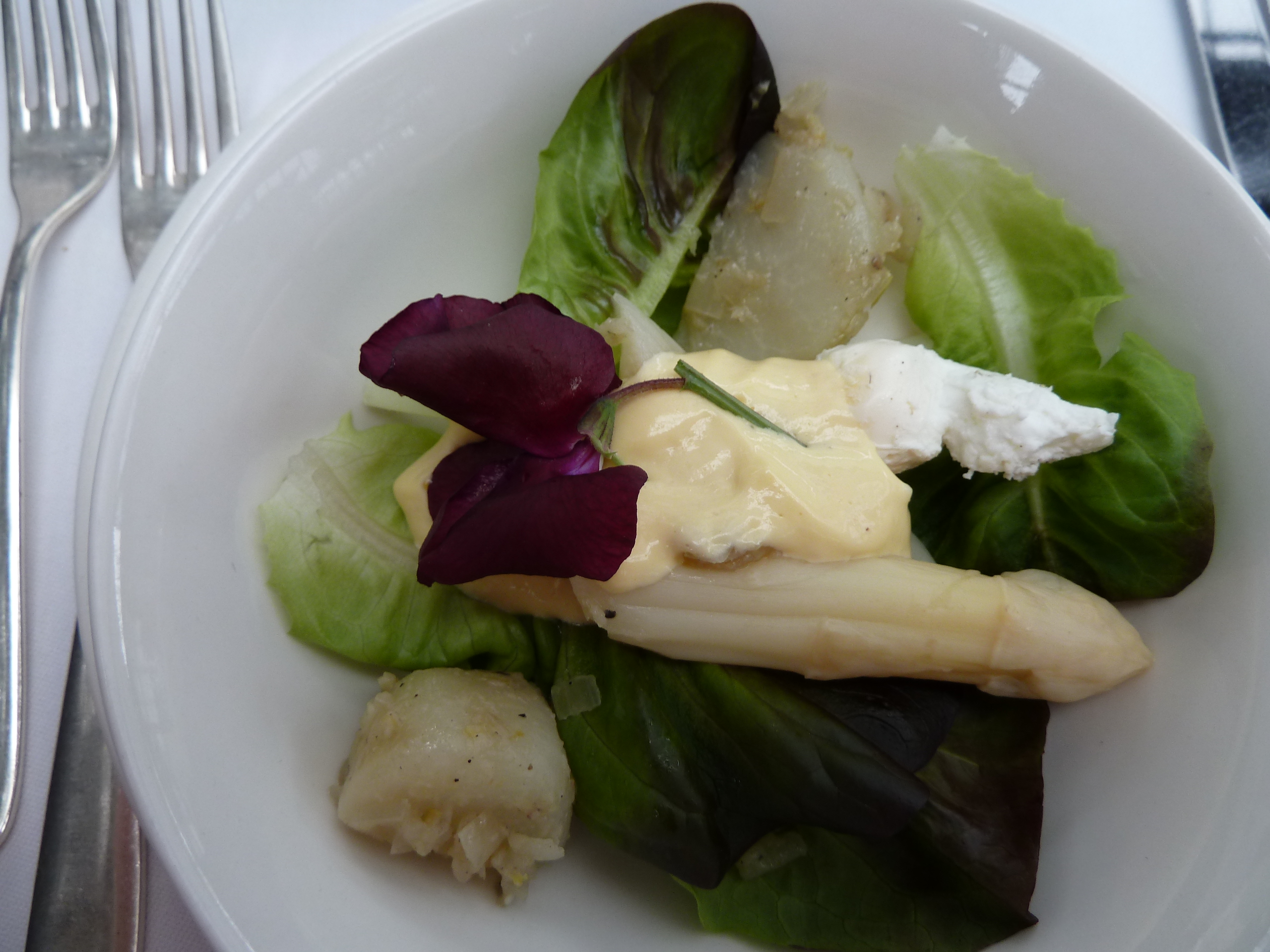
Second of two first-course salads: White asparagus, turnip and a boiled quail's egg over young lettuce greens with a sauce of some kind (sorry, whatever it was, it was delicious) and sweetpea blossoms.

Second course: Lobster with a bechamel sauce topped with a light frisee salad.

Third course: Pollack over roasted eggplant and cauliflower with a North Sea-shrimp and caper brown butter sauce. (Oh man, was this good.)

First dessert: Pistachio meringue with salt-touched white chocolate ice cream and pansy petals.

Second dessert: Platter of three cheeses with fruit and nut brown bread and a dot of apple-pear stroop (syrup) to the right and a candied cherry (?). Translation of cheese on right is "cheese that sticks to your knife."
While the municipal nurseries are long gone, the remainder of the property has retained its “municipalness”—it’s now a public park enjoyed by people and wildlife alike.

Children's play area below, and a stork nest with baby on top of the smoke stack.
Bread Cracking in the Oven—Solved!
March 14, 2011 § Leave a comment
Last summer I discovered the joys of bread baking. I guess you’d call it my hobby now. And I say hobby because … well, unlike putting a Pop Tart in the toaster and waiting for the ding, there are levels of complexity at every step. There’s practice and skill and problem-solving and continual learning from mistakes. Described that way, it seems more like a sport. And, considering I currently have three different sourdough ferments tucked snuggly in the warm and draft-free microwave, perhaps I’m also a collector.
Yesterday, I had one of those “Aha!” learning experiences. I made a batch of Country Sourdough from the Amy’s Bread cookbook. It was my first time making this recipe and considering my firm levain wasn’t so firm and I substituted in my sourdough starter, I wasn’t so sure the recipe would work properly.
I made the dough, let it autolyze, formed it into a ball, let it rise, punched it down, let it rise again, separated into two doughs, formed boules and let them rise again – seam side down – in floured baskets. The dough looked and felt great. So far, so good.
Now, in Amy’s instructions, typically once you get to this point in the recipe it’s almost as if they copied and pasted the remainder of the instructions for each and every recipe. At least for the handful of recipes I’ve tackled so far. BUT, this time she had a slightly different twist in the instructions. She said to tip the boule out of the basket onto the prepared parchment paper so the seam was now on top. Hmmm … I had not encountered that in previous recipes. All others were seam side down. Why would you put the seam up?
I had two boules – I thought, “Let’s try one seam side up, one seam side down, and see what happens. I scored both loaves on top, put them in the oven, and let them go.
Here’s what came out of the oven. Can you guess which one was which?
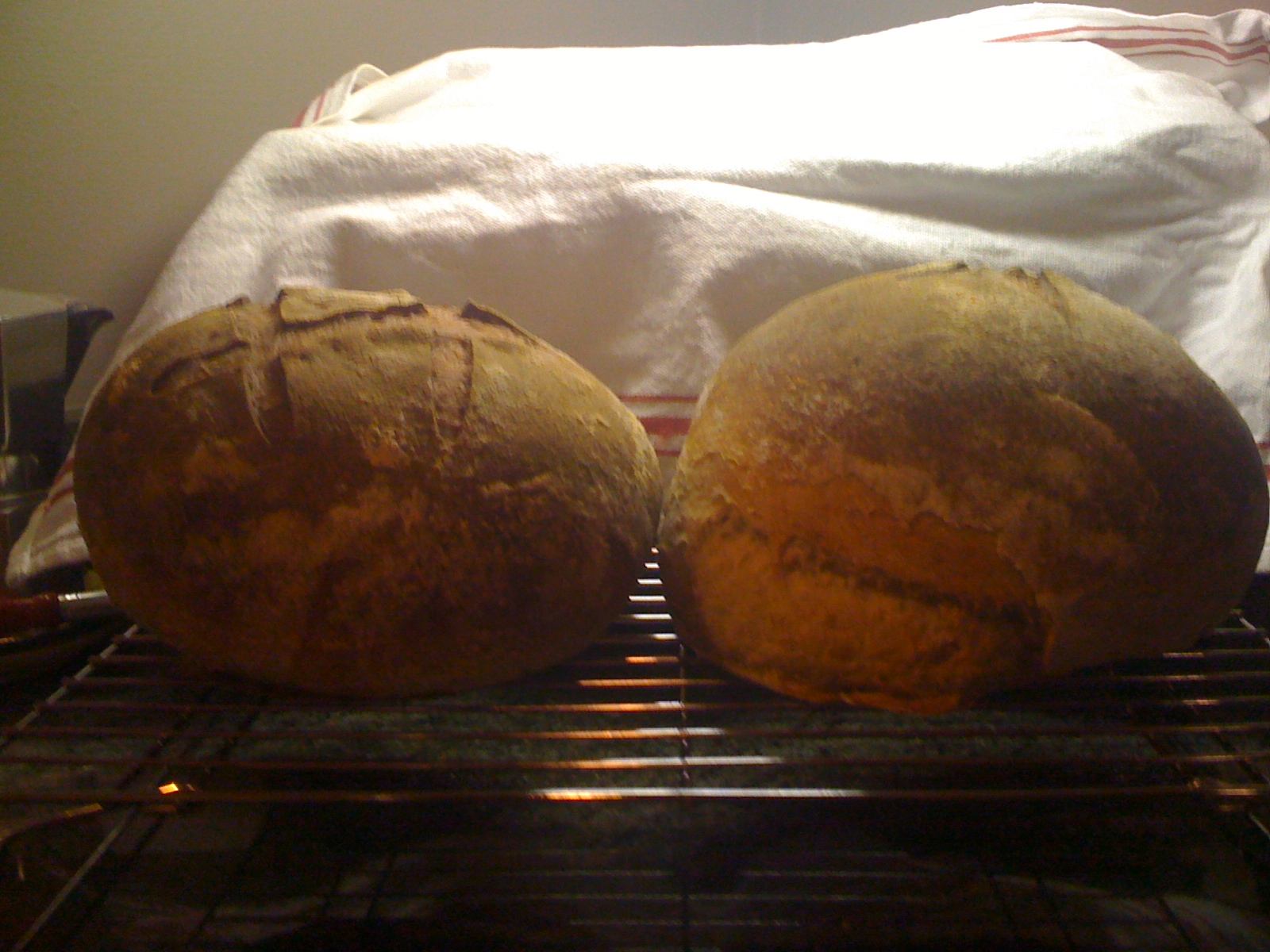
Seam side up on the left, seam side down on the right.
The one on the right was the seam-side down. Even though I scored the top, the steam escaping the loaf escaped through the seam on the bottom, causing it to tear.
For the boule on the left, the scores through the seam on top let the steam escape. Not having a weak spot—a seam on the bottom—prevented the bottom from bursting.
I tried to seal that seam as tightly as possible, but apparently not enough. This doesn’t happen with all of the breads I’ve made, but I have had this happen before. And now I know why. Problem solved.
Lentil Soup with Spinach
March 14, 2011 § 2 Comments
It turns out—now that we are paying attention—a number of our on-hand recipes are vegan. While it’s nice to cruise online looking for appropriate recipes for our new two-thirds vegan lifestyle, we need only turn to our own recipe collection to find something without meat, fish, dairy, etc.
Jennifer’s Red Lentil Soup with Spinach, for example. She collected this recipe from a local adult-ed class on soup making she attended 10-15 years ago. She just recently found it again, after I had made a batch of the Moosewood lentil soup. Lentils are pretty friggin’ amazing, if you ask me. It’s my favorite dry bean, if only because you don’t have to soak it any more than 30 minutes, which you can easily incorporate into the cooking process (see below). The addition of the spinach is inspired, tasty and I am sure, good for you, as well.
Ingredients
- 1-2 TBS evoo
- 1 onion
- 1 large carrot, diced
- 2 ribs celery, diced
- 1 cup red lentils, rinsed (I guess green would be fine, too)
- 4-5 cups water
- 1/2 tsp EACH of thyme, oregano, basil
- 1 tsp salt
- 1 lb. spinach or Swiss chard, torn into pieces
-Saute the onion in the oil over medium heat. Add the carrots and celery and saute another few minutes until just soft.
-Add the herbs, lentils and 4 cups of the water. Bring to a boil, reduce heat, and simmer 30-40 minutes. Stir occasionally to prevent sticking on the bottom. If it’s too thick for your liking, add up to a cup of water.
-When lentils are soft, add the salt and spinach. Stir. Cook for another 2 minutes.
Jennifer likes to add a swirl of sherry vinegar on top of her bowl of soup. I add a dash of balsamic vinegar. Try it without the vinegar first, then with the vinegar. The addition really pulls out the flavor of the lentils and adds an acidic brightness. You’ll also want to keep a slice or two of fresh bread on hand for dunking.
You may want to double the batch. This soup is even better in subsequent days, and is nice as your vegan lunch dish.
Apple Sourdough: Updates
February 11, 2011 § Leave a comment
No, I’m not obsessing over this apple-based sourdough. Not in the least.
But … I did keep an eye on it throughout the day on Tuesday. Good stuff was going on inside that quart container. Liquid pockets continued to build up around the apple chunks. I could see bubbling going on in there – they’d form lines from the base of the pocket going upward. Occasionally some bubbles would burst forth from that area, not unlike some undersea activity where bottom feeders send up the intermittent belch. The surface of the starter was covered with tiny bubbles, too. And, it smelled nicely fermenty. All good signs.
Wednesday, 5:57 a.m.: The layers have separated completely. No bubbles. Flour looks settled. Hmm … this happened to the grape starter, too. So, I move on to the next step, which calls for me to remove the apple chunks and add 36 grams flour. Stir well.
8:06 a.m.: I took a peek—bubbles seem to be appearing again. Bigger bubbles on the surface this time. But fewer. So far. A quick temperature reading says it is 75F. The starter pulls a bit as I bring up the thermometer. Fingers crossed.
Friday, 6:30 a.m. So, I just poured the starter down the drain. Again. Calling it starter is not correct—it was a mass of watery flour, that’s all. No bubbles. No yeasty activity. Nothing.
I don’t understand where I’m going wrong. I look online and I see all sorts of success with wild sourdough starters. Lots of bubbling! Lots of yeasty stuff going on! And me? The starters just … stops.
I will try again! I will. I just won’t blog about it—I’m getting sick of it.
BUT, if anyone out there (is anyone out there? anyone?) has some advice or a wild sourdough recipe or some suggestions of where to look for success, please let me know. Help a girl out, yo.
Obsessing with Sourdough Starter
February 8, 2011 § Leave a comment
There’s a fine line between baker and mad scientist. And I’m walkin’ that line.
I hate to fail. Hate it. And when the sourdough starter recipe from the Amy’s Bread cookbook failed miserably—TWICE—I was a volcano inside. Watch out, sourdough … I’ll get you yet.
The Amy’s Bread sourdough is, as I envision it, the sourdough the pioneers relied upon. They didn’t have a packet of Fleischmann’s Active Dry tucked into their bonnets. They used yeast, baby … real yeast just floating around in the air or found on … things. Like grapes. This is where I stop envisioning – I don’t want to know what else they used as yeast sources.
The Amy’s Bread sourdough used grapes as the yeast source. Organic grapes. Well … Okay. This is where I admit I went wrong with the recipe. I used conventionally grown grapes, not organic. I went to two or three different Whole Foods! Even the HUGE one in Legacy Place – nada! According to one produce manager, organic grapes are sparse this time of year. Conventional grapes didn’t have that yeasty bloom. What else could explain my lack of bubbling?
What to do …
This is where Dainty the Mad Scientist makes her appearance. Jennifer had related to me a scene from one of Anthony Bourdain’s books. Apparently he had a mad scientist of a baker who worked under him at one point. He was a drug-addled guy, but a baking genius. All sorts of funky smells emerged from his underground yeast lab. He had to be using all sorts of … things … to source his yeast. So, in the middle of the Whole Foods produce department I thought, “What would a drug-addled baker use?”
I didn’t go too crazy in my problem solving. I just looked around and picked what I thought would harbor the most yeast. I chose an organic apple. I figured that, while the smooth part of the apple would have been wiped or polished in some way, the indentations on both ends of the apple would have something native still hangin’ out in there. Now that I think about it, I bet an organic fig would be a good bet, too.
I added 113 grams of 75F-78F water, 72 grams all-purpose flour to a quart container. I chopped the apple into about a 16 pieces and added mostly the end sections to the other ingredients. Stirred vigorously. Put the cover on. Heated some water in the microwave to create a warm environment. Put the container inside at around 3pm on Sunday.
Monday: I checked on the dough periodically throughout the day. Small bubbles started to appear around the apple chunks. Pockets of liquid appeared later on. Lines of bubbles and flour appeared through those pockets. I heated the water about three times during the day to maintain a warmish environment. Hmm … could this possibly be working?
Tuesday, 5:57 a.m. 39 hours later, there’s definitely yeast activity in the container. The bubbles are bigger with the mixture. And there’s small bubbles – like someone took a straw and blew bubbles – on the surface. And, it smells like fermenting apples. Good sign! I stick an instant-read thermometer into the mix and it reads 70.7F. Not bad. Plus, when I pull it out, the substance is a bit gooey and pulls up with it. Yay!!
I move on to the next step – my first refreshment. I add 113 grams of 76F water and 72 grams of flour. Stir vigorously. Close container. Stick in a warmed microwave. Cross fingers.

The sourdough with apples begins to bubble.

Liquid pockets and bubbles appear around the chunks of apple
Rye Bread: Do-Over
February 3, 2011 § Leave a comment
Thursday, 6:01 a.m. No signs of life in Baby Dough. Sad. So sad.
What did I do? Where did I go wrong? Tuesday morning Baby was full of life! Thick and gooey! Bubbly and giggly! Now … now it’s just some mass of water-soaked flour in a 1-quart container.
But, there’s no odor of death in there. It doesn’t smell toxic. Baby didn’t turn bad on me. There might not be a breathing and burping going on, but I don’t think there’s any rank, poisonous build-up taking place either.
So, I’m keeping Baby and attempting to do a Frankenstein-like operation here. I’m adding more grapes. Yeast – Baby has no more yeast (a good thing for a real child, but as a dough baby, it’s the stuff of life). Thinking back to Tuesday, Baby started going downhill once I removed the grapes. So, I’m adding them back in. Fingers crossed.
I saw a good idea from a YouTube video yesterday. Henrietta Homemaker put her grapes in cheesecloth for easy removal of the grapes. Brilliant idea. In those little grapes went, cheesecloth and all. It’s like Baby Dough has a diaper now.
So, Baby Dough is back in the microwave, tucked in there with some warm water. I’ll check on him tonight. Perk up, Baby.
Rye Bread: Day 3
February 2, 2011 § Leave a comment
Wednesday 7:37 a.m. Checked on Baby Dough. He’s supposed to be bubbly and active 12-24 hours after the last addition of flour, according to Amy’s Bread recipe. But he’s not so active. In fact, a layer of liquid has formed on top and he’s not gooey anymore. He’s runny. Hmm… Not quite sure what to do. Except put on my boots and shovel.
Wednesday 8:45 a.m. I gave him a good stir with a wooden spoon to see if I could incorporate that liquid. Big bubbles popped up right away then settled down a bit. It smells sourish – I guess that’s a good sign? I put him back in the microwave with some hot water. I’ll check back in around noonish.
Wednesday, 12:32 p.m. Baby Dough began to separate again with a layer of liquid on top. No bubbling means no yeasty activity. Hmmm… so I decided to take a leap of faith here and I went ahead and fed Baby Dough with 113 grams of 80F water and 72 grams of flour. I took Baby Dough’s temp around 11:30 and it was 77F, so that’s good. I don’t think he”s not warm enough. I just think he’s hungry. Or … maybe there’s no yeasty goodness left alive in there? Could that be? Let’s see what happens by evening.
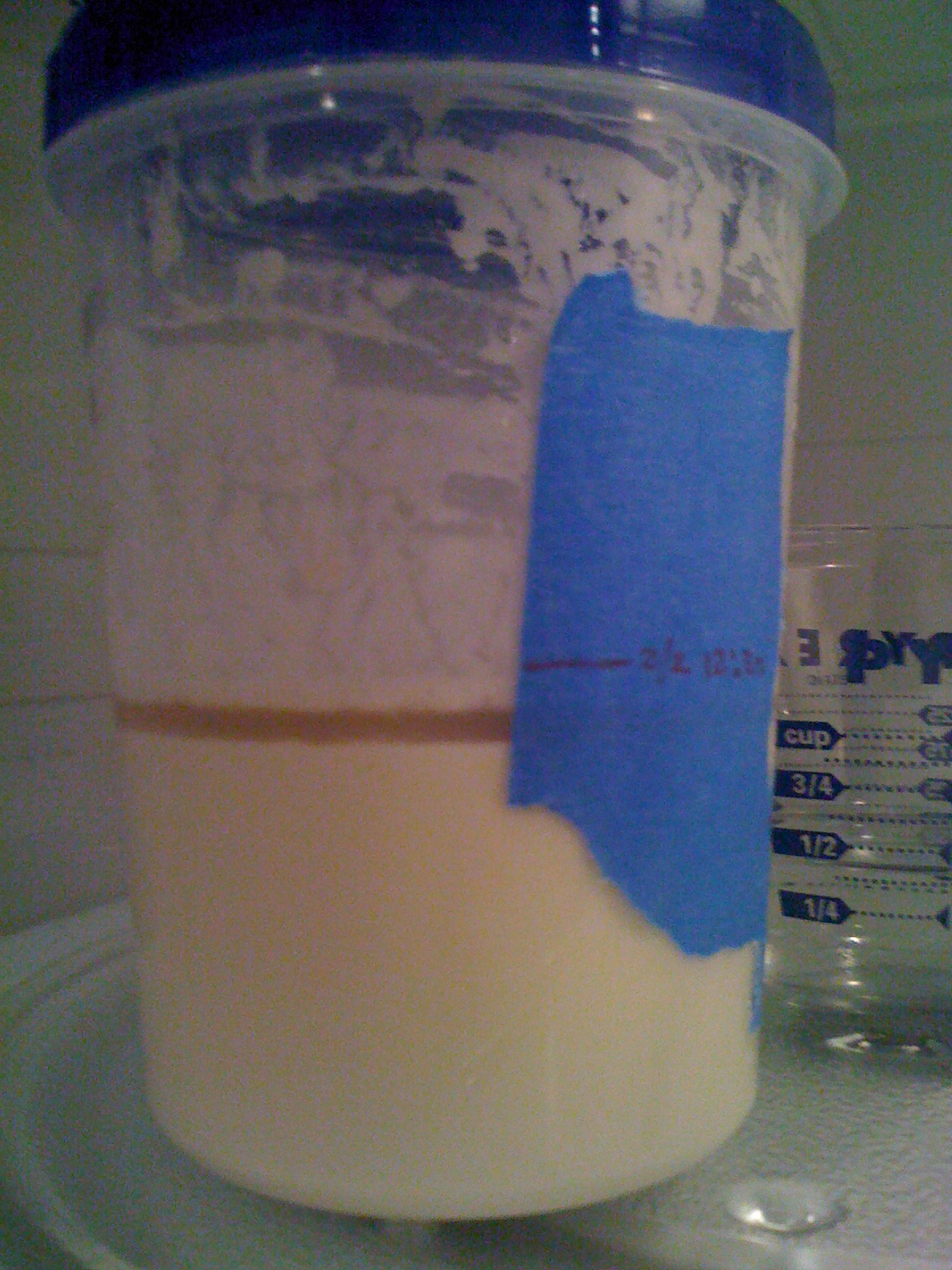
Baby Dough at 68 hours
Wednesday, 5:58 p.m. I did a little YouTubing. This liquidy layer is normal. I think. It was on YouTube, so it must be right, right? And Baby Dough is supposed to be a bit runny. I think. My thought is I don’t have a whole heckuva lot of yeasties in there so it’s not bubbling tons. But it is bubbling.
So, reading over the recipe just now, I see I was supposed to have discarded half of Baby Dough and add the 113 grams water and 72 grams flour. Hmmm… I think tomorrow morning I’ll do a do-over on this step and do it right this time.
Gave Baby Dough a good stirring. Tucked him back in the microwave with some nice warm water. Sleep tight, Baby. Bubble away.

After a good stirring, Baby Dough's blowing some tiny bubbles.
 The Dainty Dot