
Hearty Soup: Potato & Kale
March 8, 2012 § 1 Comment
We’re nearing the end of Hearty Soup season. And I feel like it got short-shrifted this year. Bone-warming broths, stews and soups weren’t really needed so very much this winter. And it’s too bad—hearty soups are my favorite to make.
We were able to squeeze in a batch of Potato & Kale Soup earlier this week. Thank goodness, because a winter soup season shouldn’t go by without this cooking on the stovetop at least once.
Jennifer and I tag-teamed this recipe. I chopped and prepped late in the afternoon, then she came home and cooked, giving it her special touch while I lunged and downward-dogged and shavasana’d. The potatoes and kale really satisfied a hungry yogini.
Full disclosure here: Full credit goes to Jennifer, who got this recipe from a soups class she took back in the late ’90s. We’ve adjusted a bit here and there. But not spectacularly so.
Potato & Kale Soup

Potato-Kale Soup with a drop of sherry vinegar
- 1+ tbs evoo
- 2 cups chopped onion
- 2 leeks, white and light green parts only, sliced thin (we omitted, used extra onion)
- 6 cups water (we used 4-6 cups leftover chickpea broth – remember that from the chickpea stew and hummus?) PLUS 2 additional cups water/broth
- 4 medium potatoes, cut into medium-sized cubes (~4 cups)
- 2 tbs minced fresh parsley
- 3 carrots, trimmed but whole
- 3 celery stalks, trimmed but whole
- 2 bay leaves
- salt & pepper
- 1/2 lb kale (we used an entire bunch of kale as bundled by the local neighborhood grocery)
- sherry vinegar
-Heat oil in large Dutch oven over medium heat. Add onions (and leeks if you have them) and sautee until soft and translucent.
-Add potatoes, parsley, whole carrots, whole celery, bay leaves and 6 cups water or broth, and season with salt and pepper (several good pinches of salt/twists of the pepper grinder). Cover. Simmer on low to medium low for about 45 minutes.
-While the soup is simmering, wash the kale and remove the thick ribs. Tear the kale into a size that won’t annoy you – i.e. not too big. You’re going to steam/cook the kale in about a cup or two of water/broth in a high-sided skillet with a lid. Boil that water, add the kale, cover, and let it cook for not that long – 4-5 minutes. You want it tender but not melty-mushy. Drain out the water and set the kale aside.
-When the soup base has simmered 45 minutes, remove and RESERVE the carrots. And remove and DISCARD the celery. Puree by using a light touch with an immersion blender—you want part of it pureed but you still want some chunks of potato in there. OR, just puree half of the soup in a food processor and return it to the soup pot.
-Stir in kale. Chop the reserved carrots, add them back in there, too. Heat until nice and hot. Give it a taste – add salt and pepper as necessary.
-Here’s the last bit that is Jennifer’s touch and it’s completely optional: Add a tad – let’s say a 1 tbs – of sherry vinegar. Not so optional, uh? That’s good stuff, that soup is.
A nice “creamy” soup—and absolutely no cream! And now that I think about it, it’s vegan. Bonus.
What’s your favorite hearty soup recipe? Drop in a comment and let us know.
Moroccan Chickpea Stew
March 1, 2012 § 9 Comments
If you don’t like cumin, step away. You’ve made up your mind about the spice, and no amount of my praising it will change the way your taste buds feel. So, I’ll see you another day, okay?
But you cumin fans, lean in a bit closer—I have something to tell you. This stew … it’s awesome. Awesome as in delicious. Really. Super. Delicious. And it’s all due to the cumin.
It being from Bon Appetit may explain why it’s so delectable. Theirs is a meaty version. I’m sure the addition of chicken thighs is nothing but fabulous. I didn’t have them on hand—plus I’m doing a no-meat kinda thing currently. Still, this rocks with out the cluck factor.
Ingredients
- 4 tbs olive oil, divided

Chickpea Stew ala Bon Appetit
- 2 skinless, boneless chicken thighs—optional
- 1 medium sweet onion, sliced
- Kosher salt
- 3 large garlic cloves, minced
- 2 tbs ground cumin—yes, that much
- 2 tbs tomato paste
- 3/4 tsp crushed red pepper flakes
- 2 bay leaves
- 2 15-ounce cans chickpeas, rinsed, drained OR 1 lb. dry chickpeas cooked to firm
- 1/2 cup chopped drained roasted red peppers from a jar (I just roasted a whole large red pepper myself)
- 2 tbs (or more) fresh lemon juice
- country-style bread
- 3 tbs coarsely chopped flat-leaf parsley

-IF you’re going the chicken route, heat 2 tbs of the oil in a Dutch oven over medium-high heat. Season chicken with salt; add to pot and cook, turning once, until browned, 8–10 minutes. Transfer to a plate.
-IF you’re not using chicken, heat 2 tbs of oil to medium low, add onion and garlic, and saute for 5-6 minutes or until onions become translucent. Add cumin, tomato paste and red pepper flakes; stir until a smooth paste forms, about 1 minute.
-IF using chicken, add it back into the pot along with bay leaves and 4 cups water and dislodge any of the brown chicken bits that might be on the bottom of the pot.
-Just a quick note: I used dry chickpeas and cooked them in a pressure cooker with 9 cups water, kosher salt, a celery stalk, a carrot, 2 bay leaves and 3 whole garlic cloves for 28 minutes. When I drained the chickpeas, I reserved the liquid and used that in place of 4 cups water. Mmmmm … more flavor.
-Bring everything in the pot to a boil; reduce heat to medium-low and simmer, uncovered, with occasional stirring. IF using chicken, let it simmer until chicken is tender (20 minutes). Sans chicken, 10 minutes is enough to get the flavors to meld.
-Transfer chicken to a plate (if it’s in there). Add chickpeas to pot and bring to a simmer and cook for 5 minutes. Shred your chicken off the bone and add it in there. Otherwise, skip it. Add in the red peppers and stir in remaining 2 tbs of oil (but only if you want – you don’t need to).
-Don’t skip this part: Give it a taste. Good, right? Yummy power-packed cumin flavor. Okay, now add in 2 tbs of lemon juice (or about half a lemon). Let it simmer for a minute. Now give it another taste? Better, huh? Yup, that lemon is a major major plus here. Adjust seasonings with salt and maybe more lemon if you think it needs it.
-Serving: Bon Appetit says to cube crusty bread, put it in an individual bowl, and ladle the stew on top. DO NOT even attempt. All you get is soggy bread. Bleck. But DO enjoy a nice slice alongside, dipping it to your liking. Oh, and sprinkle some parsley on top, too.
Good, good stewy stuff. There’s no room for cumin haters here.
Vegetarian Chili with a touch of chocolate
February 6, 2012 § 2 Comments
Chocolate. I knew I’d hook you with that ingredient. And yes, there really is chocolate in this version. Two types of chocolate, actually. But first …
Vegetarian … yeah, vegetarian. We’re pretty much completely meat-free now. Seafood being the exception. And chicken stock, although we have been doing a good job of keeping ourselves supplied with homemade vegetable and seafood stocks. The reason for ditching the fowl – the last remaining terrestrial flesh I ate – was simple. I just don’t trust where it comes from and what’s in it. Sure, I could purchase meat from Whole Foods or a retailer that sources only organic and local foods. News alert: That stuff is expensive.
Local fish and seafood is, too. I get that. But somehow I feel the seafood is a better value for the protein we get. And we use it all—from tip to tail (or claw). And we enjoy being members of our local Community-Supported Fisheries. I guess that’s a big part of it, too—it makes us feel good to support the local folks who definitely could use our dollars.
Okay, back on track. We’re talkin’ veggie chili here. I wish I could take credit for this but I can’t. This is one of Jennifer’s signature dishes (one of many). I have made it now and then, but she does it justice. And Jennifer, if you see anything wrong with the recipe, please correct me in the comments section.

Vegetarian chili with a touch of chocolate - we added green beans in place of the corn (we were out!).

Vegetarian chili, two minutes later.
Ingredients
- 1 tbs oil (olive will do)
- 1 large onion, chopped
- 2 clove garlic, chopped
- 2 peppers, whatever color you prefer but red is nice
- 2 jalapeno peppers, minced (seeds removed if you don’t like it so spicy)
- 1 bag of frozen soy crumbles
- 1 28-oz. can of whole chopped tomatoes (or whole tomatoes that you squish with your hands)
- 1 15-oz. can of red kidney beans
- 1 15-oz. can of black beans
- 1 cup (or small can) of whole kernel corn
- 1 tbs chili powder
- 1 tbs cocoa powder
- 1 tbs lime juice
- 1 tbs cumin
- 2 tsp dried oregano
- 1 small block (2 oz?) of Baker’s semi-sweet chocolate
- 2 tbs chopped cilantro
- salt and pepper to taste
1. In a large pot or Dutch oven, heat oil to medium and add chopped onion and garlic. Saute until translucent.
2. Add both types of peppers and cook until tender – about 5 minutes. Add the bag of frozen soy crumbles just so it thaws out a bit before adding other ingredients. It’ll take just a couple of minutes.
3. Add the tomatoes, beans, corn, chili powder, cocoa powder, lime juice, cumin and oregano—and a general sprinkle of salt— stir thoroughly, and let it come to a boil. Turn heat down a bit and let it simmer for about 30 minutes. During that time it will thicken a bit.
4. Add in the 2-oz. block of chocolate and stir it around, helping it to melt and incorporate into the chili. Add the cilantro, season to taste with salt and pepper.
Serve with a dollop of sour cream, Greek yogurt, guacamole, grated cheese or straight up. Give it a taste. Good, right? And you know that flavor that’s right on the edge of being familiar? It’s the chocolate. Serve it to guests and when they ask what that ingredient is, don’t tell them. It’ll be our secret.
Some notes:
1. Feel free to soak and use dried beans of any kind. I would use 1 cup of two different types of dried beans—we’ve used pinto, cranberry, garbanzo.
2. Want to speed up the cooking? Use a pressure cooker. It’ll shave off 10-15 minutes from the simmering time.
Down for Maintenance
December 1, 2011 § Leave a comment
“Down for Maintenance.”
I’m not referring to the Dainty Dot blog. I’m referring to Dainty herself. Not one single post in the month of November. Call it my month of maintenance. Am I good with that? Yeah, I’m good with that. And now that December is here, I’m good with that, too. Get back in the saddle, as they say.
So, what have I been doing, maintenance-wise … Let’s see:
1. Exercise stuff. I had big plans to lose 6 lbs by the end of the month. A continuing bum knee (yes, ma’am, I did finally go to the doctor) kept me from running, but I learned to love the elliptical. But the 6 lbs? No way, but close.
2. I discovered I love yoga. Like, really LOVE it, with all caps. It’s kinda like how I really get excited about a batch of soft and growing bread dough. Or when the row of spinach seeds come up. But instead of bread forming or food growing, it’s me doing something really cool. I like it. I want it. I’m gonna keep doing it.
3. Shhh … Don’t tell my boss … I’ve learned how to streamline my work to get it all done in about … Well, in less time. At least for now – until travel season starts in a matter of a month or so. But, it’s afforded me some time to do #1 and #2.
4. I did go on one biz trip and extended it into a long weekend in Chicago with Jennifer. Here’s my thought on Chicago: It’s s nice town, and too bad it’s in the middle of the country. Because as you may or may not know, I’m a time zone snob. I just can’t do the middle. No offense, Middle America. You’re just not for me.
5. #3 also afforded me time to do some soul searching about what I wanna be when I grow up. And I realized, wait, I’m already all grown up. As Bette Midler says in my most favorite song she sings, “Is that all there is?” The answer? The answer … If I had the answer, man …
6. Speaking of looking for answers, So I picked up a thin book that’s been on my shelf for about a dozen years. It’s called Buddhism Without Beliefs. It’s not religiony in any way – hence the “without beliefs” reference – and it’s been a good way to get my head decluttered. I recommend it.
7. Pie was made. And if there’s anything Dainty does, it’s pies. It was just one pie, but it was a mighty fine pie. Dutch apple. Sorry I didn’t share. I’ll make another. I promise.

8. Dainty has plans in the works for 2012. Big plans. Now with the paying work streamlined into lean-flow efficiency, I have some time to do Dainty the way it deserves. Details to be revealed over the next month or so.
9. So, here’s a question for you: what do YOU want to see Dainty do next year? More travel stuff? More baking? Bread or sweets? Wanna know more about my mad skills in the garden? Oh man, I mean I’ve got mad skills. You want to see something, you let me on know. ‘K?
Moqueca, or a Tasty Brazilian Fish Stew
October 31, 2011 § 1 Comment
This year was supposed to be the Year of Ellen Baking, right? Or was it the Year of Ellen Reading? I was supposed to run three  half-marathons this year, read 12 books, and start the engine on something Big and Awesome. It’s turned out to be more of the Year of Ellen Waffling, and I don’t mean those maple-dripped golden squares on your brunch plate. It’s not been an all-that-great year, and I want it to be over with. I’ve petitioned the International Calendarological Society to just end 2011 here and now, and to get a move on with 2012. Apparently only Popes and Julius Caesar can do that. Officially. You can imagine my regard for “official.”
I’m declaring an end to 2011 as of Oct. 31—which conveniently makes Halloween the equivalent of New Year’s Eve. November 1st will begin a 61-day period known as Daintydays. It’s a time when Dainty and anyone who may have a thread of Daintyness in her/himself says “I’ve had enough of this, and I’m just gonna do ______” (with the blank being nothing that harms others, of course; that’s not very Dainty). Two months. Two months to do what you think you couldn’t by the end of the year. Think on it—we start tomorrow.
What does this have to do with moqueca? Absolutely nothing. Unless “Making the freakin’ best fish stew ever” is that thing you want to do by the end of the year. I first had moqueca at Edwige at Night in Provincetown in 2010. When I heard they were closing for good at the end of the Summer 2011 season, I rushed over for one last order. Last week, we made our own moqueca with a little help from Emeril Lagasse. While it’s no Edwige, it’s still damn good.
Moqueca (Brazilian fish stew)
Ingredients
- 2 1/2 pounds white-fleshed fish cut into 1-2 in. pieces —we used a combo of bluefish (from our Cape Ann Fresh Catch share) and some shrimp
- 3 tablespoons fresh lime juice
- 1/4 cup olive oil
- 1 1/2 cups thinly sliced onions
- 1 tablespoon minced garlic
- 2 tablespoons tomato paste
- 2 cups roughly chopped tomatoes – we used a 25 oz. can of whole peeled tomatoes and gave them a rough chop
- 1/2 cup fish stock or water
- 2 teaspoons salt, divided
- up to 1/4 cup hot sauce – recipe calls for Piri Piri, which is a blender hot sauce, but we dumbed it down a bit
- 1 (14.5-ounce) can coconut milk
- 2 tablespoons chopped fresh cilantro leaves
- Steamed white rice, as an accompaniment

-Put the fish in a glass mixing bowl with the lime juice. Set aside for 20 minutes and prep the remaining ingredients.
-Heat a large saute pan over medium-high heat. Believe me, you’ll need a larger pan than you expected. Heat up the oil, and saute the onions until translucent, about 3 to 4 minutes. Add the garlic saute for about 30 seconds. Add the tomato paste, chopped tomatoes, fish stock and 1 teaspoon salt. Stir to combine everything.
-Turn up heat a tad and bring the mixture to a boil. Once boiling, add the limed fish, the hot sauce (try half the amount first then add more after afterward) and the coconut milk. Stir it up again and let it heat to boiling. Reduce heat to medium-low and until the flesh starts to flake, about 10 minutes. IF you are using shrimp, add the shrimp separately from the fish, about 5 minutes through that cooking period.
-Remove the cover and sprinkle the cilantro over the fish. Season with the remaining salt and hot sauce, if you so choose.
-Serve with the rice. A nice basmati rice is perfect. Make LOTS of it, you’ll need it.
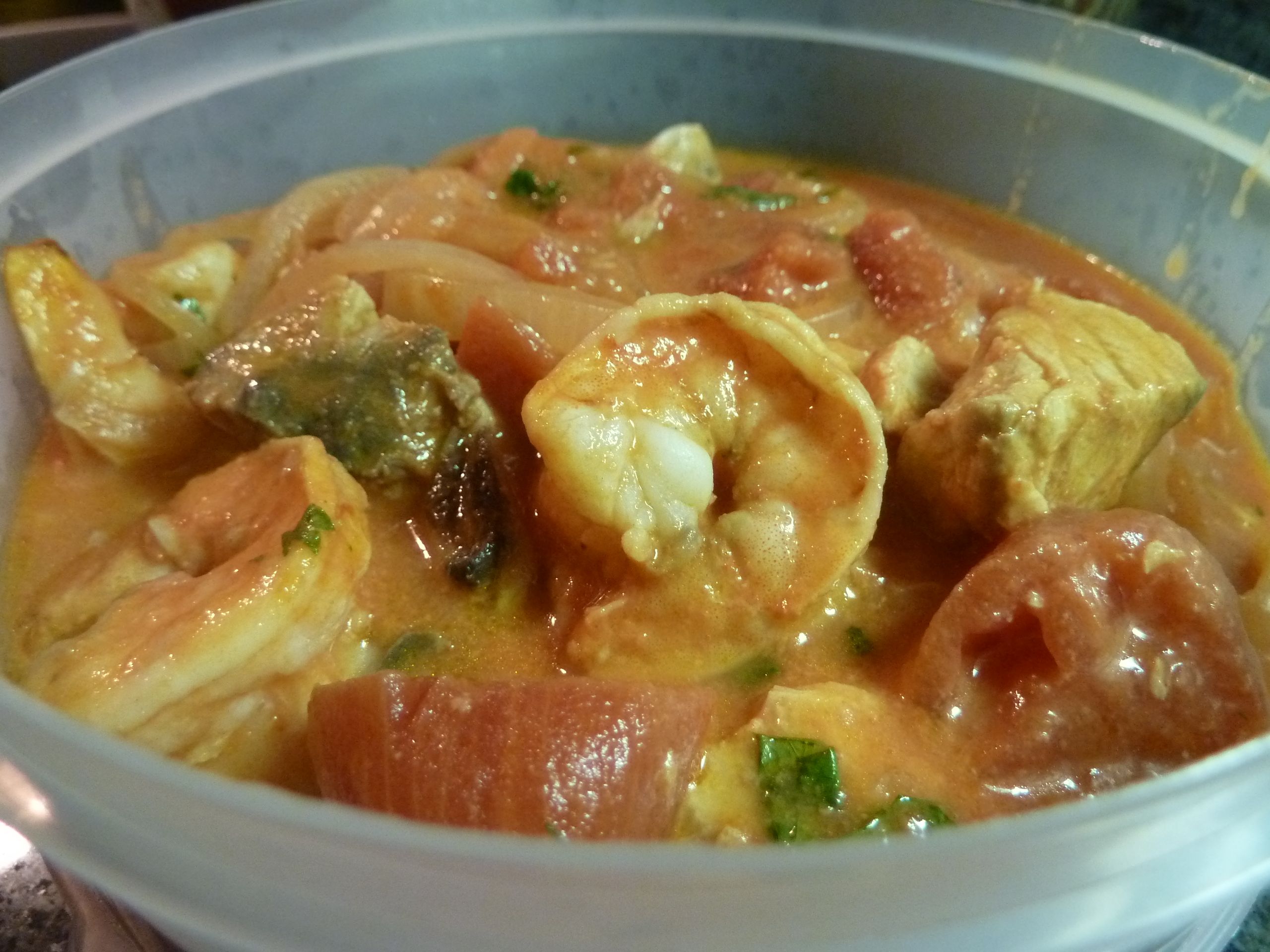
Ahhh ... leftovers.
Homegrown Food Challenge—Days 6 & 7
October 21, 2011 § Leave a comment
No, we did not whither away and die from lack of food after Day 5 of our Homegrown Food Challenge. We survived quite nicely, thank you very much. I’ve just not been … well … in the blogging mood, I guess. If you’re a blogger, you’re pickin’ up what I’m puttin’ down. Hey, it happens. I’m back on track now, though, no worries.
Breakfast:
Day 6—it was all the way back last Saturday. I had promised we’d kick it up a bit with something for breakfast that was more interesting than yogurt. And we did—omelets! Not an omelet, per se, but more of a flat egg. That’s what my mom called them when I was growing up. It’s just two eggs, slightly beaten and NOTHING added to the eggs, as you would were you making omelets. Just a straight ol’ egg. We added in some local goat cheese and diced homegrown tomato right at the last second, folded and called it breakfast. A slice or two of toasted homemade bread made it a filling meal.

Lunch:
After, Jennifer took off for the weekend to attend to some business, leaving me to fend for myself. Lunch was … honestly, I can’t remember. Must have been the last of the grilled eggplant paninni … yum … By the way, that post was way popular. Way. Popular.
Dinner:
Dinner was when I got creative on Day 6. Earlier in the week I had cooked up some homegrown Vermont cranberry beans. Used the pressure cooker, actually, and the process yielded some terrific bean broth. Add some homegrown leeks, homegrown carrots, and a neighbor’s small bunch of homegrown celery, and it’s the beginning of soup! I added to that the leftover Vermont cranberry beans, some leftover homegrown/homemade tomato sauce, a fading homegrown zucchini and a couple of locally grown potatoes—along with salt, pepper, homegrown oregano and sage. Soup and bread for dinner—the end of a great gardening day.

Day 7
Our weeklong Homegrown Food Challenge ended not with a big banquet ala Julie and Julia, but on a much more common, everyday note. Plans for going out with a bang—lasagna of homemade pasta, homegrown broccoli, eggplant and kale—faded with the afternoon. Instead we hunkered down, ate our soup and toasted our accomplishment with the last of the local beer.
Next year … I truly wonder what that will bring.
Homegrown Food Challenge—Day 4
October 15, 2011 § 1 Comment
Day 4 … halfway through our week of eating and drinking stuff as homegrown and as local as possible. How’s it going? Great. In fact, we might have too much food. Well, we’ll make it to the end, definitely.
Okay, I had promised some scintillating breakfasts. Not happening on Day 4. The morning meal, to me, is utilitarian. I know, that’s the wrong way to think about it. You’re supposed to eat breakfast like a king, lunch like a queen and dinner like a pauper. Or something like that. I honestly don’t have the stomach for breakfast until, say, 9 am.
Day 4 was a whole two days ago. Let’s see if I can remember what we had.
Breakfast:
Flat Black coffee. Maine’s Own Organic Milk. And honestly, I may have had an apple. I know it wasn’t much. I was kinda busy and on a role with things, work-wise. Sometimes that happens. Kids, eat your breakfast and don’t be like Auntie Dainty.
Lunch:
Lunch … I have to say what I made for lunch was the best thing ever constructed out of two pieces of bread. Seriously. Some cookbook-writing chef is going to see my delicious creation and will put it front and center in his/her lunch options.

It’s a grilled eggplant and tomato paninni with smoky mayo. Recall the smoky mayo originally topped the broiled bluefish on Day 2. Imagine that spread not-too-thinly on two slices of homemade sourdoughish bread. And remember the eggplant on the grilled pizza from Day 3? Lay a couple of those grilled eggplant slices down on top. Add some sliced tomato, top with another mayo-slathered slice of bread. Put a bit of olive oil in a hot cast iron pan. Lay down the sammies. And add some wait to make them “pressed sandwiches.” In this case, I used a very heavy Dutch oven. Grill both sides to a nice crispness. Smoky mayo+grilled eggplant=the world’s perfect pairing. I wanted to share it with everyone and no one all at once.
Dinner:
We still had two bluefish fillets in the fridge from our Cape Ann Fresh Catch share on Tuesday. We did another round of Broiled Bluefish with Smoky Mayo since it was so good on Day 2. And we had a small side salad. See those beans on top? Vermont Cranberry Beans – the best homegrown beans. Ever.
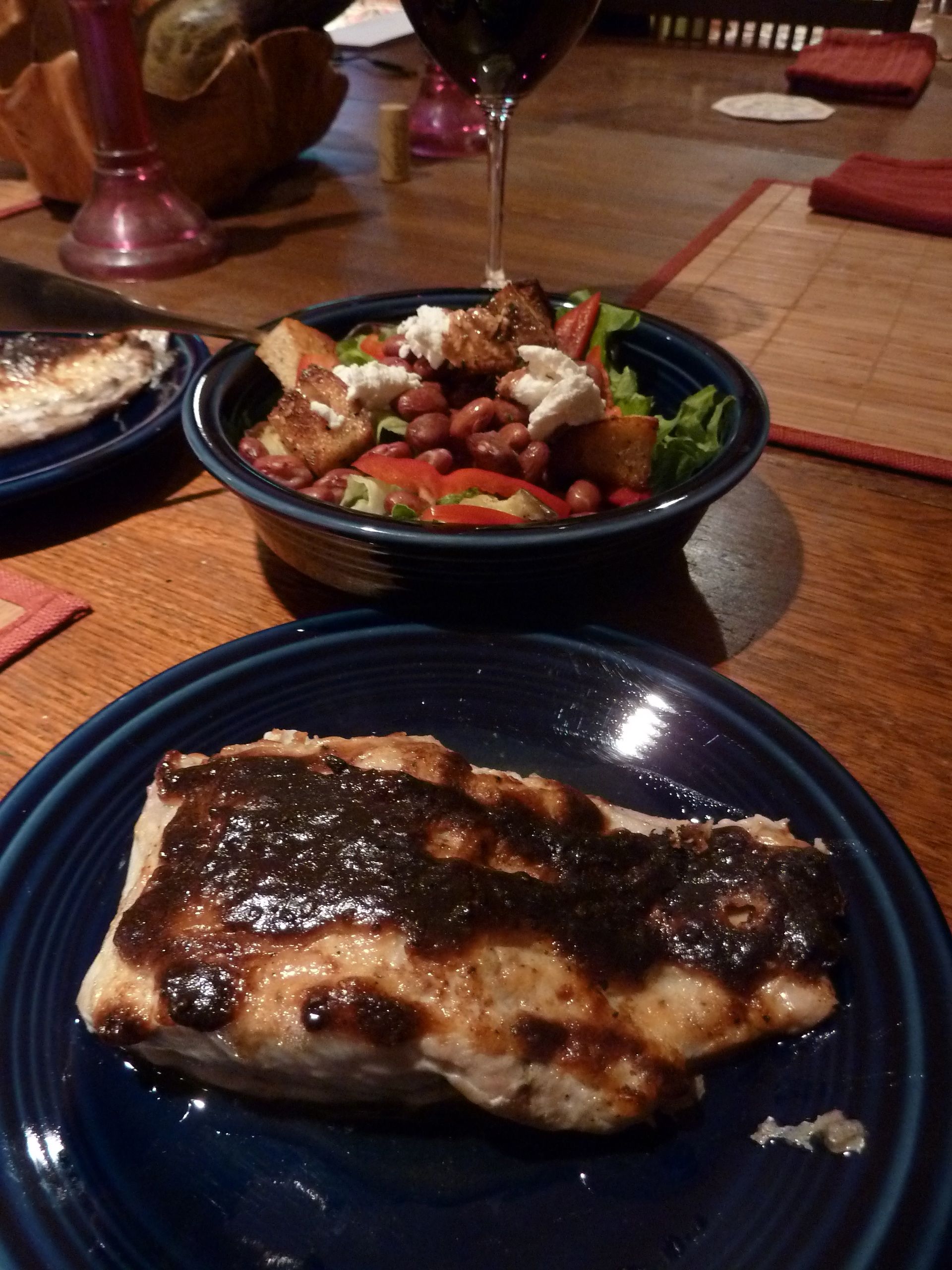
That was it for Day 4. We won’t tell you if we finish the remaining Topsfield Fair-made kettle corn. We’ll let you think on that.
Spicy Tomato Soup
October 2, 2011 § Leave a comment
Normally, if you let produce sit around for awhile, bad things happen. Soft spots. Wilt. Mold. Eyes sprouting. Ooze. Fruit flies. Rot.
Okay, I’ll stop with the grossness.
But sometimes, if you let produce sit around, good things happen. Like what? Like ripeness, for one.
This time of year, you just never really know what’s gonna happen in the garden. And I speak specifically of the summer hangers on—the zucchini and yellow squash, the basil, the peppers, the tomatoes. Especially the tomatoes. Less sun, cooler weather means they take a way long time to ripen on the vine. And the frustrating part is a tomato could be green and happy one day, and then the next day it could be on the ground, fodder for the ants.
So, I pick them up and bring them home. Or I pick them when they’re just turning orangy. Or I pick one or two whenever I visit the garden, which is about twice a week this time of year.
What to do with green tomatoes? Orangy tomatoes? Let them sit on the counter—they’ll ripen. Kinda. Not a nice and juicy vine-ripening experience, but they’ll turn red. Ish.

The fixins.

It's Tomato Christmas.
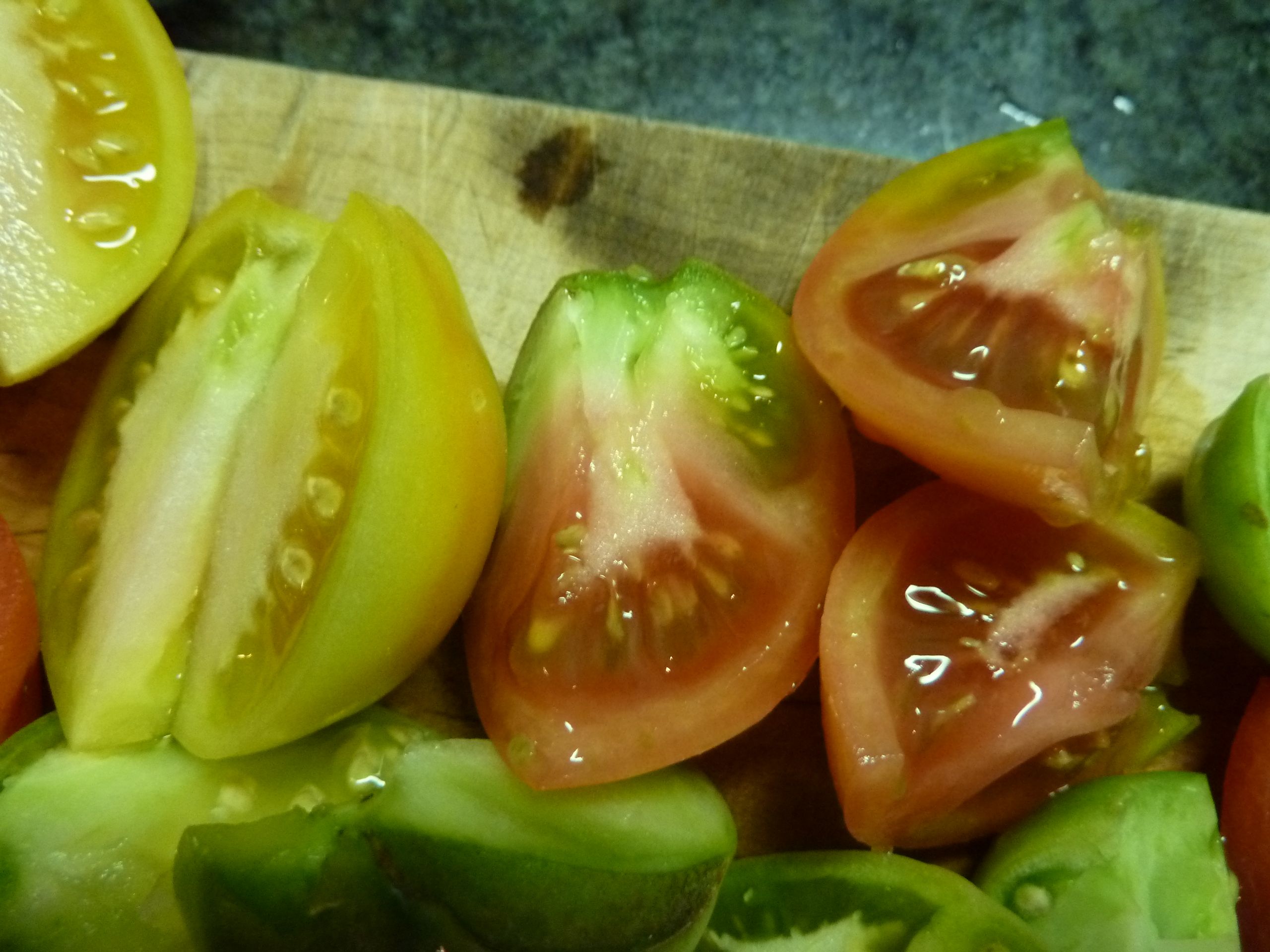
Look at that tomato in the middle—it's like the Italian flag.
With a mix of tomatoes in all stages of ripeness, I turn to a recipe from Emeril Lagasse I pulled off the Food Network website. The original calls for pancetta and three different types of hot peppers – jalapeno peppers and Anaheim and pasilla chiles. And, it calls for just green tomatoes.
Is it spicy? Oh yeah, it’s spicy. Feel free to add a dollop of sour cream to cool it down. Me? I like to add a spoonful of pesto. Tomatoes and basil – a perfect match.
Spicy Tomato Soup(this is a double batch)
-

Spicy Tomato Soup
1 Tbs olive oil
- 1 large sweet onion, sliced thinly
- 5-6 cloves garlic, peeled
- 2 bay leaves
- 5-6 hot peppers, whatever type you want to cook with, diced (I used jalapeno and Hungarian wax)
- 3.5 lbs tomatoes, cored and roughly chopped
- 6 cups chicken or vegetable stock
- Juice of 1 lemon
- Salt and pepper

-Heat oil in a pan over medium heat. Saute onion until just translucent – 4-5 minutes. Season with salt and pepper.
-Add garlic, bay leaves, garlic, and peppers and cook for 4-5 minutes. Add tomatoes and stock, then adjust seasonings with salt and pepper to taste. Bring soup to a boil, then turn down heat and simmer for 15 minutes or so, until the tomatoes are soft.
-Time to puree!! But remove the bay leaves first!! You can puree in batches in a blender. Or, we have an immersion blender that does a terrific job. Sure, you’ll get a bunch of tomato skins getting kinda caught in the blendery parts. Just remove, or put back into the soup—whatever your preference. If you’ve pureed in batches in a blender, pour the soup into a separate bowl.
-Add the lemon juice. Give it a taste. Spicy? That’s what it’s supposed to be.
Try with a bit of sour cream. Or shaved parm. Or the runny part of your stash of pesto. Be sure you have some crusty bread. You’re gonna want to sop up that goodness.
You know, this would be a great soup to make for the Homegrown Food Challenge. Luke, give this a try—I know you love spicy stuff!
Pressure Cooking Black Beans
September 20, 2011 § 3 Comments
You’re going to think I’m a bit crazy, but I actually really like this two-thirds vegan kick I’m on. Now, let me clarify:

Buy the dry - dried black beans are easy as pie to cook up and enjoy in 30 minutes.
1a. Two-thirds vegan means two meals out of three meals each day are non-dairy, non-poultry, non-animal products. Not even a boiled egg on my lunchtime salad – and I love a good boiled egg, too.
1b. What about snacks, you ask? What am I gonna do, eat a meat stick? Almonds, an apple, hummus and chips if I feel the need.
2. I first mentioned the two-thirds vegan thing back in … was it March? April? Lest you think I’m Superwoman, I need to inform you that I haven’t been two-thirds vegan all the time. Vacations don’t count. Weekends away don’t count. And sometimes that boiled egg would find its way onto of my salad. And, last week … I had a whole mess o’ Old Bay-seasoned wings on my business trip to Baltimore. The only wings I’ll eat, and the only town I eat them in. There are rules about being two-thirds vegan, and I make them up as I go along.
3. And sometimes, you go away for the weekend and someone makes you a three-egg omelet. With mozzarella. And lobster. Just be sure there’s a veggie burger in your near future.
BUT! It’s a new season. And I have a renewed interest in sticking to the vegan thing. At least two-thirds of the time.
BUT! I need more protein. That’s what a recent doctor visit and blood test suggested. So, here come the beans, which are an excellent source of protein and fiber awesomely tasty food. Rather than stocking up on cans upon cans of beans – they add salt and calcium chloride, which, by the way IS a salt! – we buy the dry. Oooo … I like the way that sounds, “buy the dry.” Plus, they are cheaper (I’m showing my frugal side).
Dry beans are NOT a pain in the ass to work with. It’s easy. If Dainty can do it, so can you. And you don’t have to wait around 24 hours while your beans soak, etc. etc. Invest in a pressure cooker and your beans will be done in 30 minutes, and that includes 5 minutes of prep time.
The recipe we use comes from Pressure Perfect by Lorna Sass. (Oooo … sassy.) Hey, meat lovers, there’s a roast chicken on the cover! That’ll assure you Lorna has added something for everyone inside. There are a bunch of bean recipes included – the one we use is for black beans with soft tortillas. We use just the first half of the recipe and add our own seasonings depending on what we’re using the beans for. Here, I’ll just go through the first process and produce a batch of pressure-cooked beans.
Ingredients
- 4-6 cups water (depending on how much bean broth you want)
- 1.5 cups dried black beans, pick over to remove icky ones, small pebbles, etc. and rinse
- 1 small onion
- 4 cloves, peeled and roughly chopped
- 1 TBS oil (apparently it prevents or controls foaming)
- 1/2 tsp salt
-Combine everything in a 4 qt. pressure cooker.
-Lock the lid in place. If you’re like me, you’ll do it three or four times, making absolutely sure the lid is on and won’t fly off. Seriously though, when it’s locked, it’s locked. No hardhat needed.
-Bring the pressure cooker to high pressure over high heat. READ YOUR PRESSURE COOKER INSTRUCTIONS! It will tell you how you can tell when it has reached high pressure. For our Fagor pressure cooker, high pressure is indicated when two red lines are visible.
-When it has reached high pressure, turn down the heat to a temp that will maintain that high pressure. For ours and on our gas stove, that means at a point between “lo” and “2”.
-Let the beans bubble away in there for 25 minutes. Then turn off the heat. Let them sit there as is – don’t open the lid! – and let the pressure come down naturally. READ your cooker instructions to find out how you can tell on your device.
-When the pressure has come down, open the lid AWAY from you. You don’t want to get a face full of super-heated steam, right? Always always always be careful.
-The beans should be tender. If not, lock it up, stick ’em back on the heat and cook for another couple of minutes. Repeat the heat coming down and all that.
What you have now are several cups of firm yet tender beans in broth. If you used 6 cups of water, you are halfway on the path to making a black bean soup. If you used 4 cups of water, you have a bit less broth. Letting it sit, the beans and broth will thicken slightly but not much.
We use 4 cups of water, and after the beans are pressure cooked, we typically add a touch more salt, some pepper, several shakes of red pepper and a diced small tomato. We then serve it over a bowl of rice. We’ve added other things, as well – roasted sweet potato, butternut squash, for example.

We add a touch of salt, pepper, red pepper flakes and diced tomatoes to our black beans.
If you have any suggestions for what to add in to the black beans, I’d love your suggestions. We need to keep up the variety. Please leave your comments below!
What to Do With Kohlrabi?
September 9, 2011 § 3 Comments

Kohlrabi, my garden's "Let's try something new" veggie for 2011.
Kohlrabi. German for cabbage turnip. English for “What the hell is this thing?”
Duh, I know what kohlrabi is. It’s a member of the brassica clan, i.e. cabbage, broccoli, cauliflower, Brussell’s sprouts, etc. All the brassica veggies are basically the same plant. One’s leaves form a head, one green florets, one really floppy outer leaves, one’s stem produces tiny head at the axillary buds. And in the case of kohlrabi, the stem swells up to the size of an ostrich egg.
Careful now, Dainty. You’re showing your botanical geek side. Calm down. Calm down.
I’ve never grown it before. Dad and the farm didn’t grow it either. But this year I bought a 6-pack of kohlrabi transplants as my “Let’s try something new” experiment. Why not, right? You only live once. Might as well grow some kohlrabi.
As you can see, my six transplants turned into 3 harvestable (barely) knobby things. One didn’t make it through the transplanting. One actually grew into broccoli. Note to self: Don’t buy transplants from the store again – your transplants labeled zucchini were actually yellow squash and the purple eggplant turned out to be white. As for the last transplant – no idea what happened to that, I lost track of it. Oh, well.
Anyway, so I’m here with three kohlrabi. One looks pretty good. One turned into the funniest looking kohlrabi ever – I expect my award in the mail any day now – and one looks like it’s been sitting in the hydrator a little longer than it should (true, every word).
And I have no idea what to do with them. Oh, sure, I’ve Googled. Saute it like broccoli stems. Cube. Puree. Middle Eastern and Indian dish galore have found their way into my searches. But I’m stuck. Folks, I’m at a loss. Indecision is a horrible thing.
So, dear Daintyites, , I’m looking to you for suggestions. Any ideas? Anyone? If you have a recipe – any recipe at all – please leave a comment below. I may need to hit the farm stands and gather up more of this brazen brassica.
 The Dainty Dot