
Tomato and Pesto Sandwich
September 27, 2011 § 2 Comments
Leaves falling from trees, temperatures dropping, plants succumbing to the elements, days shortening … The world as we’ve known it these last few months is coming to an end. We must eat as many fresh tomatoes and as much basil as possible.
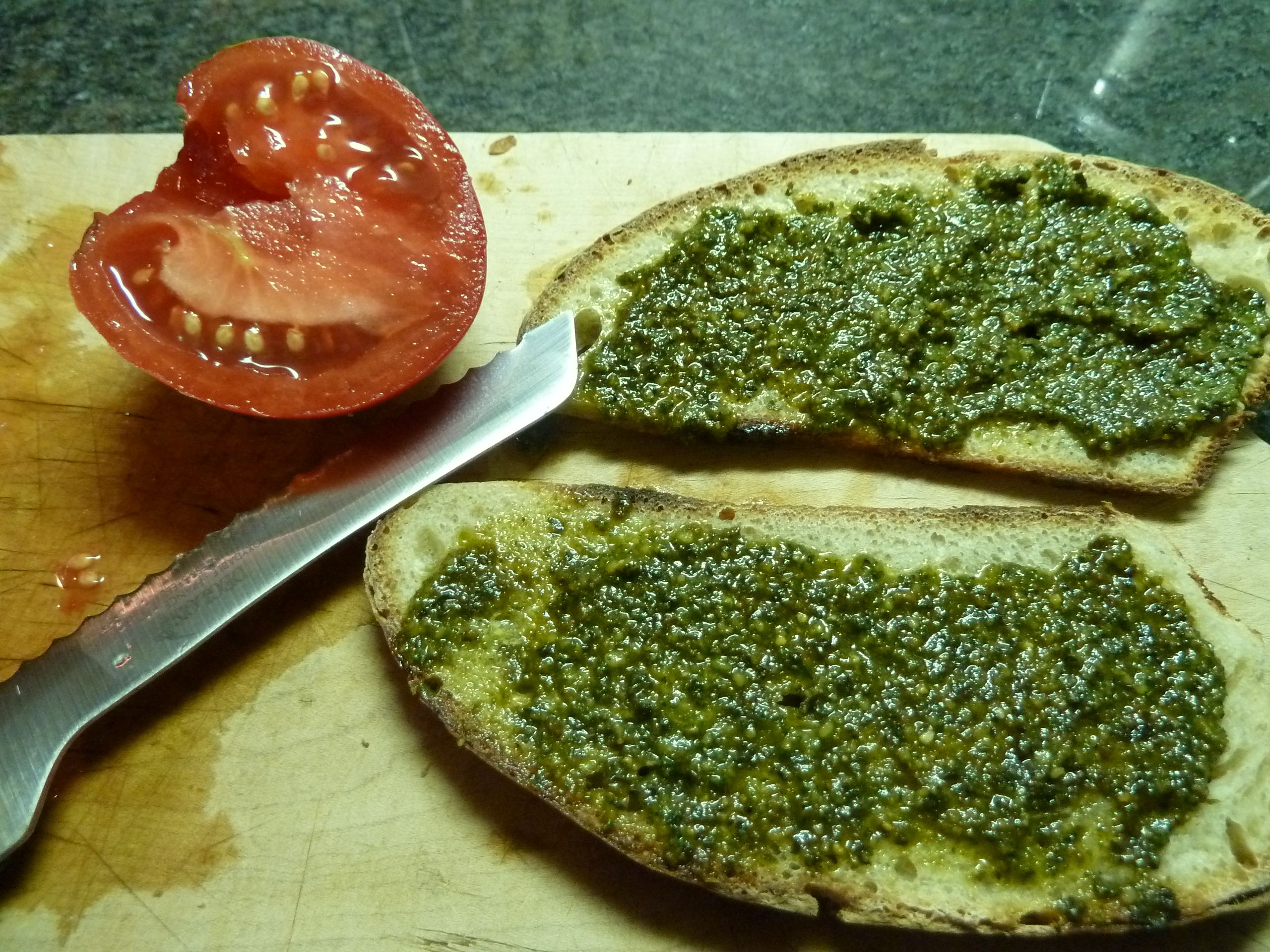
Our world is collapsing. Eat tomatoes and basil while you can.
I’ve taken up that challenge, gladly. Who wouldn’t? Fresh tomatoes and bright bristly green basil is the ultimate garden combination, really perking up the mouth with the pairing of acid and mellowness. I don’t have to describe it—you know all too well how delectable the two are together.
Maybe one of the simplest pairings of tomato and basil is in a sandwich. I know, it’s not really a recipe. It’s more of a lunch suggestion. And if you’re like me and disregard the miniscule amount of Parmesan cheese in pesto, tomato and pesto on toasted sourdough becomes a vegan meal. The tomatoes—homegrown. The pesto—homemade, with the added “yeehaa!” of the basil being homegrown. The sourdough—made by my own two little hands.
Want to share lunch with me? There’s enough here for at least five more sandwiches.

Kinda looks like a big smiley face, don't it?
Your favorite tomato—basil combination? Do tell. (please! feel free to share below!)
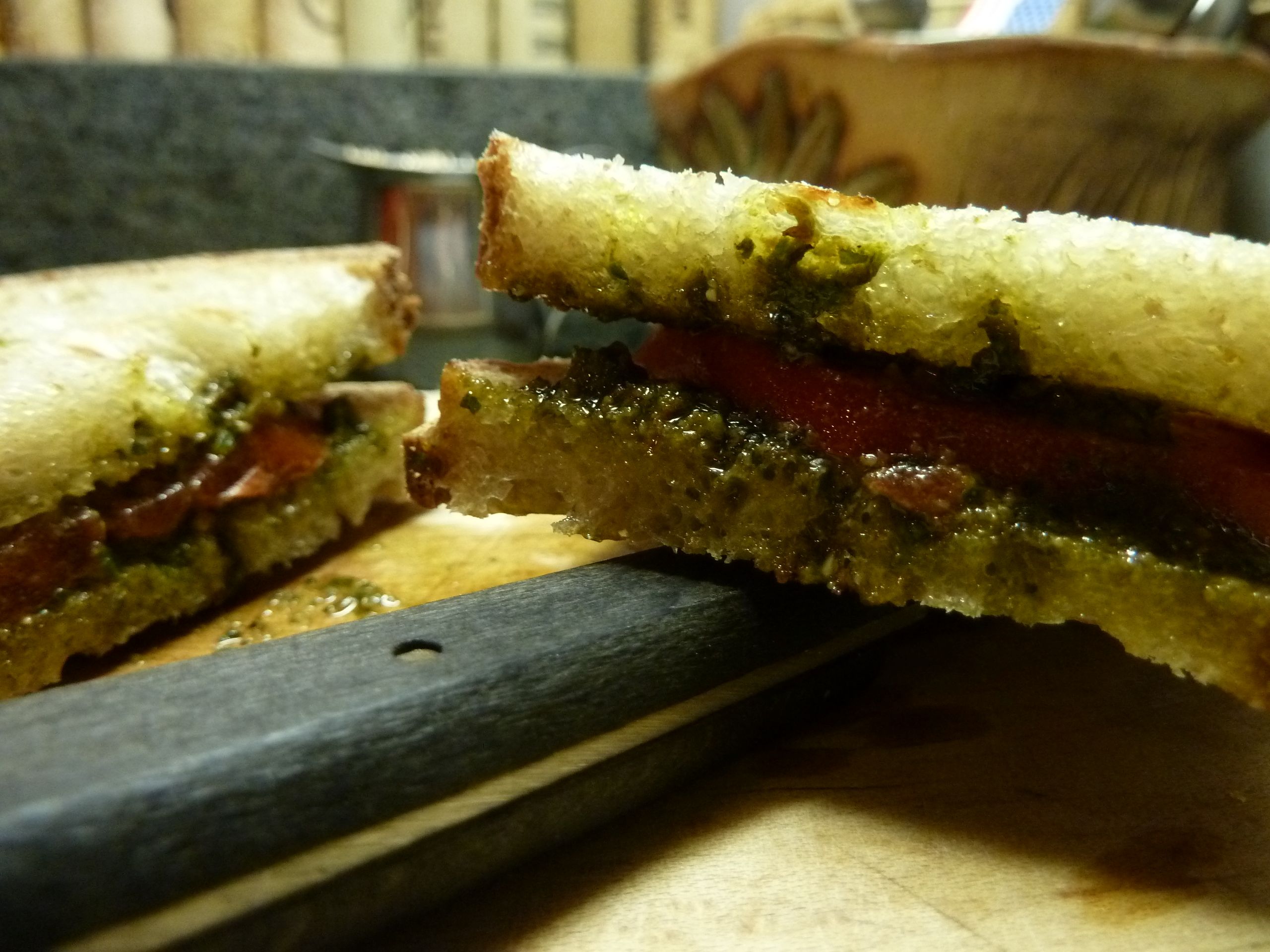
Nothing but goodnes here.
Pressure Cooking Black Beans
September 20, 2011 § 3 Comments
You’re going to think I’m a bit crazy, but I actually really like this two-thirds vegan kick I’m on. Now, let me clarify:

Buy the dry - dried black beans are easy as pie to cook up and enjoy in 30 minutes.
1a. Two-thirds vegan means two meals out of three meals each day are non-dairy, non-poultry, non-animal products. Not even a boiled egg on my lunchtime salad – and I love a good boiled egg, too.
1b. What about snacks, you ask? What am I gonna do, eat a meat stick? Almonds, an apple, hummus and chips if I feel the need.
2. I first mentioned the two-thirds vegan thing back in … was it March? April? Lest you think I’m Superwoman, I need to inform you that I haven’t been two-thirds vegan all the time. Vacations don’t count. Weekends away don’t count. And sometimes that boiled egg would find its way onto of my salad. And, last week … I had a whole mess o’ Old Bay-seasoned wings on my business trip to Baltimore. The only wings I’ll eat, and the only town I eat them in. There are rules about being two-thirds vegan, and I make them up as I go along.
3. And sometimes, you go away for the weekend and someone makes you a three-egg omelet. With mozzarella. And lobster. Just be sure there’s a veggie burger in your near future.
BUT! It’s a new season. And I have a renewed interest in sticking to the vegan thing. At least two-thirds of the time.
BUT! I need more protein. That’s what a recent doctor visit and blood test suggested. So, here come the beans, which are an excellent source of protein and fiber awesomely tasty food. Rather than stocking up on cans upon cans of beans – they add salt and calcium chloride, which, by the way IS a salt! – we buy the dry. Oooo … I like the way that sounds, “buy the dry.” Plus, they are cheaper (I’m showing my frugal side).
Dry beans are NOT a pain in the ass to work with. It’s easy. If Dainty can do it, so can you. And you don’t have to wait around 24 hours while your beans soak, etc. etc. Invest in a pressure cooker and your beans will be done in 30 minutes, and that includes 5 minutes of prep time.
The recipe we use comes from Pressure Perfect by Lorna Sass. (Oooo … sassy.) Hey, meat lovers, there’s a roast chicken on the cover! That’ll assure you Lorna has added something for everyone inside. There are a bunch of bean recipes included – the one we use is for black beans with soft tortillas. We use just the first half of the recipe and add our own seasonings depending on what we’re using the beans for. Here, I’ll just go through the first process and produce a batch of pressure-cooked beans.
Ingredients
- 4-6 cups water (depending on how much bean broth you want)
- 1.5 cups dried black beans, pick over to remove icky ones, small pebbles, etc. and rinse
- 1 small onion
- 4 cloves, peeled and roughly chopped
- 1 TBS oil (apparently it prevents or controls foaming)
- 1/2 tsp salt
-Combine everything in a 4 qt. pressure cooker.
-Lock the lid in place. If you’re like me, you’ll do it three or four times, making absolutely sure the lid is on and won’t fly off. Seriously though, when it’s locked, it’s locked. No hardhat needed.
-Bring the pressure cooker to high pressure over high heat. READ YOUR PRESSURE COOKER INSTRUCTIONS! It will tell you how you can tell when it has reached high pressure. For our Fagor pressure cooker, high pressure is indicated when two red lines are visible.
-When it has reached high pressure, turn down the heat to a temp that will maintain that high pressure. For ours and on our gas stove, that means at a point between “lo” and “2”.
-Let the beans bubble away in there for 25 minutes. Then turn off the heat. Let them sit there as is – don’t open the lid! – and let the pressure come down naturally. READ your cooker instructions to find out how you can tell on your device.
-When the pressure has come down, open the lid AWAY from you. You don’t want to get a face full of super-heated steam, right? Always always always be careful.
-The beans should be tender. If not, lock it up, stick ’em back on the heat and cook for another couple of minutes. Repeat the heat coming down and all that.
What you have now are several cups of firm yet tender beans in broth. If you used 6 cups of water, you are halfway on the path to making a black bean soup. If you used 4 cups of water, you have a bit less broth. Letting it sit, the beans and broth will thicken slightly but not much.
We use 4 cups of water, and after the beans are pressure cooked, we typically add a touch more salt, some pepper, several shakes of red pepper and a diced small tomato. We then serve it over a bowl of rice. We’ve added other things, as well – roasted sweet potato, butternut squash, for example.

We add a touch of salt, pepper, red pepper flakes and diced tomatoes to our black beans.
If you have any suggestions for what to add in to the black beans, I’d love your suggestions. We need to keep up the variety. Please leave your comments below!
What to Do With Kohlrabi?
September 9, 2011 § 3 Comments
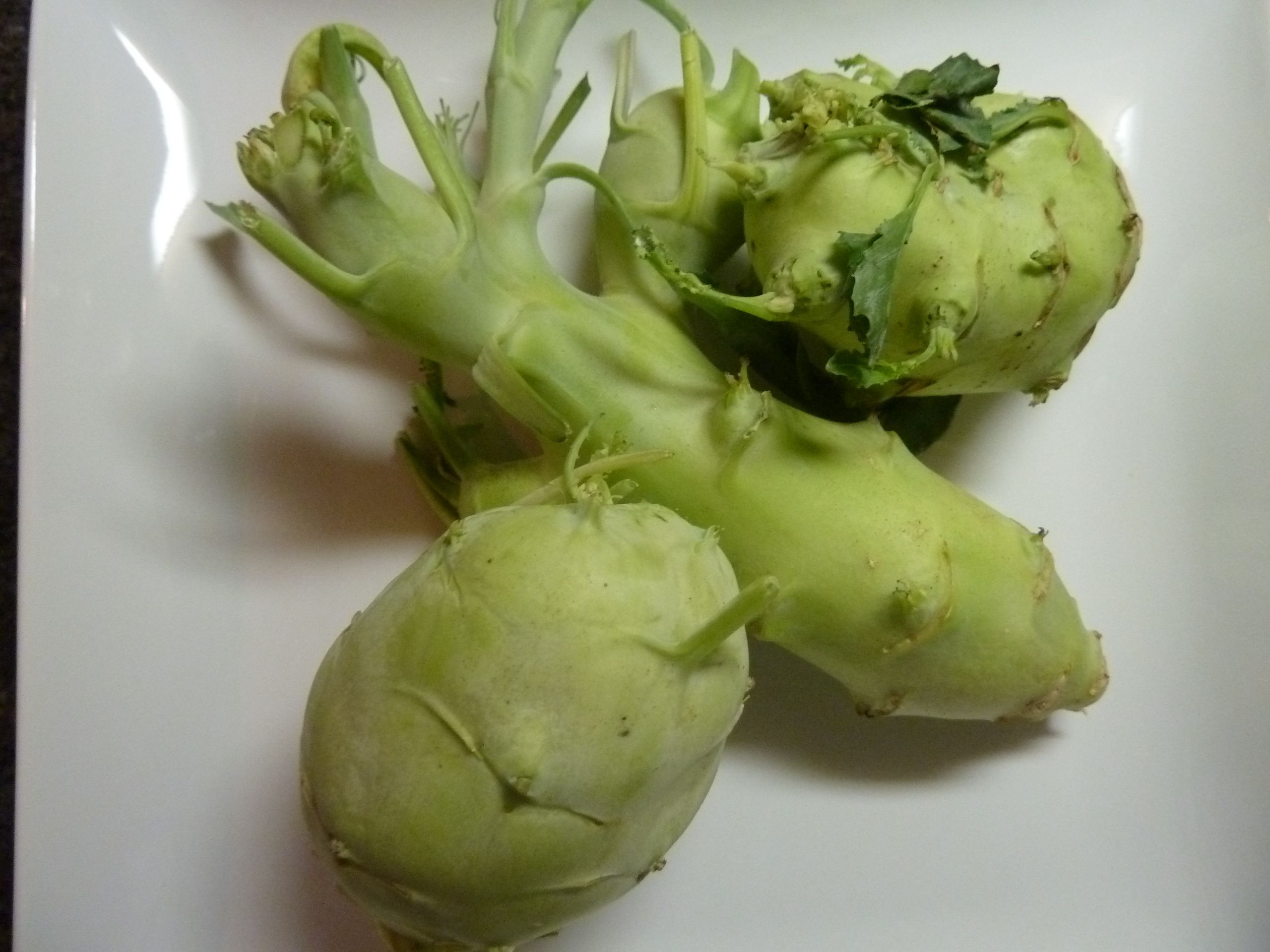
Kohlrabi, my garden's "Let's try something new" veggie for 2011.
Kohlrabi. German for cabbage turnip. English for “What the hell is this thing?”
Duh, I know what kohlrabi is. It’s a member of the brassica clan, i.e. cabbage, broccoli, cauliflower, Brussell’s sprouts, etc. All the brassica veggies are basically the same plant. One’s leaves form a head, one green florets, one really floppy outer leaves, one’s stem produces tiny head at the axillary buds. And in the case of kohlrabi, the stem swells up to the size of an ostrich egg.
Careful now, Dainty. You’re showing your botanical geek side. Calm down. Calm down.
I’ve never grown it before. Dad and the farm didn’t grow it either. But this year I bought a 6-pack of kohlrabi transplants as my “Let’s try something new” experiment. Why not, right? You only live once. Might as well grow some kohlrabi.
As you can see, my six transplants turned into 3 harvestable (barely) knobby things. One didn’t make it through the transplanting. One actually grew into broccoli. Note to self: Don’t buy transplants from the store again – your transplants labeled zucchini were actually yellow squash and the purple eggplant turned out to be white. As for the last transplant – no idea what happened to that, I lost track of it. Oh, well.
Anyway, so I’m here with three kohlrabi. One looks pretty good. One turned into the funniest looking kohlrabi ever – I expect my award in the mail any day now – and one looks like it’s been sitting in the hydrator a little longer than it should (true, every word).
And I have no idea what to do with them. Oh, sure, I’ve Googled. Saute it like broccoli stems. Cube. Puree. Middle Eastern and Indian dish galore have found their way into my searches. But I’m stuck. Folks, I’m at a loss. Indecision is a horrible thing.
So, dear Daintyites, , I’m looking to you for suggestions. Any ideas? Anyone? If you have a recipe – any recipe at all – please leave a comment below. I may need to hit the farm stands and gather up more of this brazen brassica.
Pickled Beets
September 6, 2011 § 2 Comments
Last year I had a Ziploc bag of small red beets sitting in the hydrator for … months. Months. I had intended to pickle them. Didn’t happen. They sat for ages – actually, I was quite impressed with just how long they lasted – until one day they were just gone. I think Jennifer may have realized the pickling wasn’t going to happen. Or I chucked them and don’t remember.
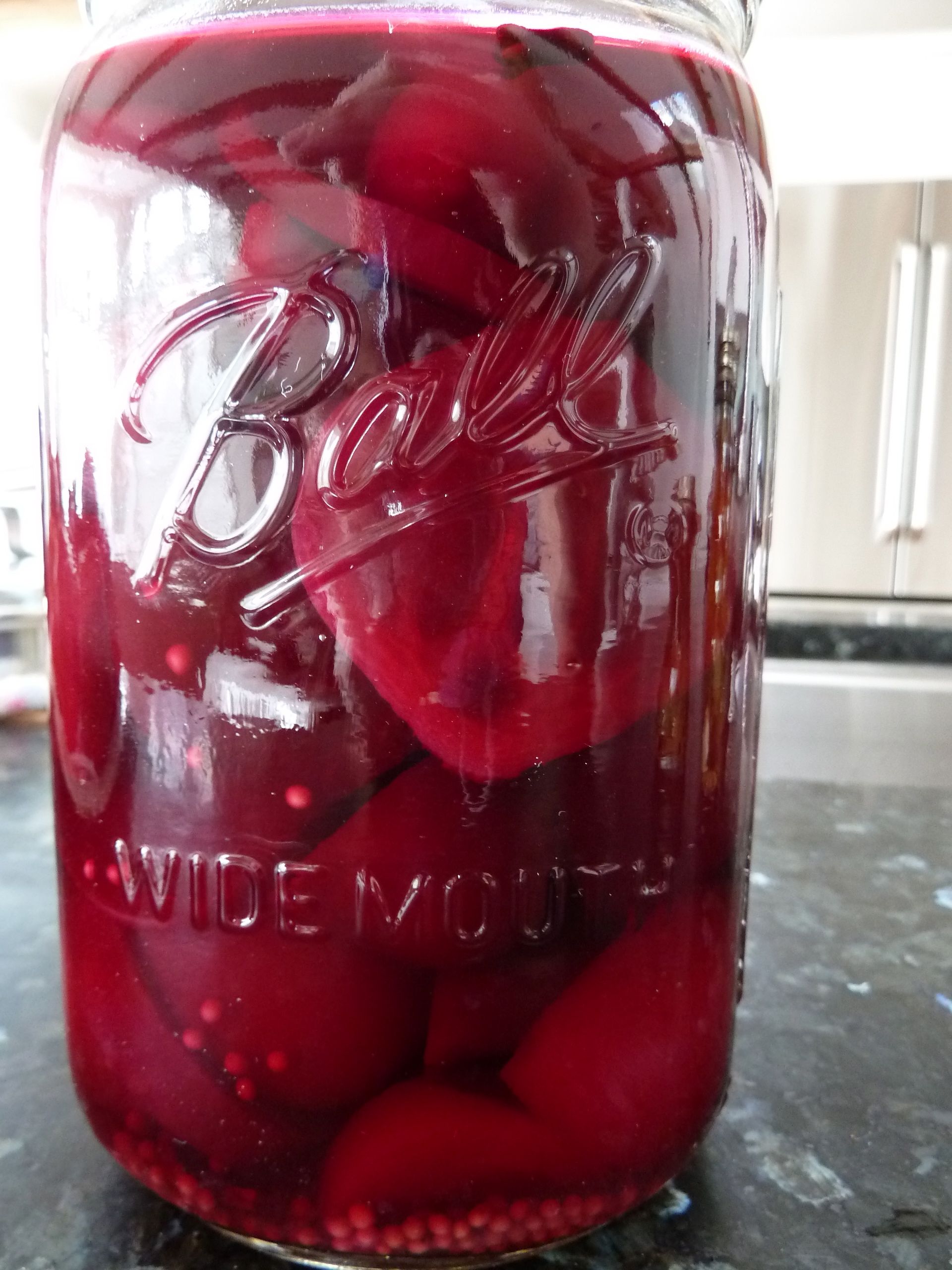
Pickled beets, not quite how Grandma used to make.
The pickling didn’t happen because I couldn’t decide on exactly how to tackle it. What recipe to use? What about canning them? What if?
My god, I can’t live with the what ifs anymore. Just freakin’ pickle beets, Dainty.
That’s exactly what I did last week. And I’m happy to say I have a quart of beautiful pickled beets sitting in my fridge at this very moment.
Well, what recipe did I decide on, you ask? It’s a combo of a recipe found in the August Bon Appetit and a recipe for Vinegar Beets from my mother, which I just found out was her mother-in-law’s recipe; i.e., it’s old.
Mom’s recipe calls for boiling the beets until tender, slip off the skins, and combining a cup cider vinegar, a half cup sugar, 1/4 tbs cinnamon stick, 1/4 tsp allspice berries, 1/4 tbs mustard seed, 1/4 tsp salt and 1/4 tsp whole cloves. She boils that for 3 minutes, then adds the beets to boil again. Then she adds the beets to a jar and strains the liquid. Boiling twice?? To infuse the beets with the spices, she said defensively.
On the other hand, Bon Appetit suggested 3/4 cup each of red wine vinegar and dry red wine, 1/2 cup sugar, 1.5 tsp salt and star anise.
Compromise, compromise.
Ingredients
- About 2lbs. beets – I used a combo of red and golden, and don’t use any that are too very large
- 1.5+ cups red wine vinegar
- 1/3 cup sugar
- 1/4 tsp salt
- 1 cinnamon stick
- 1/2 – 1 tsp mustard seed
- 1/2 – 1 tsp whole cloves
-Boil the beets until a sharp knife slips through your largest beet. Could be 20 minutes, could be more – it all depends on the size. Drain and let cool until cool enough to handle.
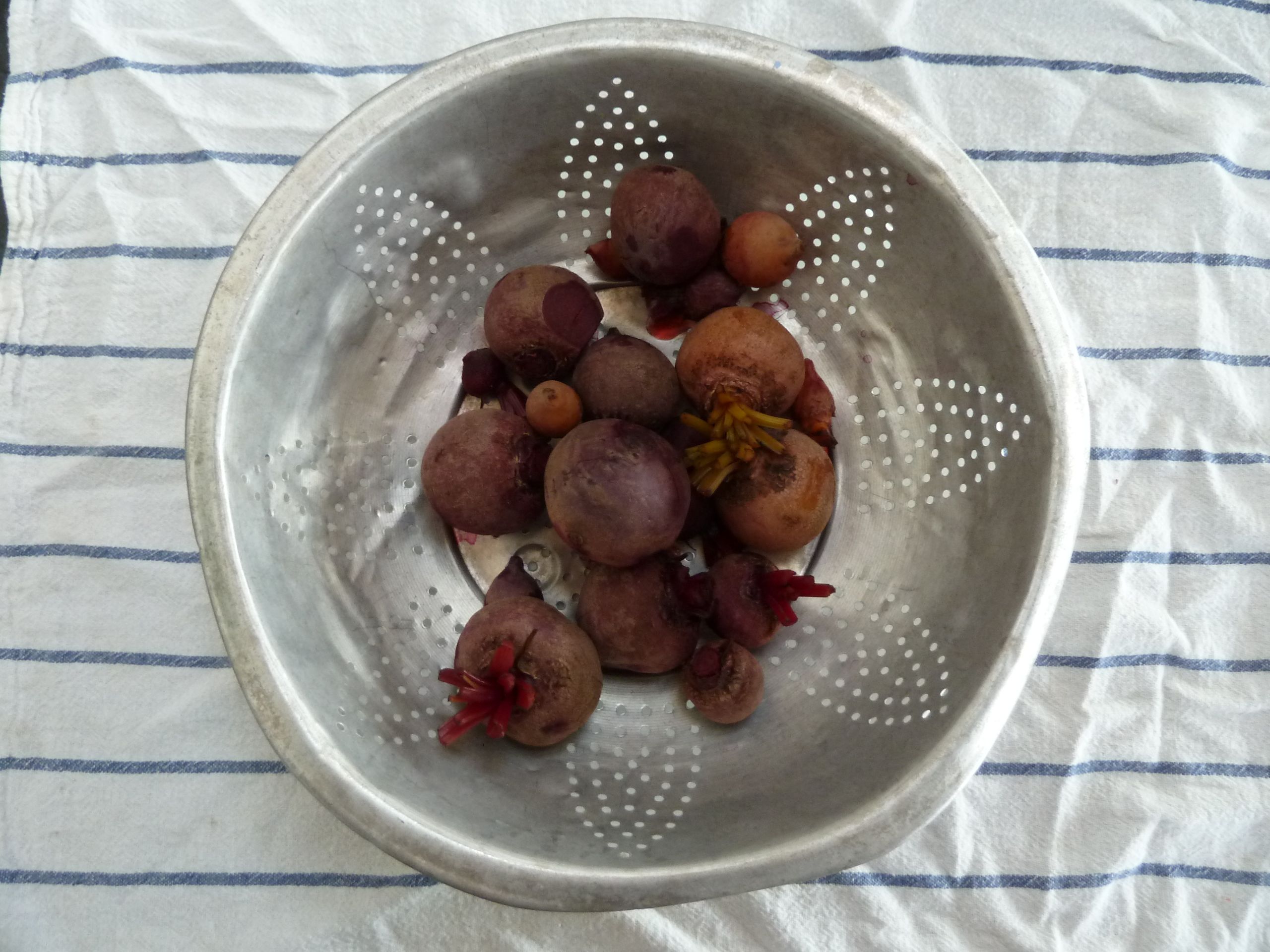
Beets cooling until they can be stripped naked
-When cool, the skins just slip right off. Pretty darn amazing how easily they come off. FYI, you’re gonna stain your hands.

Skins slip off incredibly easily once beets are boiled.
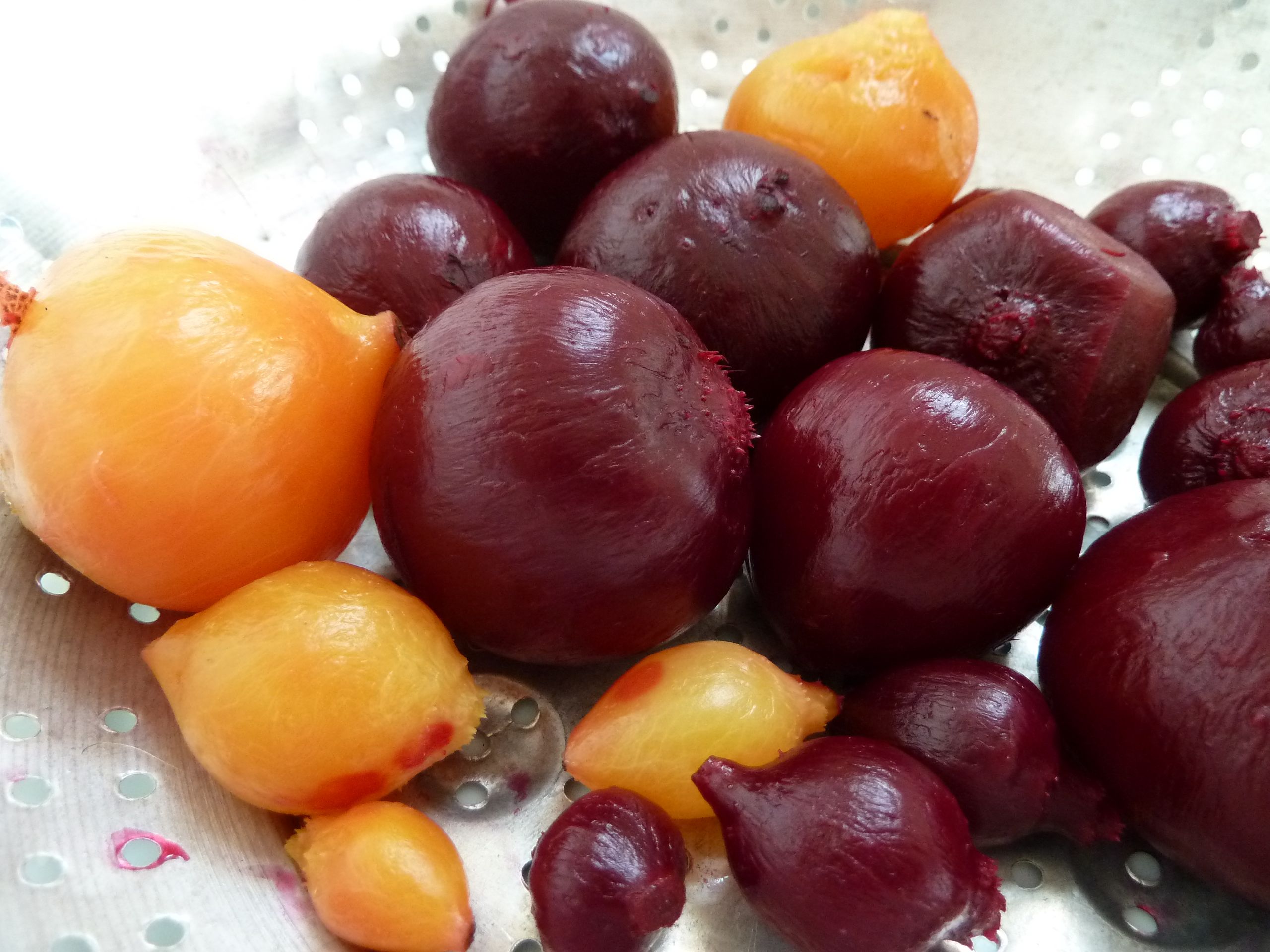
How beautiful are these??
-While those cooled, I cleaned/sterilized a 1-qt. jar. I added the cinnamon stick (which I crushed a bit), the mustard seed and the cloves.
-When the beets were cool, I left the small beets whole and put them into the. jar. The larger beets I cut into quarters, and some of them I sliced.
-Meanwhile, I combined 1.5 cups vinegar, sugar and salt in a saucepan and boiled until the sugar and salt dissolved. Then I let it cool a bit. While it was still a tad warm, I added the liquid to the jar.
-Turns out 1.5 cups vinegar wasn’t quite enough to cover the beets in the jar. Hence the “1.5+ cups vinegar in the ingredient list. I warmed another 1/4-cup-ish of red wine vinegar added with a couple pinches sugar and a nip of salt. Dissolved that, then topped off the beets.
-And then I did something crazy: I added a half-shot of Southern Comfort. Bon Appetitit’s recipe called for dry red wine, so hey, why not a glug of SoCo? Barely perceptible, but there is a hint of a sweet smokiness. Pretty good, if I do say so myself.
Cover, let sit on the counter for a day to let the flavors develop, and then give ’em a try. They’re good! And they really do only get better with time.
What? No canning them? I decided not to, and opted for the “put them in the fridge for easy access” method. I still have beets in the garden – two sets of beets, actually – one that’s ready for harvest at any time and one that I just planted a few weeks ago for a late-November harvest. The latter will likely be headed for pickling, and this time for the canner, as well. And this time I mean it.
Pickling Green Cherry Tomatoes
September 1, 2011 § 3 Comments
What does a gardener do when a little thing like a hurricane is imminent? She cleans out the garden of all ripe, nearly ripe and totally unripe tomatoes, that’s what she does.
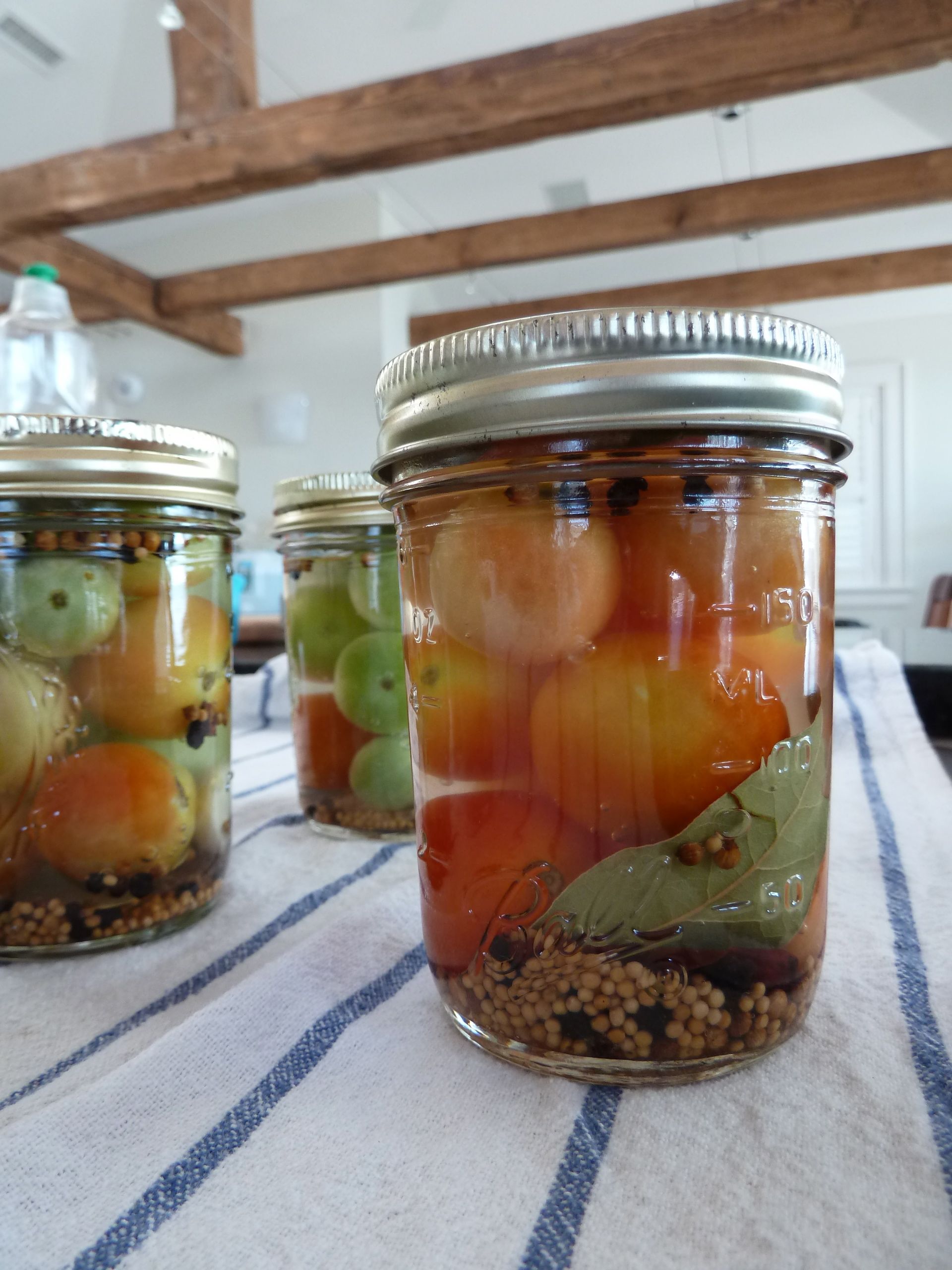
pickled tomato scrumptiousness
Ripe tomatoes have been dispatched to salsa, gazpacho and pizza toppings.
Somewhat ripe tomatoes are on a tray and ripening, possibly for a sauce.
Ripe cherry tomatoes are … well, in a bowl and thinking of what they want to become. Possibly tomato cobbler. We’ll see.
The unripe tomatoes – interestingly all cherries – are destined to be pickled.
I know what you’re thinking: Pickling is soo sooo very trendy. Maybe it is. BUT … I’ve been pickling green cherry tomatoes since 1994. My housemate at the time – Lou – had been pickling since forever and shared the recipe. Pickle the cherries at the end of the season – right as you’re grabbing them off the vine before the first frost – and they are good and pickly and presentable as hostess gifts for fall dinner parties. Oh, that Lou.
A couple of notes:
1. Pickling green fruit is key here. Too much red ripe deliciousness and they cherry will swell and burst, making a jar full of mush. But, I do try to add a cherry or two to the jar that is turning just a bit orange. It’s pretty. So so pretty.
2. Would it be okay to cut green slicing tomatoes into chunks and pickle them? Well, yeah, maybe. I’d remove the pulp and use just the flesh. We want to avoid mush.
3. And with the pickling spices, garlic clove and sneaky pepper, they taste just fabulous. Ohhhh …. yum.
Pickled Green Cherry Tomatoes ala Lou
- 21 8oz. jelly jars with new lids and rings
- 8 cups white distilled vinegar
- 4 cups water
- 1 cup salt
-Don’t have enough tomatoes to fill 21 jars? Work the proportions for the number of jars you can fill. I quartered the recipe and it filled 6ish jars.
-Boil the above and let cool.
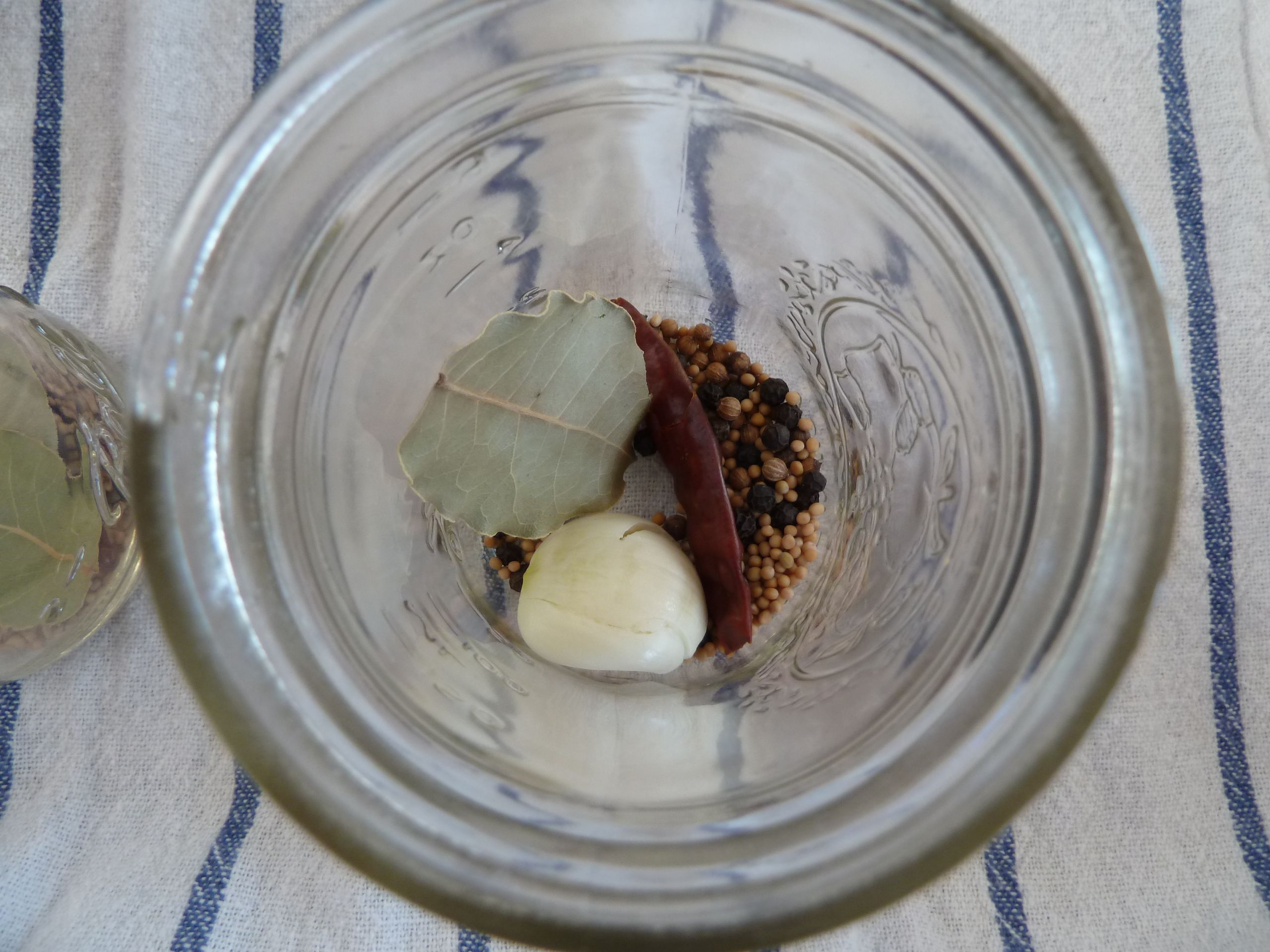
Fill'r up with pickling spices.
To each jar, add:
- 1/2 tsp coriander
- 1/2 tsp black peppercorns
- 1/2 tsp mustard seed
- 1 chili pepper, aka “a sneaky pepper”
- 1 bay leaf
- 1 garlic clove
-Add tomatoes to each jar, filling to within about 1/4-1/2 in. of the rim of the jar. Don’t jam them in too tightly – they may burst if forced.
-When the liquid has cooled, fill each jar to cover the tomatoes. Place a lid on each jar and tighten the ring. Let sit out overnight and then place in the refrigerator.
What about preserving them with canning? It’s definitely doable! I’m not the one to tell you how to do it. Really. Even though I witnessed my mother can jars and jars of everything from apricots to zucchini, none of it stuck in my head. And if something goes wrong … like when that jar of canned tuna wasn’t sealed properly … it can go terribly wrong. And I’m not gonna be responsible for your botulism.

I couldn't help myself - I made one jar more red than the others.
Vermont Cranberry Bean Salad
August 31, 2011 § 3 Comments
When I was a kid, my father would get a little stir crazy in winter and he’d do the worst thing a man with a 1-acre garden could do: Sit for hours with the Johnny’s Select Seed catalog. Fathers don’t get giddy as a rule, but I swear my dad would get as giddy as any school girl when the … um, somewhat large and heavy … box arrived. Sure, some of the seeds were for the farm: Seeds for 100 combined acres of broccoli, cabbage, cauliflower and pumpkins are a bit heavy. But then there were the items destined for our garden. Corn. Watermelon. Tomatoes. Peppers. Cucumbers. Zucchini. Squash. Yum. Yum.
But then … then there were the despised seeds: Peas and lima beans. And I swear, every single seed of those two crops came up and produced a bounty. Bleck and ugh … I really don’t like peas and lima beans. Really. Don’t. Like.
The worst part, really, and I don’t know how many of you can relate … the worst part was having to help my mother shell the bushels and bushels of pods these horrid plants would produce. You know how big a bushel is, right? It’s a lot. And now picture lots of lots. And having to take one lima bean pod or one pea pod, slicing it down lengthwise with your thumb nail, and then cajoling each pea or bean out of its home with said finger and into a pan. Pans and pans and pans of peas and beans. And Mom would blanch these mounds and mounds of peas and beans, put them into little plastic baggies, put the baggies in boxes, put the boxes in the freezers (yes, we had multiple freezers to store multiple upon multiple boxes), and then those boxes would come out of the freezer in the deepest, darkest of winter and end up on our plates. And then after dinner Dad would get out his Johnny’s Select Seed catalog and order more for the coming spring …
I really hate peas and lima beans. Really.
What did I find myself doing yesterday pre-lunch during my vacation? Shelling beans. Not a bushel, thankfully; just a gallon ziplock’s worth. The beans in question we grew in our garden this summer. No, not peas and not limas.They are Vermont cranberry beans. Beautiful pink and red speckly things. Gorgeous, really. No, I didn’t snap a pic pre-cooking. Sorry. But yes, we grew them this year—my garden plot neighbor has been growing them for years and loves loves loves them. Easy to grow. I’d tell you more about how to grow them except … well, okay, I’ll tell you. Sow the seeds about 2 inches apart in a row. Water. They will emerge. They’ll keep growing if you keep watering. I can’t even recall if I had to fertilize. It’s seriously that easy, people.
And the process at the other end of the line is just as simple, and way way way delicious. So very not a lima bean.

Vermont cranberry bean salad
Vermont Cranberry Bean Salad from Epicurious.com)
Serves 4
- 1 1/2 pounds fresh cranberry beans in pods
- 2 tablespoons salt
- 1/4 cup evoo
- 1 to 2 tablespoons fresh lemon juice, or to taste
- 2 tablespoons chopped fresh parsley or basil leaves
- ground black pepper
– Shell beans and place in a saucepan of boiling salted water. Salt the water! That way the beans really take in the flavor.Unfortunately, the boiling spoils the beans’ beautiful coloration.
– Boil the beans until they are tender. If all of your beans are picked at the same stage, they should all come along at the same time. Mine, not so lucky. To get the “more done” or more dry beans to a tender stage, the more fresh beans got a tad over-mushy. But, I kinda liked the variety within the dish.
– Drain beans and transfer to a bowl. While beans are still warm, toss with remaining ingredients and season with salt, if needed. Serve still warm for a fabulous flavor, or at room temperature.
I could eat this for days. And luckily, there’s a bunch more beans ripening when we get home.
This Morning’s Harvest, Next Week’s Meals
August 26, 2011 § 2 Comments
Okay, so I’m rushing for two reasons: 1) A big storm’s a-brewin’ and 2) leaving town for a week. What’s that mean? Gotta hit the community garden plot this morning and harvest.
Tomatoes are gonna get whipped in the storm. Pair that with the fact that they look like hell anyway (I think we have blight – that’s like having lice to me), I decided to harvest all the tomatoes except a few very green ones and rip up all the plants except the best two.
What else is on the list? Here it is:

Harvest it all! A hurricane's a-comin'!
- Cherry and slicing tomatoes in all stages of ripe- and unripeness
- Vermont cranberry beans
- Green bean
- Lettuce
- Sage
- Oregano
- Parsley
- Basil
- Yellow and green chard
- A cabbage
- A big ol’ purple carrot
- A zucchini – full disclosure: It’s not mine – another gardener gave it to me.
*Missing from this list are a handful of Hungarian wax peppers and a yellow squash. They were camera shy.
All of this will be processed in some form or another – along with a boat load of beets I harvested last week – in the coming week. Stay tuned!
Any suggestions? Anyone have experience frying sage leaves? What should I do with a huge purple carrot? Leave a comment, let me know.
Grilled Pizza
August 24, 2011 § 1 Comment
Summertime … and the grilling is easy. Cheese is melting, and the pizza is fine.
Okay, I’m no George Gershwin, but what I’m trying to say is this: Pizza on the grill is not only easy, it’s one of the quickest summertime grilled meals possible. What do I like about it most? The fact that I don’t have to deal with my smoke alarms going off. Yeah, that happens whenever we cook pizza inside. The super-heated oven ends up burning the corn meal that remains on our pizza stone. Pizza in January usually means both our front and back doors are open to prevent smoke buildup. No. Kidding.
So, when we can slap that pizza dough on a hot grill, we go there.
And you can go there, too.
I’m not going to tell you what kind of pizza to make. Your toppings are your toppings. You want pepperoni? Have pepperoni. You want smoked salmon? Go for it. Sauce? Yes, please—but don’t go overboard. A little dab will do ya (I’m showing my age with that quote).

My assorted pizza toppings, minus a bowl full of kale-ricotta mixture.
Plus, I’m not the pizza maker. Jennifer is the star when it comes to assemblage. I make the dough, I’ll make sauce. I’ll sous, but she chefs when it comes to pizza time. We’re practiced at this, but the following are our tips, not our must dos. Also, p.s., our grilling is done on a gas grill. Charcoal? A slightly different animal, so adjust as you see fit.
Grilled Pizza Tips
A hot hot grill is good. 500F is good. Clean it really well, not leftover burnt chicken skin, please.
Prep your toppings. I can’t emphasize that enough. Slice, dice, chop, stir. Get ’em ready. AND, pour a small bowl – maybe 1/3 to a 1/2 cup? – of olive oil to have on hand. Put ’em all on a big cutting board or tray to carry out to the grill.
Roll out a nice flat but not too thin dough. Round, square, oblong, whatever.
Here’s a great trick: Lightly oil a section of aluminum foil. Take that dough you just rolled out and put it down on the foil. Now, lightly swab the top of the dough with oil.

Okay, maybe I over-oiled this one. Swab off any extra oil!
Grill’s good and hot. Your toppings are ready to go. Your dough is ready to go. So, go out to the grill and … Quickly flip that dough, oiled top side down, on top searing-hot grill, and peel back the foil. There’ll be some “yikes!” and “oh, sh*t” moments, I’m not gonna lie to you. Pull the dough one way or the other, make your tweaks QUICKLY, and then close that grill cover. And fast. The sooner heat completely surrounds the dough, the quicker that dough is going to turn into a pizza crust. Right? Right.
Two-three minutes. Peek once or twice to make sure the underside is not burning. Oh, it’ll burn. Believe you me.

Oh damn, I burned the first one. These things happen.
NOTE: The first dough got kinda … well … crispy. I started another. Much, much better.
Get your mise en place in place, ready to go. Open the grill, flip that crust over.
Not using a sauce? Then give a quick brush all over the top with evoo. Using a sauce? Spread it thinly and quickly. Layer everything else on as you see fit. And be quick about it!
Close the lid for another couple of minutes. Keep an eye on the bottom, making sure it’s not burning. When the cheese (if you’re using) and the sauce look melty and hot, it’s time to take it off the heat.

Let sit for three minutes to let the sauce and toppings set. And then cut yourself a slice.
Worth it all, huh?
Basil Pesto: Can’t be Easier
August 23, 2011 § 3 Comments

All the fixin's for basil pesto
Think of all the good things in life.
Basil. Mmmm … Parmesan cheese … Olive oil … Garlic … Nuts … Chocolate … Okay, wait, drop that last one. All these are tasty on their own, very tasty. But whir them up together in a yummy pasty sauce and you have heaven on a spoon—basil pesto.
Basil is just one of the pesto varieties we make in the Dainty household. There are others. Oh, there are others. But typically, basil pesto is the shining star in so many dishes. A couple of dollops on pasta for a quick on-the-go meal. Spread it cautiously as a pizza topping. And schmear it on some rye bread for a tomato-provolone-pesto grilled cheese. Oh, yeah, I went there. Grilled. Cheese.
The secrets to good basil pesto are two-fold: Great-quality ingredients and a nice ratio of basil:parm:pine nuts:evoo. The amount of garlic, honestly, depends on your tastes. The recipe I use is from an old, back-‘n-the-day Moosewood cookbook called the Moosewood Restaurant Kitchen Garden. Not too much cheese. Not too saucy. Plenty of basil flavor.
Pesto Genovese (from Moosewood Restaurant Kitchen Garden)
- 3 cups loosely packed basil (avoid stems)
- 1/3 cup pine nuts
- 1/2 cup freshly grated parmesan
- 2-3 cloves garlic, roughly chopped
- 1/2 cup evoo
- salt/pepper
-Place the basil, pine nuts parm and garlic in a food processor. I like to put in half of all the ingredients, give it a whir, and then add the other half and give it a whir. That’s just the best way in my machine – things don’t get jammed in there that way. Be sure everything is chopped evenly. Give it a sprinkle of salt and pepper.
-With the food processor on, sloooooowly add the olive oil in a steady stream. It’ll slowly become paste-like. It may bunch up on the bottom—stop the machine and get all the good stuff from the corners. DON’T add all the oil. Stop the machine, give it a tasty. Good? Needs salt and pepper? Add some. Is the consistency kinda rough and thick and you like it? Then stop. Like it a bit more smooth? Keep whirring and add the remaining oil.
NOTE: The beauty of pesto is this: It can be any way you want it to be. Chunky. Rough. Pasty. Saucy. Hey, you’re the one eating it. Eat what you like.
-When it’s whirred to your liking, use what you intended it for right away.
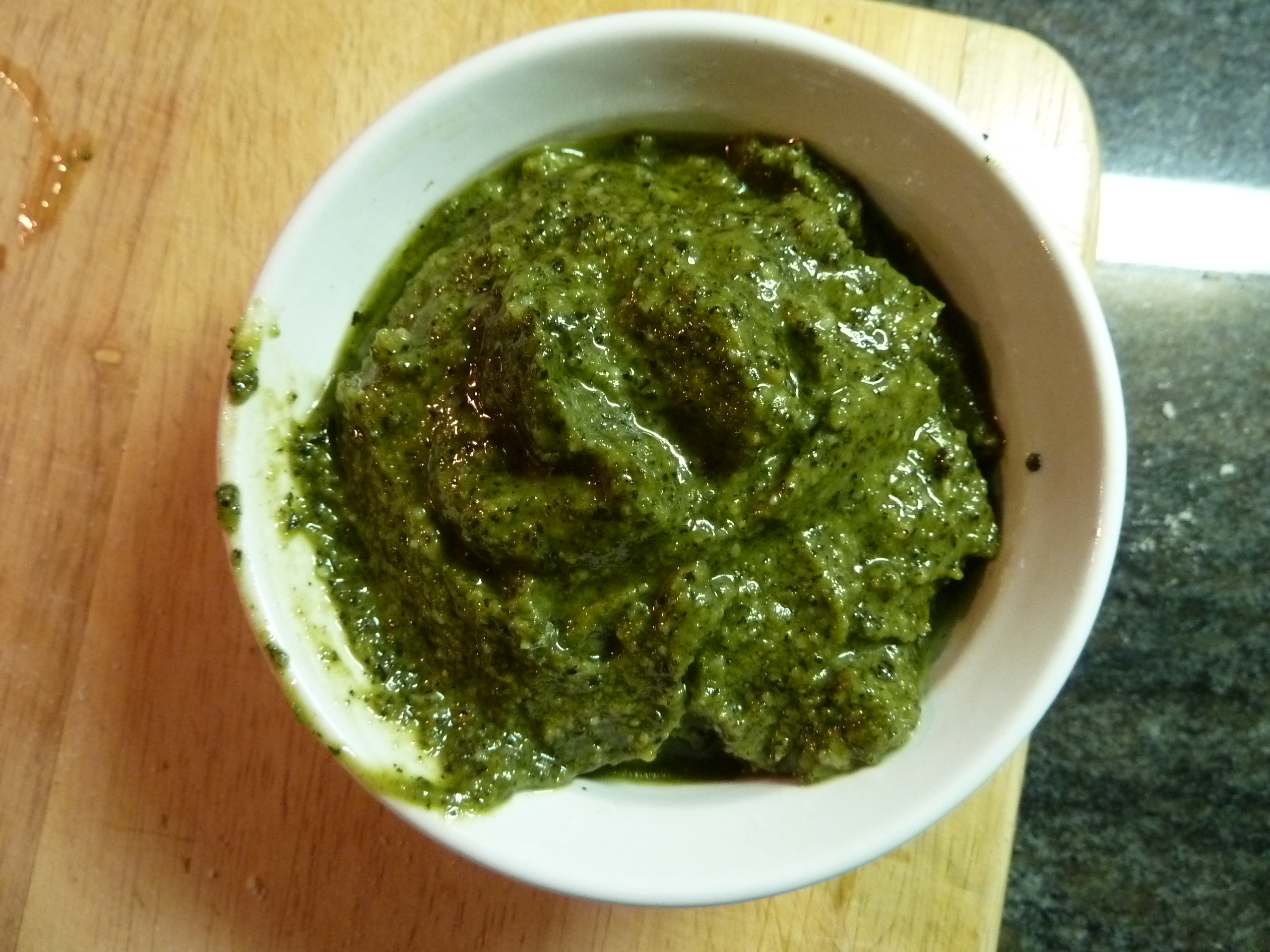
Basil pesto
OR—and this is the important part—take action to keep the pesto’s vibrant, fresh-green color. Here’s how:
-Place the pesto in an airtight food storage container (glass, plastic, whatever) that is large enough to allow some room on top. Smooth the top into a flat layer.
-Drizzle a thin layer of evoo on top so it completely covers the pesto. You don’t need to much but you do need to make sure all the pesto is covered.
This keeps the air from oxidizing the basil and keeps the bright green color. But you’re smaht, I’m sure you already knew that.
Enjoy. And maybe when it’s time to harvest our parsley before the first frost, I’ll share my super-secret recipe for parsley pesto.
Food Trucks: Lefty’s, Bon Me & Roxy’s
August 22, 2011 § Leave a comment
Our neighborhood has this gem of a Sunday market—the Sowa Open Market. With our summer travel schedule – both work and pleasure – it’s a not a place we get to a whole heck of a lot. And that’s a darn shame. We definitely are able to get there during the “shoulder seasons” – spring and fall. And if you like to explore all the artsy-craftsy stuff going on in Boston and New England, this really has been the place to go for the last eight years. 
More recently – maybe in the last couple? – they’ve also had a pretty nice array of food trucks. I put a question mark down there because, like I said, we don’t get there a whole heckuva lot. With the food truck craze that’s traveling in the left lane nowadays, it’s probably one of the major draws of the Market.
And considering that one of their usual food trucks is participating in the second season of Food Network’s The Great Food Truck Race, we decided to take one of our atypical in-town weekends are check out Roxy’s Grilled Cheese, among the other dozen or so trucks parked within the Sowa Open Market.
Of course, I scheduled only an hour (including walking time) between my various work-related activities to check out the food trucks. Seriously, not a smart move.
We decided to divide and conquer. We didn’t get far.
I stood in the Roxy’s line while Jennifer stood in the Bon Me line. Guess which line was longer? Jennifer decision to hit the Vietnamese street food truck was smart. My standing in the ‘order waiting to be picked up’ line at Roxy’s was not.
Jennifer was already chomping on her tofu and shitake mushroom banh mi (aka a sandwich on a baguette) before I decided to abandon my chance to nibble on a TV star. She shared, of course. Excellent flavor in the marinated tofu and mushrooms, a nice pickled topping. Great filling. Bread? Not the best, but I’m a bread snob. I’d definitely line up there again.
I was determined to have my own food truck experience, so I lined up for Lefty’s Silver Cart for a specialty sandwich. What drew me to that one? Pressed for time, it was close by, the line wasn’t long, and I judged a book by its cover—I really liked the old-timey font they used. Menu items were intriguing, too. It took me a good couple of minutes to realize they had a vegetarian menu, that’s how fun their combos were. I was torn between the Granny-B-Good – a grilled cheese with Vermont cheddar and Granny Smith apple – and the Figment, which was baguette with truffle-dressed mixed greens, goat cheese and fig jam. LOVE fig jam, so ordered the latter. Can’t go wrong with fig and goat cheese, and putting it on bread makes it a very healthy thing, I’m sure. Very happy with my order. Plus, Lefty’s baguette rocked. Now, if Bon Me had that baguette, they’d kick it up a notch. The difference? Baking technique, definitely. More steam produced a better crust for whoever is making Lefty’s bread.
Dainty Rates: 4 Dots.
If you’re around Boston Sundays through October, take a walk down to Sowa. Save room for lunch.

 The Dainty Dot